
The 'Beitar Illit' Youth Group at the Residence of our Teacher
Rabbi Eliezer Berland shlit"a
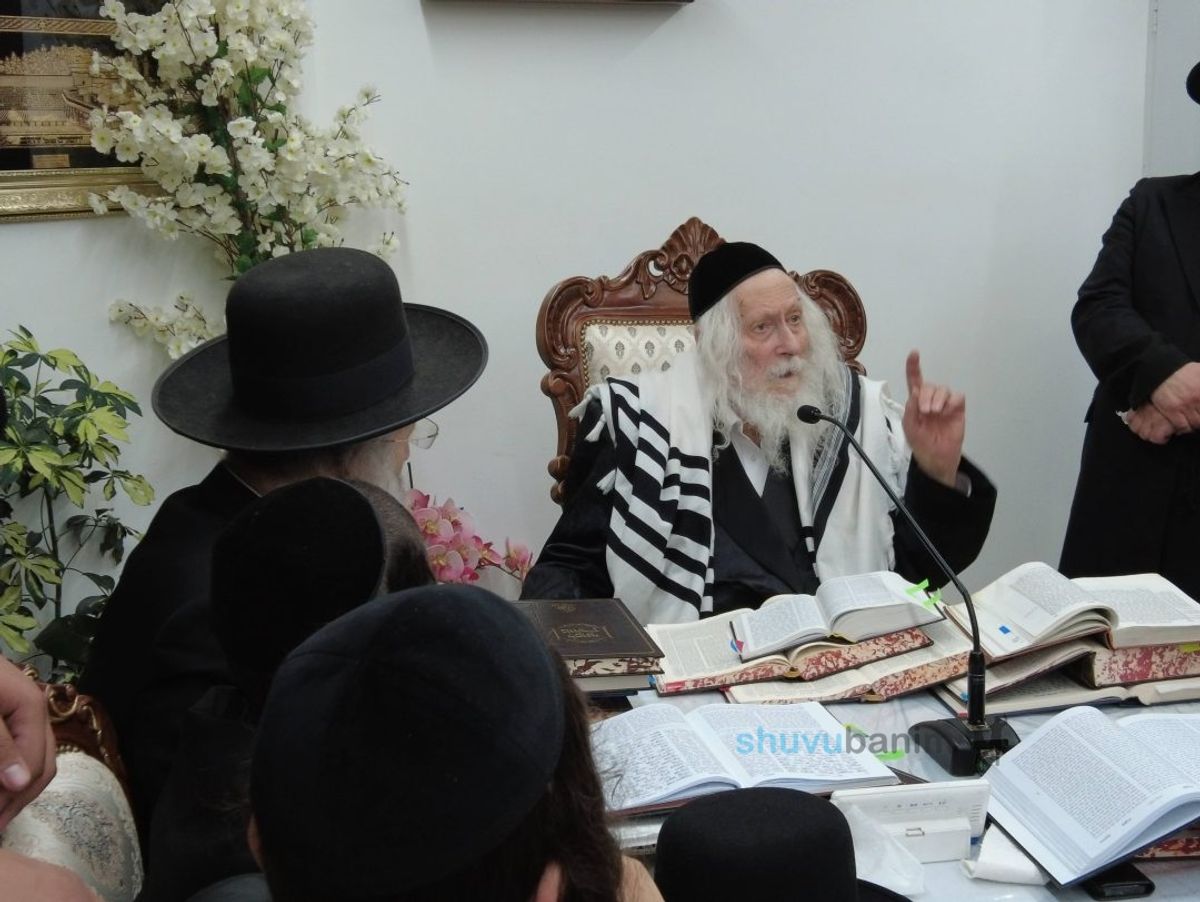
As is the case every year, a special chaburah (spiritual gathering) was held with the participation of our teacher, Rabbi Eliezer Berland shlit"a, for the young men of the 'Bnei HaNeurim' youth group of the Shuvu Banim community, Beitar Illit branch.
The gathering took place, as mentioned, at the holy residence of the Rav shlit"a on Thursday night, the eve of the 15th of Kislev—the hillula (anniversary of passing) of Rabbi Yehuda HaNasi zy"a (may his merit protect us). Initially, the young men of the group sang soul-stirring songs together with the Rav shlit"a, and afterwards, the Rav shlit"a began his holy discourse, nearly half an hour of words like "flaming fire."
Below is a summary of the topics mentioned by the Rav shlit"a during the gathering:
- The main thing is to study Gemara (Talmud); only in this way can one be saved from all the smartphones and iPhones.
- Rashi writes in Parshas Vayeshev, "him, with him, to him," and it is not understood—is Rashi merely coming to teach us a linguistic explanation? Rather, the Nitzotzei Shimshon brings that Rabbi Shmuel bar Nachman knocked on Rashi's grave to know the secret of this matter. Rashi appeared to him and revealed that the dispute between the brothers and Joseph was the same dispute between the angels and the angel Metat (Metatron) twenty-two years before the creation of the world, regarding whether to create the world.
- Esau did not agree to allow Jacob to be buried in the Cave of Machpelah; he claimed that the sale of the birthright did not include the burial plot. So, Naphtali ran to Egypt to bring the deed of sale. Meanwhile, Chushim the son of Dan, who was deaf, understood that Esau was the problem and struck off his head.
- Adam HaRishon (the first man) saw that the days were getting shorter; he would cry and fast because he was certain the world was coming to an end. Then, during the time of Chanukah, he saw that the sunset began to occur later again, so he celebrated a "Chanukah" twice. The gentiles later turned this into "Saturnalia"—a festival of fire.
- Joseph asked the brothers, "Do you have a father or a brother?" because he wanted to know how they light the Chanukah candles: like Beis Hillel (1, 2, in ascending order) or like Beis Shammai (8 to 1, where on the first day one lights eight and the number decreases).
- It is written, "And Deborah, Rebecca's nurse, died." Who cares when Rebecca's nanny passed away? Rather, this comes to teach us that Rebecca passed away at the age of 133.
- Rebecca was on a higher level than Isaac because she saw the truth—that Esau was wicked. Isaac, however, saw the root of Esau's soul, which was from the "left side" of Jacob. The Heichal HaBracha writes that if Esau had performed teshuvah (repentance), he would have been even greater than Jacob.
- Eliezer did not understand why, from the most sinful place in the world, [Abraham] would not take his own daughter, who grew up on the knees of Sarah Imeinu (our mother Sarah). However, what matters most is whether the grandparents were tzaddikim (righteous people). If the root is good, then even if Rebecca is placed in the most sinful place in the world, she herself remains a tzaddika in the merit of her righteous grandfathers.
- Rebecca's lamp never went out. The tzaddik lives forever, as we saw with Rabbi Yehuda HaNasi—whose yahrtzeit (anniversary of passing) is today—who would come home every Shabbat to recite Kiddush, until the maidservant revealed the secret.
- "See, the fragrance of my son is like the fragrance of a field which Hashem has blessed." Isaac smelled the scent of Gan Eden (Paradise) in Jacob. For whoever walks with the tzaddik merits the fragrance of Gan Eden!
Subscribe to Our Newsletter
Receive Torah articles and inspiration directly in your inbox