
The Daily Lesson — by the holy gaon and tzaddik Rabbi Eliezer Berland shlit"a
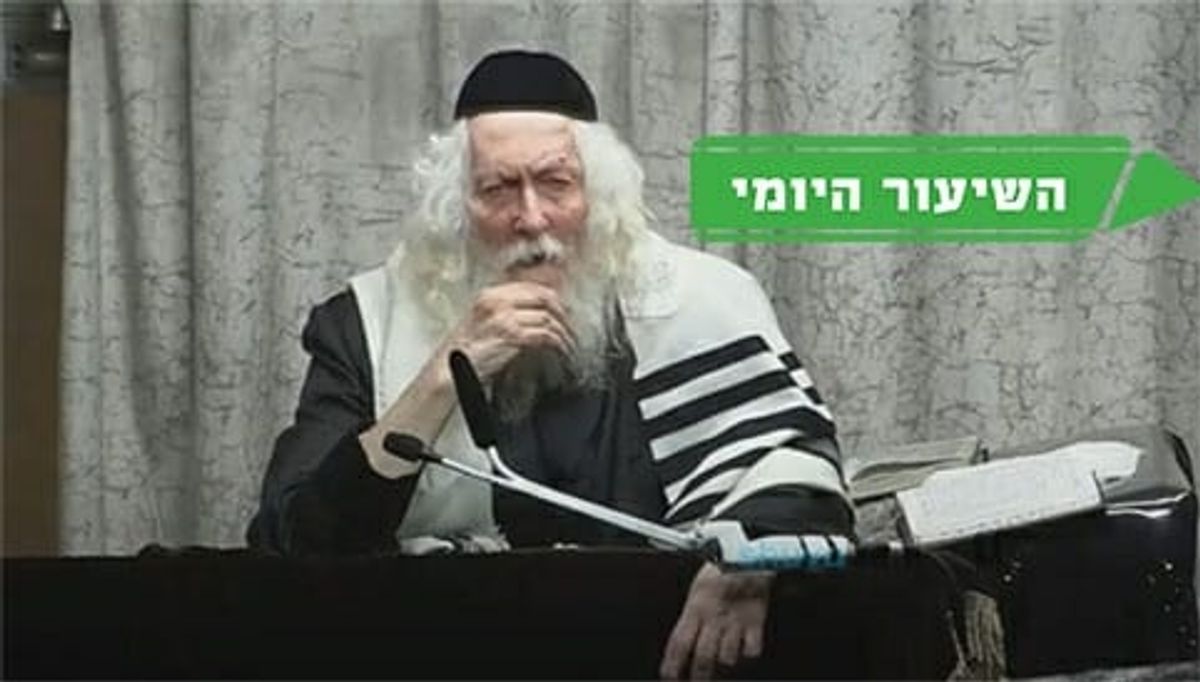
Before you is the full lesson that our teacher Rav Eliezer Berland shlit"a delivered last night, Tuesday, the night of the 20th of Av, after Maariv:
Why did Amram divorce Yocheved?
"Then Amram divorced Yocheved at the age of one hundred and thirty. At the age of one hundred and thirty, he had already had enough; how much can one suffer? How much can a person suffer? One hundred and thirty years is already enough. Everyone thought that perhaps Yocheved had burned his food, or perhaps she had made a face at him. No one understood why they were divorcing at the age of one hundred and thirty. Where have we heard of such a thing? Where does such a thing exist, to divorce at the age of one hundred and thirty? We have never heard of it from the days of old; there was no such thing. But that was the reality—at the age of one hundred and thirty, he divorced. A decree went out: 'Every son that is born ye shall cast into the river' (Exodus 1:22). Amram immediately understood: What, are we going to bring children into the world just so they can throw them into the river?! Let everyone go to their own parents; I will go to my parents. He was Amram ben Kehat; I will go to my father, Kehat. Kehat lived one hundred and thirty-three years, Amram one hundred and thirty-seven, and Yocheved will go to her father, Levi; Yocheved, the daughter of Levi."
To bring the soul of the tzaddik, one must strip away physicality
"It is written: 'And there went a man of the house of Levi, and took to wife a daughter of Levi' (Exodus 2:1). There are no names, because there were no names; this was the stripping away of physicality. No, Yocheved was not Yocheved, and Amram was not Amram; they had already stripped themselves away long ago. In order to bring a soul like Moshe Rabbeinu, one must strip away all physicality. Therefore, it is written 'And there went a man.' The Zohar says (Vol. II – Shemot, p. 11-12, see there) that this is Hashem, for Amram became Hashem Himself. Every soul must turn into a part of Hashem. This is only through prayers, for the Rebbe says that the Gemara is the preparation for prayer. 'The virgins in her train being brought unto thee' (Psalms 45:15) – 'virgins' are the letters of the Gemara. If a person studies in-depth (b'iyun), then he has the intellect (mochin) to pray. If he does not study in-depth, then he has no intellect; he does not succeed in overcoming the foreign thoughts. But only through prayer does he turn into a part of Hashem. And Yocheved became the daughter of the Leviathan – 'daughter of Levi' is a part of the Leviathan."
"Va'etchanan" (And I beseeched) - to learn from the Leviathan how to beseech
"Now it was 'Va'etchanan.' Moshe, Hashem says to him, 'Do you know how to beseech...? What are you putting on an act for? What do you think, that you are fooling Me...? How are you praying? In the middle of the prayer, you jump—like that, in order—that is not called 'Va'etchanan.' You do not know how to beseech; learn from the Leviathan.' That is what the Midrash Rabbah says: learn from the Leviathan. 'Will he make many supplications unto thee?' (Job 40:27). Hashem says to Job, 'Do you know how to speak supplications like the Leviathan?' Only the Leviathan knows how to beseech. Because the Leviathan is the fiftieth gate; in order to know how to beseech, one must be in the fiftieth gate. The Leviathan is 'Ten' (ten), it is the name 'Mah' (45)—ten times the name 'Mah,' 'Levi-ten.' Only when a person is in the fiftieth gate can he beseech, and then the prayer is accepted. Because a person does not understand why his prayer is not accepted—it is because he is not beseeching; he does not know how to beseech. Even Job did not know, and certainly not Moshe. Moshe says 'Va'etchanan' (Deuteronomy 3:23), that is five hundred and [fifteen; Hashem says to him] that is nothing. Learn from the Leviathan; go to the Leviathan, learn to beseech. Therefore, Rashi says that before one prays, one is obligated to sing some melody. Moshe would sing 'Save Thy people' (Psalms 28:9). We sing 'Light is sown for the righteous, and gladness for the upright in heart' (Psalms 97:11)."
Subscribe to Our Newsletter
Receive Torah articles and inspiration directly in your inbox