
The Death of Jacob, Like a Person Removing His Clothes and Hanging Them on the
Wall | Emunah and Bitachon for Parshat Vayechi
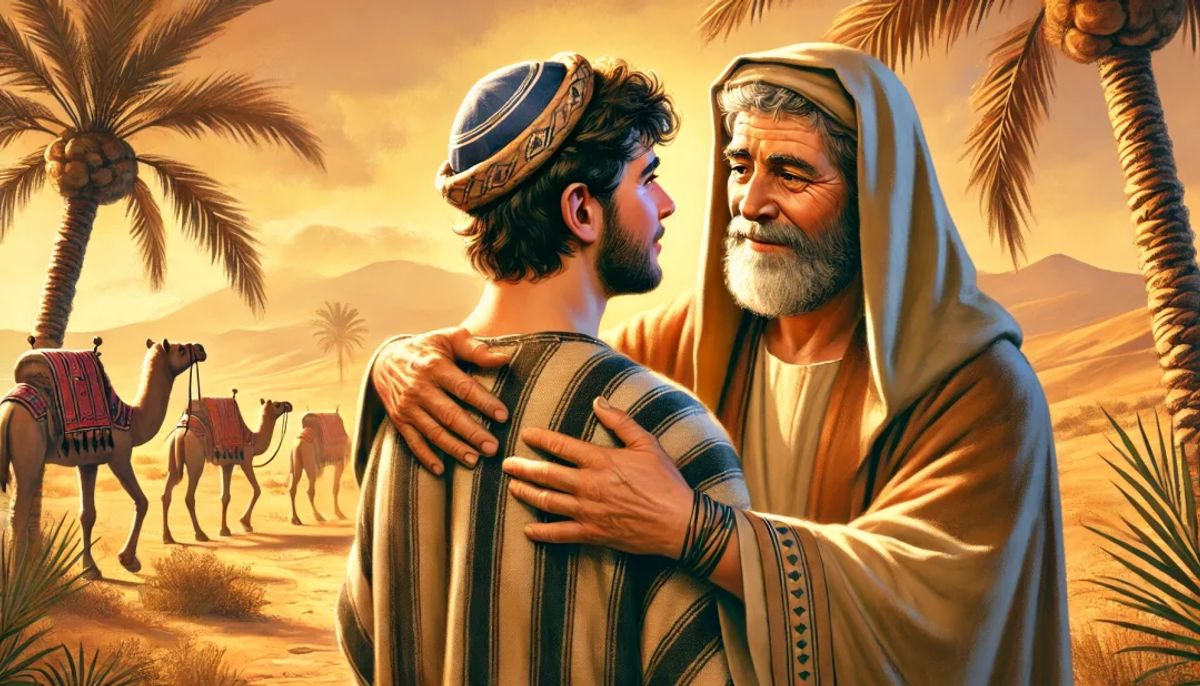
Words of encouragement and Emunah (faith) for Parshat Vayechi from the Chassidic scholar Rabbi Menachem Azulai shlit"a (may he live long and good days) – "And Jacob lived in the land of Egypt seventeen years" (Genesis 47:28)
"Our father Jacob did not die" – he did not taste the taste of death. For all death is a matter of change and transition from this world to the World to Come, whereas Jacob, all those years he lived in Egypt, Hashem (God) gave him a taste of life resembling the World to Come, and in his death, he did not change. The death of Jacob and his burial were like a person removing his clothes and hanging them on the wall; when he needs them, he will return and wear them (Sefer HaParshiyot).
"Praise Hashem, O my soul" (Psalms 146).
What is the blessing that Jacob blesses the tribes with? "And he blessed them on that day." Jacob's blessing is that they should merit "that day"—that they should have that specific day, living in the present and not in the past or the future. That they should merit to see how many gifts Hashem sends us hour by hour, moment by moment; that they should merit to see how everything we receive here in this world is all gifts given to us by the Creator, may He be blessed, out of His great love for us.
With a little bit of lowliness and humility, a person can see how everything he has and everything he succeeds in is all sent to him by Hashem. Thank You so much, Hashem, for giving to me, and how wonderful it is that You gave to me. Now that a good prayer came out of my mouth, that I didn't have distractions during the prayer, or thoughts during the prayer, but I could truly focus (kavanah) in prayer—thank You so much, Hashem. Thank You so much that I had a good heart to open the door for a neighbor, or for the one who came to ask for tzedakah (charity), and that I didn't close the door on him, and I didn't make a face. And thank You so much that I forgave and didn't hold a grudge, and thank You so much for this and thank You so much for that, because You gave me everything.
Hashem is the Giver (Mashpia) and man is the receiver. We must constantly remind ourselves of this. Every time a person suddenly receives some praise, a compliment, or even gives himself a compliment, saying, "How nice, thank God I succeeded," he must remember on the spot where he got it from. Thank You so much, Hashem, thank You, this is from You—for where would I have this knowledge, the talent to understand, to speak, to act, to operate? It is all from the Image of God (Tzelem Elokim) that You gave me. A minute later he forgets again, thinking it was himself, and he is constantly in these zig-zags: "It's me, it's not me." "I am so nice, I don't make the mistakes that so-and-so makes because I am more refined, and I understand, and I don't hurt others, and thank God I have Shalom Bayit (domestic harmony), and I succeed in this and I succeed in that"—but actually it's not me, it's Hashem. Thank You so much, Hashem, You brought me Shalom Bayit, You brought me success with the children, everything I have is You. And a minute later, again—it's a lifelong job.
One must thank, praise, and laud Hashem without ceasing. Tzaddikim (righteous ones) knew how to give thanks for every breath, for every step, for everything, even the smallest thing.
We have become so accustomed to the good that only when there is suddenly some lack, some trouble G-d forbid, only then do we understand how much we need to give thanks all the time. We shouldn't wait for Hashem to take from us so that we start to appreciate what we had. Constantly stop, look up to the heavens, and say, "Thank You, Master of the Universe, for everything." Like the story of a Jew who suddenly began to suffer from a terrible lack of appetite and severe nausea, and of course, these feelings were immediately accompanied by worry about the unknown. He suffered from such terrible weakness that when he saw a Jew carrying his two-year-old child in his arms, he wanted to shout to him: "Do you know how to appreciate that you can lift a child? Did you say thank you to Hashem for that? Did you think about the fact that not everyone can do that?" "I, for example," he thought, "cannot even lift a book." And when he suffered from terrible nausea and saw dozens of young men in the Kollel (Torah study hall for married men) eating their meals, if he hadn't been embarrassed, he would have taken a megaphone and shouted into their ears: "Hey, you, did you say thank you for having an appetite? For having the desire to eat?" For the first time, he relates, the thought struck him that we don't know how to give thanks; everything seems simple, natural, taken for granted. Only when these wonderful gifts are taken from us, G-d forbid, do we understand what a loss it is to live here all these years and not know how to give thanks... By the grace of Hashem, he recovered and slowly returned to life, but not to the same life. He simply began to give thanks for everything. For the desire to eat, for the ability to walk every morning refreshed and energetic to the Kollel, and thus he felt infinite gratitude and immense love for the Creator (appeared in "Kol Todah," a pamphlet of "Le'olam Odecha," an organization for spreading gratitude).
Jacob our father lived seventeen years in the land of Egypt, and our Sages interpret that these were the seventeen best years of all his years. This is a great wonder. Of all the years he lived in the Land of Israel, Jacob our father did not have years as good and blessed as the years when he went down to Egypt, the "nakedness of the land"? Specifically there he had a good life? Rather, Rebbe Nachman reveals to us that the essence of the perfection of joy is when one overcomes and "snatches" the sorrow and sighing and turns it into joy, "as sometimes when people are happy and dancing, they snatch a person from the outside who is in sadness and melancholy (marah shechorah), and bring him against his will into the circle of dancers and force him against his will to be happy with them as well" (Likutey Moharan II, 23).
One must declare war on sadness. A person who is used to mainly asking always sees what he lacks, but one who is used to mainly giving thanks sees what he receives. For 23 hours a day, a person needs to think and speak—with his wife, with his children, with his friends—about how good we have it, how fortunate we are, how much we need to thank Hashem, may He be blessed. Thank Hashem, there is something to eat, there is something to wear, and even though many things are still missing, don't think all day about what you lack, but rather give thanks for what Hashem gives, and this will continue more and more kindnesses (chasadim). And the same in spirituality: Thank Hashem, I keep the Torah and mitzvos (commandments), I pray in the synagogue, I study Torah—and to thank and praise Hashem. Look only at the good, think good, and then naturally it will be good. And for what is not right, for what is missing, for that there is the hour of Hisbodedus (secluded prayer). Only after 23 hours of thanking Hashem for all the kindnesses, only then can you come to Hisbodedus and cry over what is missing, over what is difficult.
Just as Jacob our father lived there in Egypt with joy and contentment, so can every Jew draw joy and life even to the places he arrives at against his will. Our joy rises above all pain, sorrow, and grief. It is not related to anything we have or lack; it is joy in Hashem. Like the story Rebbe Nachman tells about the Simpleton (The Sophisticate and the Simpleton), whose custom was to always be in joy, happy with everything to the point that he appeared to others as a fool. He was happy with bread as if it were meat and with water as if it were wine, and in this merit, he merited to feel in his food all the wonderful tastes in the world and not stop praising and lauding and glorifying Hashem. There are many small things that bring joy; one must discover them.
A person with a "good eye" (ayin tovah) will see all the kindnesses and say thank you. If a person looks to the sides, he will always have an "evil eye" (ayin ra'ah). Because if he has this, then he doesn't have that; he always lacks something that others have, there is always someone to be jealous of, someone who succeeds more, who advances more than him. But if a person looks toward Hashem, not to the sides, then nothing is missing for him, and all the abundance (shefa) he receives he can shower upon others. When a person looks constantly toward Hashem, he will look with a good eye at every person, because everyone is a child of Hashem. Each one with his uniqueness; every Jew has something in him that is not in his fellow, and with this special thing, he completes the Jewish people (Am Yisrael) in this way—no one can take care of his personal niche in his place. This uniqueness of every person is hard to see with a superficial look; sometimes it is not noticed even if one knows the person for a long time. But there are special opportunities where one can catch the special point of the person, be impressed by it, and thank Hashem for this giant mosaic that all of Israel are partners in.
One must give thanks in great detail. Do not settle for general words. "And for Your miracles that are with us every day"—a person must search and find every single day the miracles that Hashem does for him and give thanks for them. A person must educate himself, accustom himself to give thanks for every single detail in life, at every single moment. Nothing is taken for granted; everything is a kindness from Hashem—even the water coming out of the tap, even the clean and folded clothes he takes out of the closet. Our holy Rebbe (Rebbe Nachman), when he was a child, did not settle for the blessings recited over food; he would give thanks in his own language for every single food item: "Thank You, Hashem, for the cucumber; thank You, Hashem, for the tomato," etc.
There is nothing that is exaggerated to give thanks for; everything is a kindness from Hashem, everything happens with complete Divine Providence (Hashgacha Pratis).
Giving thanks (hoda'ah) is submission and humility; we understand that without Hashem we are nothing, we cannot achieve anything by our own strength. We both thank Hashem and admit (modeh) that without Hashem we are nothing.
Gratitude is "Hakaras HaTov" (recognizing the good), which is such a lofty trait that it both brings one closer to Hashem and opens all the gates. Just as we see that when a person truly thanks you, you immediately have a desire to do more and more favors for him, and when a person does not know how to recognize the good, the heart closes and there is no desire to help him or give to him.
This world was created for only one thing: that every single moment we remember Hashem and mention Hashem. A person should constantly murmur, aloud or quietly, "With the help of Hashem" (B'ezrat Hashem), "Thank Hashem" (Baruch Hashem), "If Hashem wills" (Im Yirtzeh Hashem), "Praised be His Name" (Yishtabach Shemo). Everything that passes over him all day is only so that he will say "Baruch Hashem." Hashem created the world so that we would know of Him. So that we would recognize Him. So that we would know that we cannot do without Him. That we would know that every single moment we are dependent on Him. And that everything we have is all from Him, may He be blessed. And the main thing is that we should be happy. You are here now alive, healthy, breathing—so be happy, be joyful, stop thinking all the time about what was and what will be. Live the moment. Connect to Hashem every single moment, in everything you do. Rejoice in the good that Hashem gives you! This is your work—to be happy! Every mitzvah (commandment) you do is a gift. Kiss it. Hug it. It brings you closer to Hashem, it connects you to Him—and you aren't happy? Say "Ashreinu" (how fortunate are we) several times a day; you merited to be part of the Jewish people—with this itself, make yourself happy.
Did you fail? Did you not succeed? This too is a reason to say thank you, because only in this way do you begin to understand that alone you cannot do it. As King David says, "It is good for me that I was afflicted, so that I might learn Your statutes" (Psalms 119:71).
The past is gone, the future is yet to be and it too is not here. What exists is only this moment before you, so connect to Hashem and be happy. A Jew wakes up in the morning, the Creator gave him back his soul anew; he must give thanks first of all for that. This is how Jews were always happy, this is how they had enthusiasm all their days, until even before their death they rejoiced in every additional moment that it was possible to do the will of Heaven.
To be like children who have so much happiness and joy because they are not troubled by the future; they live and enjoy every existing moment, utilizing it to the fullest.
Every word of Torah, every word of prayer, every negative thought avoided, every small movement I make in "turning away from evil" or "doing good"—it is worth everything. This is everything. This is the purpose. This is eternity. You study Torah for a minute—for this the world was created. You pray and exert yourself a little to focus—for this Hashem created the world.
To rejoice in our portion and say thank you. How fortunate are you, Israel, that you merited the Torah; how fortunate are you, Israel, that you merited the mitzvos (commandments); how fortunate are you, Israel, that you love one another and perform acts of kindness (Gemilut Chasadim) with one another, even if sometimes there is a price for it.
Subscribe to Our Newsletter
Receive Torah articles and inspiration directly in your inbox