
The Deep Secrets of the Megillah: From the Temple Vessels and Self-Sacrifice to the Holiness of the Eyes
Class No. 234 | Cassette 234 Monday, Parshas Vayakhel, eve of 23 Adar I 5760 - Engagement at the home of the Rav Thursday, Parshas Vayakhel, eve of 26 Adar I 5760 - Ohr HaTorah Yeshiva at the home of the Rav
A fascinating discourse explaining the unfolding of the miracle of Purim, beginning with the hidden light within the Temple vessels at the feast of Achashverosh, continuing through the mesiras nefesh (self-sacrifice) of Queen Esther, and culminating in Haman's wicked advice to cause the Jewish people to sin. Through this, we come to understand the immense importance of listening to the voice of the tzaddik and guarding one's eyes, which is the key to achieving true teshuvah (repentance).
The Midrash relates regarding the feast of Achashverosh that he possessed a diamond that illuminated the night as brightly as the midday sun. This is similar to Noah's Ark, about which it is written, "You shall make a tzohar (window/skylight) for the ark." This tzohar was actually a radiant diamond that provided them with light. They had no need for electricity; they would simply place a single diamond, and it would illuminate everything. All the technological advancements people create today merely demonstrate how primitive humanity has become. Today, people travel in airplanes, whereas in ancient times, a person would utter a holy Name of Hashem and fly through the air, just as Bilaam and Pinchas did.
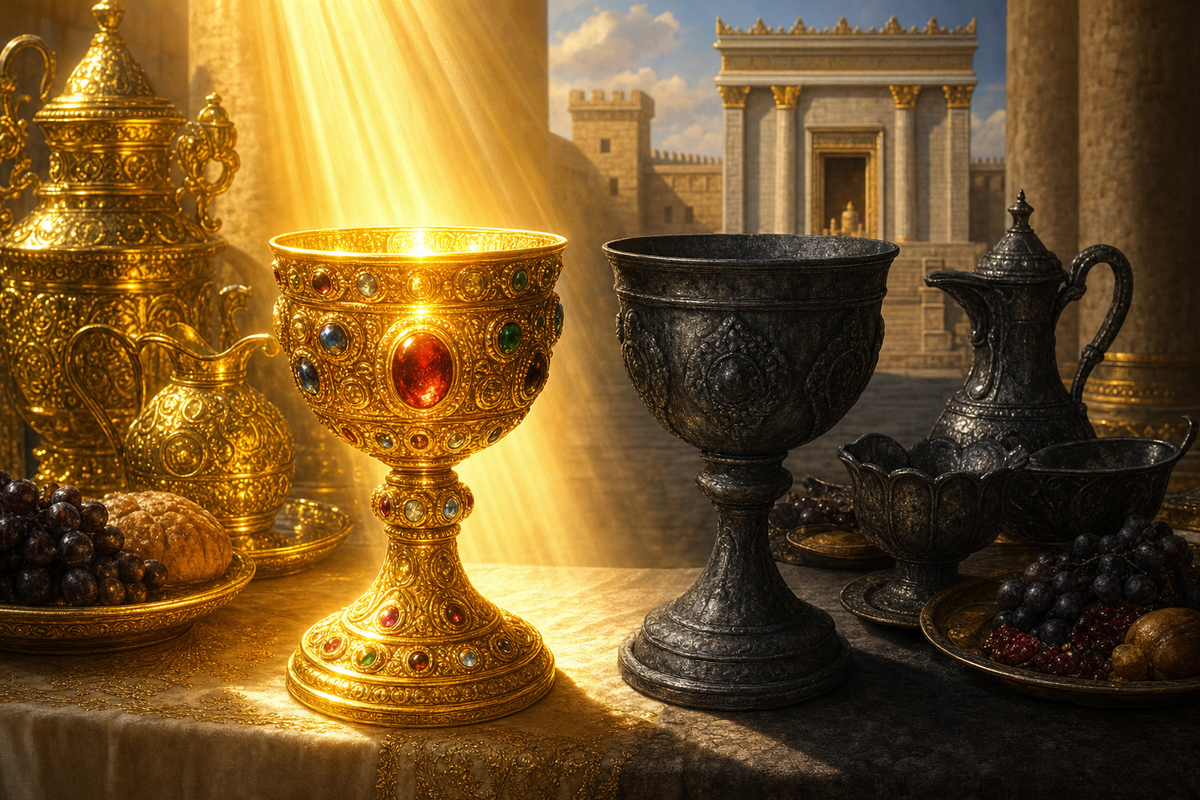
The Megillah describes the feast: "Drinks were served in golden vessels, and vessels differing from one another." What is the meaning of "vessels differing from one another"? The Midrash explains that initially, they brought vessels from all the different provinces to the feast. Afterward, Achashverosh brought out his own personal vessels—goblets inlaid with brilliant diamonds. At that moment, all the vessels from the other provinces were transformed; they appeared as black as lead when compared to the dazzling light of his royal vessels.
Following this, Achashverosh declared, "Now we will bring out the vessels of the Beis HaMikdash (Holy Temple)." He possessed all the treasures of the Temple, which he had inherited from Nebuchadnezzar. The moment they brought out the vessels of the Beis HaMikdash, which were also inlaid with precious stones and pearls, all of Achashverosh's vessels were transformed and became as black as lead. Every time the guests would look back and forth between the holy vessels of the Temple and the king's vessels, his vessels would pale in comparison, appearing as dull as lead.
The Mesiras Nefesh (Self-Sacrifice) of Queen Esther
When reading the Megillah, one must pay close attention to the dates in order to understand the timeline of events. The first chapter describes the third year of Achashverosh's reign. The second chapter recounts how Esther was chosen and how she desperately tried to hide.
The Vilna Gaon zt"l shares a profound insight on the verse: "And when the turn of Esther, the daughter of Avichail, the uncle of Mordechai, who had taken her as his own daughter, arrived to go in to the king." The Gaon explains that the cantillation mark known as a "munach" (literally meaning "resting" or "lying down") appears multiple times in this verse. This comes to teach us that every single day, Esther would prostrate herself on the floor. Esther prayed all day long that the king would not take her, begging Hashem to make her appear ugly so that Achashverosh would not desire her.
When she saw that her turn was approaching and they were coming to take her, she employed every possible tactic to avoid it. She threw herself down the stairs, rolled around, claimed she had sprained her ankle, and begged them to send her back. She purposely slipped on the diamond floor and injured herself, until there was simply no other choice and the guards took her by force. It is here that the holy Arizal zy"a reveals in his work Etz Chaim that because she prayed with such intense devotion, Hashem sent a spirit in her place to the palace, while her true self remained safely at home.
It took four years for the king's men to finally capture Esther. The Midrash states that the entire decree to gather the women was orchestrated specifically to find her. The spiritual forces of the nations sensed her existence in the world and wanted to make her their queen. They searched for her relentlessly for three years everywhere, knowing that she represented the very root of life. Esther embodies the Tree of Life, which is why she is referred to as a "Shoshana" (rose). Rebbe Nachman teaches that her sole power was the power of prayer. This is why the verse states, "And Esther found favor in the eyes of all who saw her"—because a person who spends their entire day in prayer naturally finds favor in the eyes of all who see them, as they channel Divine abundance and vitality to the entire world.
Haman's Decree and the Cry of Mordechai
In the third chapter, we reach the twelfth year of Achashverosh's reign. Nine years had passed since the events at the beginning of the Megillah. For nine long years, Hashem waited for the Jewish people to do teshuvah (repentance) for attending the king's feast in direct defiance of Mordechai's warnings.
When did the decree actually take place? The verse states explicitly: "In the first month, which is the month of Nissan... he cast the pur, which is the lot." The decree to annihilate the Jews was sealed on the thirteenth of Nissan. Mordechai immediately donned sackcloth and ashes, went out into the city streets, and cried out with a great and bitter cry. Esther, unaware of the impending doom, sent a message asking him, "Why are you crying?" He informed her that a decree had been issued to kill all the Jews. When she asked when this was scheduled to happen, he replied that it was set for the month of Adar.
Esther responded to him: "Why are you worrying now, in the month of Nissan, about something that will take place in the month of Adar, eleven months from now? Where is your emunah (faith) and trust in Hashem? Right now is Erev Pesach (the eve of Passover). We are busy with biur chametz (destroying the leaven). Tomorrow night is the Passover Seder, where we will recount the great miracles that occurred in Egypt when Pharaoh drowned in the sea. Surely, Haman will drown just as Pharaoh did!"
Mordechai answered her, "We cannot afford to wait." The Midrash explains the terrifying reality of the situation:
"When a Jew would go out to the marketplace to buy a loaf of bread or a pound of meat, a Persian would grab him by the throat and say, 'Tomorrow I am going to kill you!'"
The non-Jews had no intention of waiting eleven months. They had already decided to start murdering Jews immediately in the streets. Therefore, Mordechai warned Esther that they could not wait even a single day; she had to approach the king immediately. Realizing the urgency, she replied, "Go, gather all the Jews... and fast for me for three days."
The Secret of the Feast and Listening to the Voice of the Tzaddik
In Midrash Rabbah (Parshas 7), Rabbi Yitzchak Nafcha states: "Haman the wicked came against the Jewish people with a massive plot." Haman's entire intention was to cause the Jewish people to sin. He had consulted with all his advisors, and they warned him that it was absolutely impossible to destroy the Nation of Israel by force—after all, Sisera, Pharaoh, and Sancheriv had all tried and failed miserably. Realizing this, Haman presented a new strategy to Achashverosh:
"The God of these people despises immorality. Let us make a grand feast for them, where they will become intoxicated and stumble into sin."
Since Mordechai saw this, he stood up and declared to them: Do not go to the feast! The tzaddik says not to go here, not to go there, do not wander around in dangerous places because in the end you will stumble. No Jew wants to sin, every Jew wants to be holy and pure like Moshe Rabbeinu, but when a person faces a test with bad friends and he is already drunk, he does not know what is happening to him.
They did not want to believe Mordechai that it was a danger. They said: The king is giving us food and drink "according to every man's pleasure," he brought us all the best kosher certifications! Everyone received the certification of the rabbi they rely on. But Mordechai said: No kosher certification will help here, I do not permit you to go to the feast!
The Holiness of the Eyes - The Key to Teshuvah (Repentance)
What the tzaddik says is the holy of holies. When the tzaddik says not to go to certain streets, one must listen to him. Do not go outside, do not wander around, and do not look. There are secular people there, and in the end, they will do teshuvah (repentance) and we will fall, Heaven forbid. The one who causes others to sin will do teshuvah, and the other will remain in Gehennom (Hell).
Therefore, the entire essence of Purim is guarding one's eyes. The Rambam (Laws of Repentance, Chapter 4) writes that if one does not guard their eyes, Hashem does not accept their teshuvah. If a person wants to do teshuvah, the very first thing is guarding the eyes, because with this he sins every moment. He needs to ask the Rav to pray for him and give him advice until he gets out of it.
In truth, it is not such a great test. If a person decides that he is not looking - then he does not look. Exactly like a person who decides that he does not smoke cigarettes. What does smoking give a person? It is just arrogance, just poison and nicotine entering the blood until he cannot get out of it, like drugs. There is no need for any of this.
When a person decides to guard his eyes, he guards his eyes, and then Purim becomes like Yom Kippur. Hashem will accept our teshuvah, and we will truly merit the complete Geulah (Redemption) and the building of the Beis HaMikdash (Holy Temple) speedily in our days, Amen.
Part 3 of 3 — Lesson No. 234
Subscribe to Our Newsletter
Receive Torah articles and inspiration directly in your inbox