The Depth of the Holiness of Uman and the Secret of the Dochek
Part 1: Tuesday, Parashas Miketz, 29 Kislev 5763, Sheva Brachos at the Yeshiva
A ma'amar (discourse) by Rabbi Eliezer Berland shlit"a on the source of the tzaddik's Torah, the mesiras nefesh (self-sacrifice) required to draw close to him, and the immense holiness of the city of Uman. The article reveals how specifically through the dochek (hardship and crowding) and difficulties, one merits supernal attainments and the in-depth study of Torah.
Every novel Torah insight that a person expresses from his own intellect is limited. However, Rebbe Nachman of Breslov does not express insights from regular human intellect; every word of the Rebbe is drawn from the Ein Sof (Infinite), from "Atika Kadisha" (the Holy Ancient One) and from "Adam Kadmon" (Primordial Man). The Rebbe says, "I bring it down tens of thousands of levels lower, so that they will be able to receive it as words of mussar (moral instruction)."
Our path does not seek false publicity or fake leadership. We do not chase after anyone, and we do not beg anyone to stay. On the contrary, the door is open. We are happy for everyone who chooses their own path, because the message here is a completely different message—a message of pure truth. Whoever seeks the truth will stay, and whoever finds it difficult to deal with the dochek and the pressure can go in peace, and we will respect him.
A City of Self-Sacrifice and Concealment
The city of Uman exists in the greatest concealment, yet hidden within it is a holiness the likes of which has not descended since the time of the creation of the world. All the tzaddikim—the Berditchever, the Ruzhiner, the 'Ohev Yisrael' of Apt—saw the holiness hovering over this city and wanted to settle there. Why? Because buried in Uman are thirty thousand Jews who gave their lives with mesiras nefesh (self-sacrifice) for the sanctification of Hashem's Name.
Unlike other places in history, such as the Spanish Inquisition where some became conversos (hidden Jews), in Uman the Jews were given the full choice to convert and remain alive. They set up a cross in the courtyard of the synagogue with a canopy, and told them that only whoever passes under the canopy would be saved. Not a single Jew agreed to cross. They were sliced apart with hellish tortures in front of everyone for three days, and no one even entertained the slightest thought of converting.
The Encounter with the Heretics and the Opportunity for Geulah (Redemption)
Specifically in this holy city ruled the three greatest heretics in Russia, students of Mendelssohn, may his name be erased. They were the governors of heresy and did not allow any tzaddik to set foot in Uman. When Rabbi Levi Yitzchak of Berditchev arrived there and those wicked men entered his presence for the third Shabbos meal, he immediately turned his face to the wall, for he knew that it is forbidden to look at the face of a wicked person.
But when Rebbe Nachman arrived in Uman, he acted differently. Instead of turning his face away, he began to speak with them about calculations, mathematics, and all sorts of wisdoms in which they excelled. They began to follow the Rebbe's words until they admitted, "Such a wise man and such a mind we have never seen before!" Those heretics possessed a golden sword from the king, and they wrote to the Czar of Russia that there was a man in Uman possessing rare wisdom.
The Czar invited the Rebbe to the Kremlin in Petersburg. Had the Rebbe met with the Czar, everything would have been overturned. All the decrees against the Jews would have been canceled, we would have received the Land of Israel, and the Geulah (Redemption) would have drawn closer in an indescribable way. The Rebbe would have become the chief advisor to the Czar and changed all of global politics.
The Secret of the Dochek and Attainments in Torah
But why didn't this happen? Because there were two people who decided not to come for Rosh Hashanah. They were fed up with the dochek (crowding and hardship). They said, "How much can we travel to Uman and suffer the dochek? There is nowhere to eat, nowhere to sleep." Because of their insistence on comfort and their distress from the dochek, this tremendous process was canceled.
We must know that the dochek is an inseparable part of drawing close to the truth. Even today, there is immense dochek in places of holiness. People sit and learn, practice hisbodedus (secluded prayer), and pray with a flaming fire, truly people from "ancient years" as the Torah leaders of the generation have testified about them.
"The reward of the Torah gathering is the dochek" (Berachos 6b)
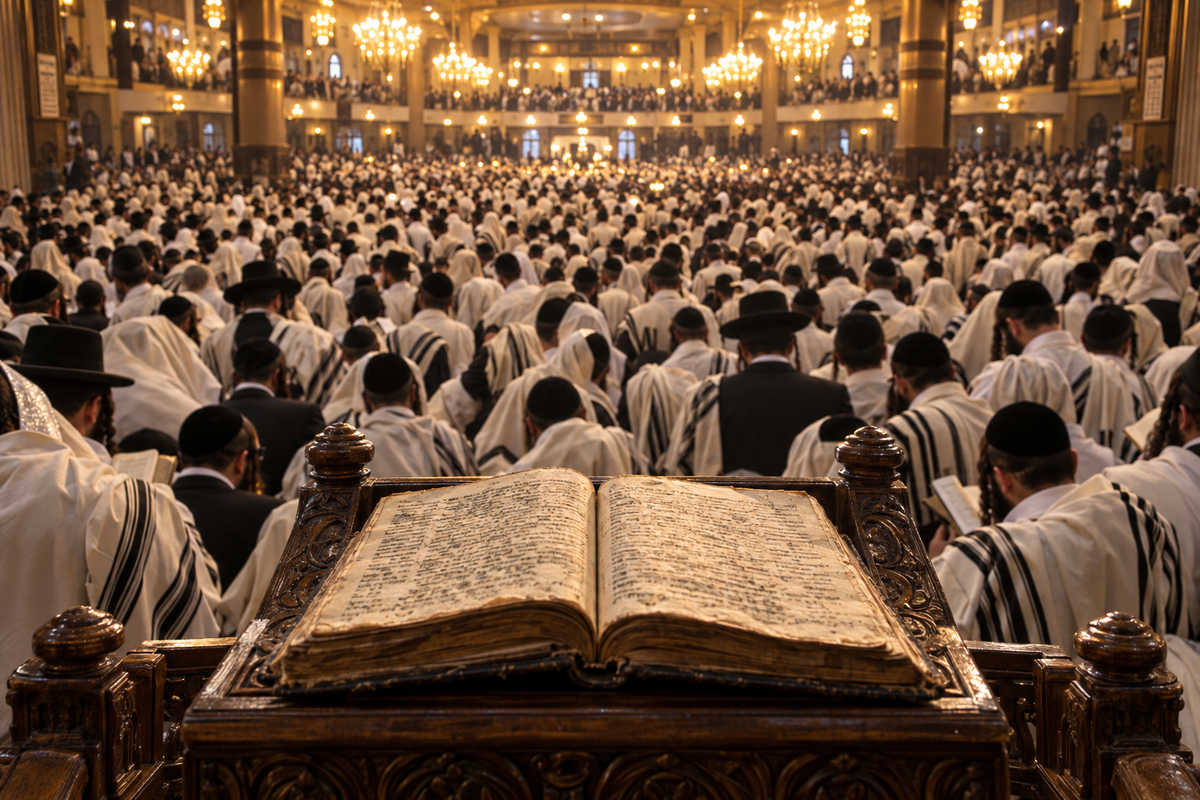
The Gemara says that the reward for attending a Torah discourse is the dochek (the crowding and hardship). The main thing is the dochek, and from the dochek one merits the 'shma'ata'—a deep understanding and straight reasoning in Torah study. It is impossible to merit true, in-depth Torah study and to break the evil inclination without mesiras nefesh (self-sacrifice). Whoever is willing to suffer the dochek for the sake of Torah and prayer merits supernal attainments and a life of clinging to the Ein Sof (Infinite).
Part 2 of 5
All parts: Part 1 | Part 2 (Current) | Part 3 | Part 4 | Part 5
Subscribe to Our Newsletter
Receive Torah articles and inspiration directly in your inbox