
The Secret of the Chanukah Candle: Rectifying the Sin of the Tree of Knowledge and the Power of a Chassan and Kallah
Part 1: Tuesday, Parashas Miketz, 29 Kislev 5763, Sheva Brachos (seven wedding blessings) at the Yeshiva
A profound discourse explaining how the Chanukah candles and the joy of a chassan and kallah (groom and bride) work together to rectify the sin of the Tree of Knowledge. Through the secrets of "Butzina d'Kardonusa" (the spark of darkness) and the offering of Kayin (Cain), the path is revealed to sweeten the Gevuros (strict judgments) and return to the spiritual level of Adam HaRishon (the First Man) in the Garden of Eden.
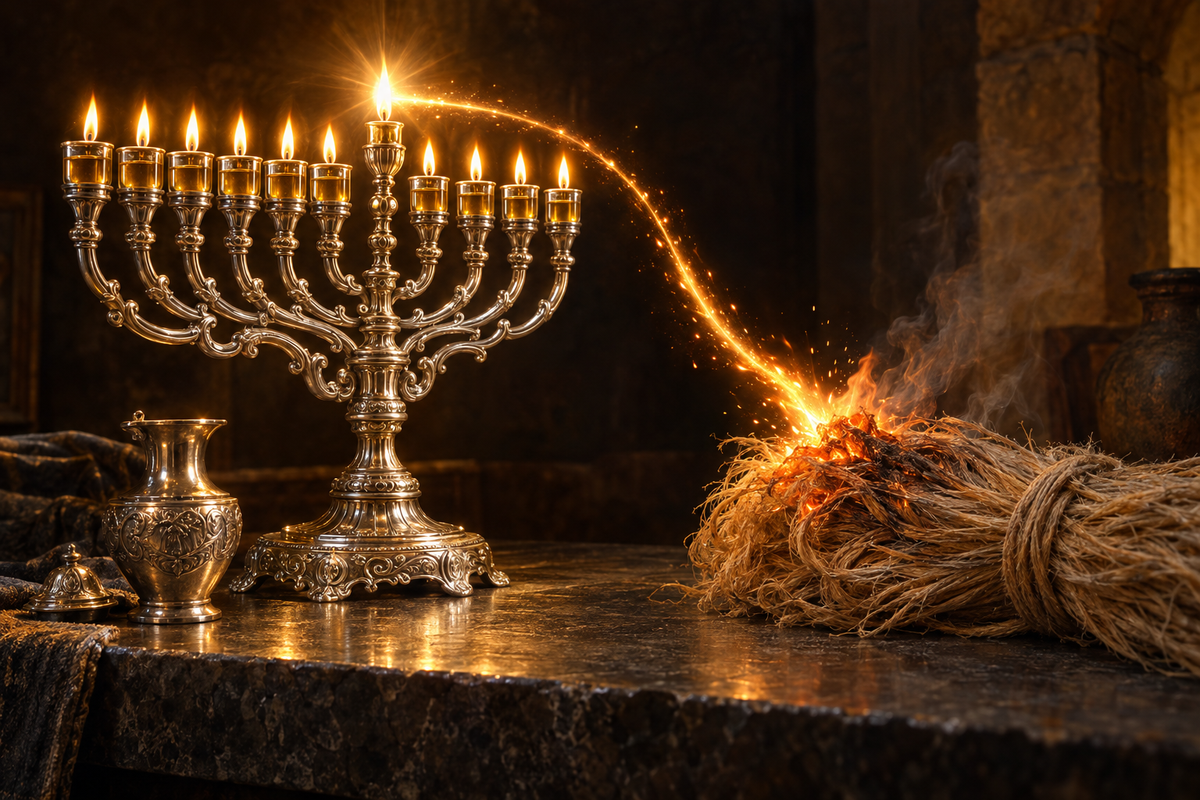
The Gemara in Tractate Shabbos (21b) discusses the secrets of the Chanukah candle, mentioning the concept of:
"A spark that emerges from beneath the hammer."
The holy Arizal explains, based on what is brought in the holy Zohar and the Eitz Chaim, that this spark emerging from beneath the hammer is called "Butzina d'Kardonusa" (the spark of darkness). From this very spark, Hashem created the entire world. Originally, before the sin of the Tree of Knowledge, the Gevuros (strict judgments) were always sweetened by Chasadim (loving-kindness). This is how Hashem created the world—out of a perfect balance between Gevuros and Chasadim.
However, after the sin of the Tree of Knowledge, when the woman said, "And the woman saw that the tree was good for food and that it was a delight to the eyes," lust entered the world. Since then, man loves to look and stumbles in forbidden sights. All of this stems from the five Gevuros that he needs to rectify. Along with the lust of the eyes, there also appeared the desire, "and the tree was desirable to make one wise"—the search for secular enlightenment and external wisdoms.
These three lusts go hand in hand: the lust for external wisdoms, the lust to look at forbidden places, and the lust for eating, which is the very essence of the sin of the Tree of Knowledge. The essence of the sin is that a person is forbidden to eat anything superfluous or to put anything into his mouth that is not necessary. As Rabbi Nasan of Breslov said when asked for advice regarding eating: "I do not know how to give advice on whether to eat one spoonful of soup more or less, and you are asking me for advice?"
The Camel, the Flax, and the Offering of Kayin
The continuation of the Talmudic discussion speaks of a camel laden with flax. Who is this camel? It is brought in Pirkei d'Rabbi Eliezer and in the holy Zohar that the S"M (the evil angel) descended and rode upon the snake, and the snake had the form of a camel. Initially, the snake had four legs and knew how to speak. It spoke with Adam and Chava (Eve) and was jealous of them, after seeing how the angels would roast meat and pour wine for them even before the sin.
That same camel, upon which the S"M rode, is laden with flax. Rabbi Nasan explains that flax alludes to heresies and the secret of the Chalal HaPanui (the Vacated Space). This is exactly the flax that Kayin brought as an offering.
Seemingly, this is baffling: Kayin was alone in the world together with Hevel (Abel). Hevel was in charge of the flocks, and Kayin received all the orchards. The world was full of olives, grapes, and dates, and people did not have to work hard but rather delighted in abundant peace. If so, why did Kayin, who was a prophet and wanted to bring an offering to Hashem, choose to bring specifically flax—from the worst of his crop?
The answer is that Kayin was angry with Hashem. When a person is angry with someone, he brings him the absolute worst thing he has, even if he possesses every good thing. Kayin brought flax, and when Hashem did not turn to his offering, "Kayin became very angry, and his face fell." He lost the seventy-two nehorin (lights of the face). After all, you brought the worst possible thing, so what are you angry about?
The Power of a Chassan and Kallah to Bring the Geulah (Redemption)
Here lies the secret of the Chanukah candle, and this is also the tremendous power of the chassan and kallah—to burn this flax, those very heresies and kelipos (spiritual impurities).
The Geulah (Redemption) is ready to come every single day and every single second. If we would only stop Kayin's aspect of "the end of all flesh" and view everyone with a good eye—seeing only the good points in every person—the Geulah would come today. The reason a person sees bad in his fellow is out of excessive arrogance or excessive feelings of inferiority. Therefore, King David says:
"Surely I have composed and quieted my soul, like a weaned child with its mother; my soul is like a weaned child upon me."
A person must be in the state of "I have composed" (shivisi)—neither in inferiority nor in arrogance. To rejoice in his lot exactly as Hashem created him.
The chassan and kallah merit the light of the Tefillin. A chassan and kallah are the aspect of the Tefillin of the hand and the Tefillin of the head. It is brought in the book Megaleh Amukos (Ofan 96) that all 515 prayers that Moshe Rabbeinu prayed, the numerical value of "Va'eschanan" (and I pleaded), were for the chassan and kallah. Moshe Rabbeinu prayed for the chassan and kallah that they should be able to rectify the sin of the Tree of Knowledge.
The True Joy: Returning to the Garden of Eden of Old
The Rebbe, author of the Imrei Emes of Ger, spoke these awesome and holy words at the Sheva Brachos (seven wedding blessings) of his son, the Beis Yisrael, in the year 5670 (1910). The Beis Yisrael himself writes in his discourses and asks: How is it possible to bless a chassan and kallah with such a tremendous blessing, using Hashem's Name and Kingship: "Bring great joy to these loving friends, just as You gladdened Your creation in the Garden of Eden of old"?
The answer is that this is the essence of true joy. All the joy of a groom and bride is in the fact that they merit to ascend to the level of Adam and Chava in the primordial Garden of Eden, before the sin of the Tree of Knowledge.
There is no true joy in eating, drinking, or worldly desires. When a person is hungry he eats, and when he is thirsty he drinks, but this is not joy – it is merely the prevention of hunger and thirst so that he can pray and learn Torah. True and complete joy exists only when the groom and bride succeed in reaching that supernal and pure level of the primordial Garden of Eden, and thereby they come to rectify the sin of the Tree of Knowledge and bring the King Mashiach.
Part 1 of 5
All parts: Part 1 (current) | Part 2 | Part 3 | Part 4 | Part 5
Subscribe to Our Newsletter
Receive Torah articles and inspiration directly in your inbox