
The Good Is Suppressed and Waiting to Break Out
The Daily Chizuk from Rabbi Eliezer Berland shlit"a
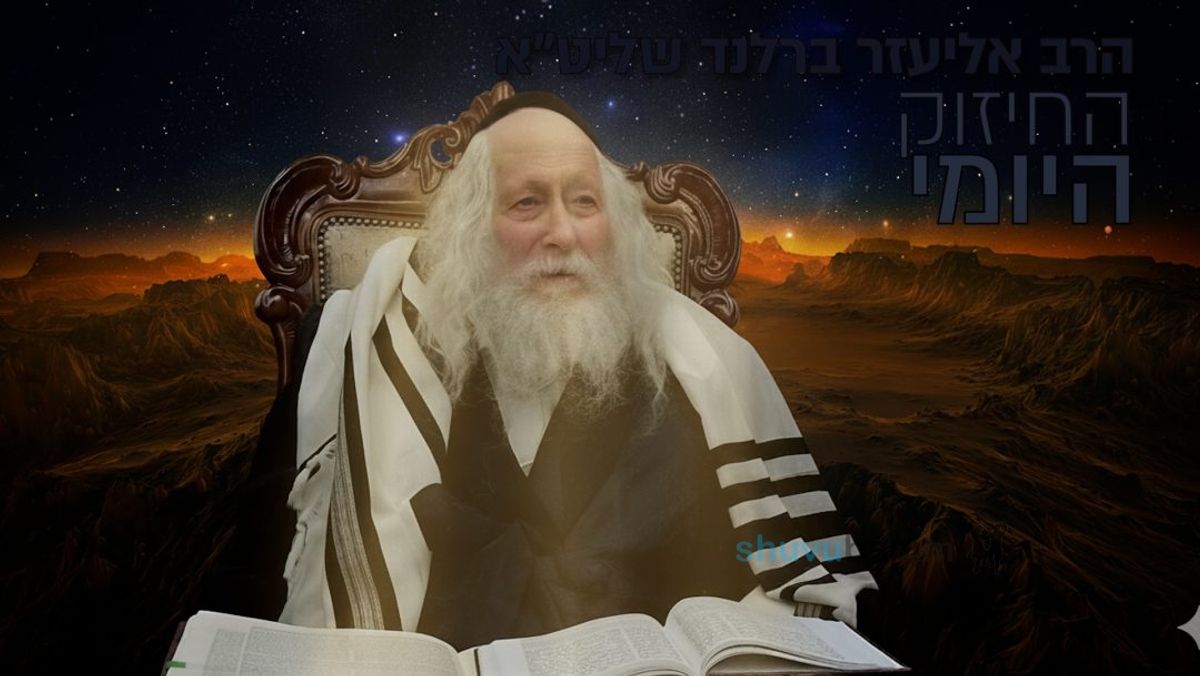
The Daily Chizuk from our teacher, the Gaon and Tzaddik, Rav Eliezer Berland shlit"a – Devorah says: "For your glory will not be upon the way" (Judges 4:9), for the moment the tzaddik says a word, one must immediately run to fulfill it!!
Thursday, 25 Iyar 5782 – The good is repressed within the wicked and awaits revelation, these are his holy words:
Barak hesitated; he was a hesitating person, he was a person who debated. Why does he debate? Because he is arrogant (mitbalet)! Whoever is arrogant, then he debates (mitbalet)! (The pride that distances a person from the tzaddik and his advice).
Barak was a procrastinator; he said, "I cannot go," "And if you will not go with me, I will not go" (ibid. 8) – You will not go with me? You have lost!
The tzaddik told you to go, so go! Do not make deals or conditions with him! He said to go, you should have gone at that very moment! You would have merited a complete victory over Sisera, over everyone.
"From heaven they fought, the stars from their paths" (ibid. 5:20), all the stars came to fight. The moment the tzaddik arrives, even the stars descend; the stars come to fight for him.
All the stars in the heavens descended to fight with Devorah; one star did not descend, it became a black star.
Black stars—whoever has studied a little astronomy knows there are black stars that swallow light. Everything is a punishment for not coming to help Devorah; the moment they did not come to help Devorah, Hashem turned them from shining stars into dark stars.
Because whoever does not come to help the tzaddik becomes dark; all his light darkens.
Within the wicked are embedded the souls of tzaddikim, and if they merit, they are revealed
And therefore, only Yael merited to strike Sisera, because she knew that Rabbi Akiva was embedded in the temple of Sisera. In the ankle of Sisera was Og, King of Bashan, therefore Moshe struck him on the ankle. In 'Bashan' is Rabbi Shimon ben Netanel, the student of Rabbi Yochanan who is buried in Tiberias.
Every wicked person has some tzaddik embedded within him; if he performs teshuvah (repentance), then this tzaddik is revealed.
If he had performed teshuvah, like Lavan, he would have become the supernal whiteness from the World of Atzilut; like Esau, if he had performed teshuvah, it is written that one opinion says he would have been a thousand times greater than Yaakov.
The wicked person has more strength; it is written in Likutey Moharan (Lesson 17) that he contains the repressed good, the hidden good.
Cain was more wicked (than Abel); why is he wicked? Because he overcomes the good within him (instead of giving the good the strength to win and break out).
Why did Cain become wicked? Because the good is constantly surging within him and the good wants to go from potential to actual, but he does not let it! So he becomes more and more wicked.
So even when he is wicked, it only shows how much good is in him; in one second (the good, the tzaddik) brings him back in teshuvah. The Rebbe says (Likutey Moharan, Lesson 9, Part 2), it is like a volcano; a person is like a volcano, everything explodes suddenly, lava comes out, all the good comes out.
The greater you are, the greater the good that comes out, and this is what Devorah the Prophetess did, who brought the entire generation back in teshuvah.
Subscribe to Our Newsletter
Receive Torah articles and inspiration directly in your inbox