
The More Arrows Fired at a Person
the More He Merits the Level of Yechidah d'Yechidah | The Hiloula of Moharnat from the Gaon and Tzaddik Rabbi Eliezer Berland shlit"a
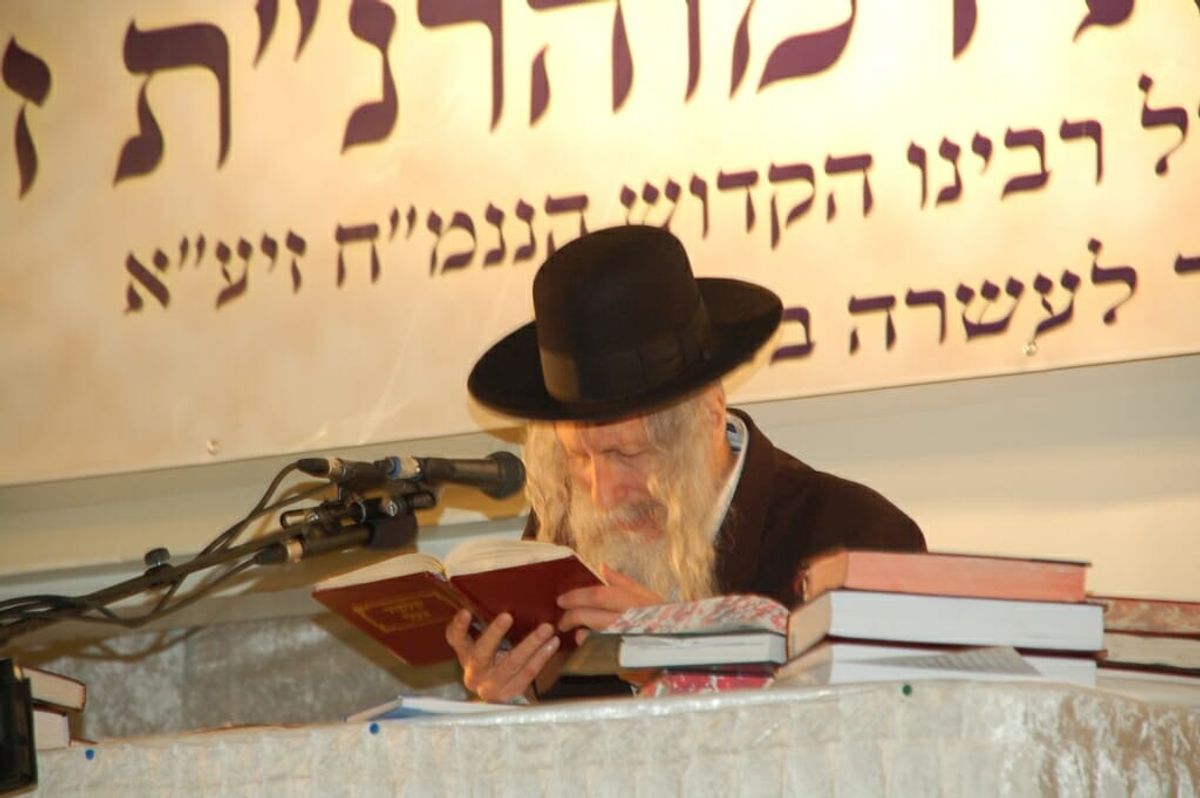
The holy Hiloula (anniversary of passing) of Moharnat (Rabbi Nosson) of Breslov on the 10th of Teves will fall this year on Tuesday night, the eve of the tenth of Teves.
As a great preparation for the great day, the day of the yahrtzeit (anniversary of passing) when the soul of the Tzaddik ascends and influences a great light upon the world, we bring the words of our teacher, the Gaon and Tzaddik Rabbi Eliezer Berland shlit"a. From a lesson delivered at the Hiloula of Rabbi Nosson of Breslov in 5777 (2016).
So now, on the Tenth of Teves, we merit the level of Yechidah d'Yechidah (the highest level of the soul), which we do not merit all year long—to the level of "the crown of the head of him who was separate from his brothers."
The Tenth of Teves always falls during the week of Parshas Vayechi, except for the years 5761, 5781, 5784, 5801, and 5808. For twenty years now, it has always fallen in Parshas Vayechi, except for those mentioned years... We are now in Parshas Vayechi, in the aspect of "the crown of the head of him who was separate from his brothers," regarding Yosef (Joseph), of whom it is said, "The archers embittered him, and became numerous, and hated him" (Genesis 49:23). In the merit of the arrows fired at him for twenty-two years, he merited "the crown of the head of him who was separate from his brothers"—to the level of Yechidah d'Yechidah. The more arrows fired at a person, the more he merits the level of Yechidah d'Yechidah.
Now, the Tenth of Teves is like Yom Kippur. It is written in the book Davar B'Ito and all the holy books that it overrides the Sabbath, and therefore it never falls on a Sabbath (in our current fixed calendar). Only when the Beis HaMikdash (Holy Temple) comes will it fall on the Sabbath, because then it was determined by the sighting of the moon. But now it is arranged so that the Tenth of Teves does not fall on the Sabbath, because otherwise, it would override the Sabbath, for it is even greater than Yom Kippur. Since we now merit—after Chanukah was a "seal within a seal"—everyone is sealed with a seal within a seal, and we merit true atonement, which is the Tenth of Teves.
For Teves—it is written in the book Sefer HaKarnayim, Discourse 6, that the month of Teves is the month of tovos (good things). "You shall be buried in a good old age" (be-seivah tovah) hints at Teves; "You shall receive good blessings" is Teves. Whoever passes away in Teves or is born in Teves is guaranteed to be a member of the World to Come. If a person passes away in Teves, like the Kotzker [Rebbe], like the Baal HaTanya, like Rabbi Nosson, and all the Tzaddikim—Rabbi Asher Zev of Tiberias, the Rabbi of Tiberias who was the only one to support Rabbi Yisrael Ber [Odesser], the only one who brought him into his home after everyone threw stones and tomatoes at him. For five years they threw things at him, and [Rabbi Asher Zev] would not go to eat without Yisrael Ber—"Yisrael Ber will eat with me." Rabbi Asher Zev zt"l never ate without an guest.
So now, on the Tenth of Teves, when we are after the "seal within a seal," after the seal of the jar of pure olive oil sealed with the seal of the Kohen Gadol (High Priest), we want the Kohen Gadol to seal us. Rabbi Nosson prayed in Likutey Tefilos that the Kohen Gadol should seal us, to nullify all the decrees in the world. No matter how much a person is shamed, it will never be enough for him; even just for the sin of Adam HaRishon (the first man), one needs to be shamed with a billion humiliations. King David was Adam HaRishon. The Asara Maamaros says: granted, King David sinned in the last five years of his life, but why was he pursued for sixty-five years? He killed Goliath and they pursued him—why? There was no claim against him! So he says: he is Adam HaRishon.
When a young man passes away at age twenty, he passes away at age one hundred and twenty. Rabbi Elazar ben Azariah said, "Behold, I am like a seventy-year-old man," yet he was only eighteen, because he completed the fifty years of Shmuel HaNavi (Samuel the Prophet) and King Solomon.
Because now, on the Tenth of Teves, a Beis HaMikdash (Holy Temple) of fire must descend. Therefore, "on this very day" (be'etzem hayom hazeh), it is the greatest day of the year, like Yom Kippur. "On this very day Abraham was circumcised"—that is Yom Kippur. And then Rashi says that he was also born then; if he was born then, he also passed away then. For the Gemara says in Rosh Hashanah (10b) that according to Rabbi Eliezer it is the 1st of Tishrei and according to Rabbi Yehoshua it is the 1st of Nissan, but Rashi says no, "on this very day" refers to Yom Kippur.
Now we are in the aspect of the Second Tablets; now we receive the Tablets anew. We have all the prayers of Yom Kippur, and more than that, we are now after the "seal within a seal." And on Purim, we will be at the third wall—these are three seals. "The walls of Jerusalem shall be built"—Rabbi Nosson says in Eruvin (22a) "wall of a wall" (chomas chomah), which is a seal within a seal, a wall within a wall. We are in the third wall, which was built by Shimon, Hillel, and Rabban Gamliel the Elder—the grandfather, the son, and the grandson; they built it.
For Yaakov (Jacob) is the Resurrection of the Dead. For the tribes merited the Resurrection of the Dead, as written in the Zohar (page 165), Zohar Shlach Lecha, that the gates of the Heavenly Jerusalem—at every gate stands Reuven, Shimon, Levi, Yehudah. Each one must enter a gate of fire. For in the future, when entering Above, one must certainly pass through a gate of fire. But also the earthly Jerusalem will spread throughout all of Jerusalem, and there are twelve gates, and every gate will be a gate of fire. Reuven will stand, Mashiach will come and build Jerusalem of "kadkod" stones (precious gems) and "saphires." Then there will be gates of fire; one will have to pass through gates of fire.
Only one who had no pgam einayim (blemish of the eyes/looking at forbidden things). For the entire work is only regarding the pgam einayim. Rabbi Nosson brings in the Laws of Damage to Neighbors (Hilchos Nizkei Shchenim) that the entire work is only on the pgam einayim, for all teshuvah (repentance) is in the eyes. The entire work is only on the pgam einayim, for a person sees nothing—what he sees are demons and spirits. He doesn't see women; he sees demons and spirits. He only sees the klipah (impure shell) that surrounds the skin of the serpent.
As written in Bechoros (7b), that a donkey is born with skin over its face, and this skin is permitted to be eaten. Everyone is born with the skin of a donkey. It is written, "Man walks in a shadow" (be-tzelem yis-halech ish); it is written, "In the image (tzelem) of G-d He created man." "Man walks in a shadow (tzelem)" refers to the negative image, the image of the serpent. There is an image of a serpent, an image of a scorpion, an image of a donkey, of a dog. All the Nazis were images of serpents. Each one had seven heads, as Rabbi Acha bar Yaakov is written to have cast down the heads (Kiddushin 29b). For the Yeshiva of Abaye consisted of gangsters (thugs/men of violence) who abused a woman and cut her into pieces.
A person does not know what he was in a previous gilgul (reincarnation)—what kind of pirate, what kind of gangster, what kind of criminal he was; he cannot know. This needs to be printed in the [books of] reincarnations of souls. In Kiddushin (29b) regarding Rabbi Acha bar Yaakov, that the entire Yeshiva of Abaye, all his students, were the gangsters of the Hill (the people of Binyamin who abused the concubine at the Hill, Judges 20). They only asked for the extradition of three or four criminals from the tribe of Binyamin, and they refused, so an entire tribe was wiped out. For one blemish, the entire tribe of Binyamin was wiped out.
Ben Oni (Son of my sorrow)—Rachel sees the "Ben Oni," the majority of the tribe of Binyamin that would be wiped out. But Yaakov sees the six hundred who would remain, and among them Shaul (Saul) son of Kish, of whom it is written "from his shoulders and upward" (taller than all). This is what Michal daughter of Shaul said to David when he danced before the Ark of G-d returning from the Philistines—that "they never saw a heel or a thumb on my father." I don't understand what is happening with my husband; he is jumping and flipping—what is going on there? He does it for the honor of the Ark, for the honor of the Ark of the Covenant, to make people happy.
For the essence of joy is only through dancing, because it is impossible to enter the Challal HaPanui (the Vacant Space) except through dancing. Only David can enter the Vacant Space. Therefore, everyone said Psalms and the Book of Job. The Zohar says (page 299) that Adam HaRishon said the Psalms and the Book of Job the moment he was expelled from the Garden of Eden. "In the multitude of my thoughts within me, Your comforts delight my soul" (Psalms 94:19)—the Pirkei D'Rabbi Eliezer (Chapter 19) says this was immediately after he was expelled from the Garden of Eden. Then he said this verse, "In the multitude of my thoughts within me"—why am I suddenly expelled from the Garden of Eden? He and Chavah (Eve) fasted almost until the Tenth of Teves.
Today is the shortest day. Until the Tenth of Teves they were still fasting. On the Tenth of Teves, suddenly the light was revealed to them—it was revealed to them that the day was beginning to lengthen. Until the Tenth of Teves, the day is still short—ten hours and ten minutes. Sunrise is at 6:40 and sunset is at 4:50—ten hours and ten minutes. The miracle is that the sunset is already getting later, so one begins to see a bit of light. Adam and Chavah fasted until the Tenth of Teves; they did not stop fasting. They fasted and cried afterward until they saw that the day was truly lengthening. Even though the sunset had already begun to lengthen, he [Adam] made Chanukah.
Chanukah according to Beis Shammai, Chanukah according to Beis Hillel. For on Chanukah, the Rebbe says (Torah 2, Second Part), the 370,000 lights return. Therefore, the Menorah is Shmag (343)—seven times seven times seven equals 343. Why does Zechariah return to "I have seen, and behold, a Menorah all of gold"? "All of gold" (kulah) means that all of the Jewish people are a Menorah of gold; every Jew is a Menorah of gold. Rabbi Nosson says that it is forbidden to speak against any Jew. Every Jew wants to return in teshuvah (repentance); we just don't know how to awaken them. This is only through songs and dances, just as King David flipped and jumped in the air. Through this, he brought all of Israel back in teshuvah—through these dances, such that there was no boy or girl with evil thoughts. As it is written, "Our sons are like saplings, grown up in their youth" (Psalms 144:12)—he says the girls were like stones and the boys were like trees; there were no [impure] thoughts.
Because if not, the Beis HaMikdash (Holy Temple) could not have been built. If someone has an [impure] thought and enters the Beis HaMikdash, he would be burned on the spot. It is impossible for there to be a Beis HaMikdash while there is any [impure] thought. Until a person is clean from every [impure] thought, the Beis HaMikdash cannot be built; if it were built, it would be burned. Thoughts are the fire of Gehinnom (Purgatory). The Rebbe says in Torah 19 that there are seventy fires burning within a person, but with a bit of Da'as (holy knowledge), a person can subdue everything (Torah 8, Second Part, Section 2: "The brain is a partition spread before desire"). With a bit of Da'as (Torah 72: "Any amount of Da'as uproots the trial of desire").
And Da'as is impossible to have without the Ketzos HaChoshen (a classic work of Jewish law). Without studying the Responsa of the Maharik, regarding the Duchess who loved the Jewish people and nullified her husband's decrees. Everyone must study Responsa 3 with awe and love, regarding the Duke who charged them five thousand "reds" or "whites" (coins), and the wealthy gave two thousand five hundred and the rest of the people gave two thousand five hundred. In the end, the Duke said, "I will never return this; I have gone bankrupt," and everyone despaired. It is written in the Shach (on Choshen Mishpat), Section 358, that there is no such thing as despair. The Shach says there is no reality of despair; a person never despairs. Even if a ship is sinking, he does not despair.
But there is a law, and it is also brought in the Shulchan Aruch (Code of Jewish Law), that even if a ship is sinking and all the property is sinking, whatever is saved must be announced, because the one who lost it did not despair. This is also the "law of the land" (dina d'malchusa), and it is also good conduct—that there is no such thing as despair. A person can never despair; a person is incapable of despair. He always hopes that he will find it one day, but in the meantime, others have permission to use it. Regarding this, it is written on page 27b in the chapter Elu Metzios (These are the Finds) that permission is given—everyone says, "I lost a hundred dollars; well, whoever finds it can use it. I don't know if I'll find it, so I'll find a thousand, I'll take a thousand"—this is a "regulation of the market" (takanas hashuk).
And in the end, it turns out that we aren't talking about physical finds at all. For "scattered fruits" refers to Keter (Crown), and "scattered coins" refers to Chokhmah (Wisdom), as it is written, "In the shadow of wisdom is the shadow of money" (Ecclesiastes 7:12). Money comes through Chokhmah. If a person studies Torah, he will have money; if he doesn't study Torah, he will never succeed—neither in collecting money nor in working. For "in the shadow of wisdom is the shadow of money"—money comes from Torah study. If he studies Torah with depth [more than money], and "the baker's loaves" refers to Binah (Understanding), which in the public domain is Da'as (Knowledge), until we reach "tongues of purple," which is Malchus (Kingship), where the colors are found.
And "flax bundles" refers to the souls of the wicked, for Kayin (Cain) brought flax. He had no pomegranates, no figs either. He could have asked Hevel (Abel) for a sheep and sacrificed it. Rather, when Kayin was born, it was said of him, "I have acquired a man with Hashem" (Genesis 4:1). The Tikkunei Zohar says: "I have acquired a man with Hashem"—he looked like a reflection of the Supernal [image]. For he didn't just bring the name; Kayin possesses the five Gevuros (Severities) and three Chassadim (Kindnesses), and Hevel is the opposite: five Chassadim and three Gevuros (Sha'ar HaPesukim, Bereishis, Discourse 4). So Hevel [—]. Hashem accepts Hevel's sacrifice. This doesn't mean He doesn't accept Kayin's; rather, the intent is that He says to Kayin: "You are not sweetening your Gevuros."
Because on the contrary, for a person who has a greater Yetzer Hara (Evil Inclination), he has a harder task. A person who has only Chassadim has an easier task. So why are you proud over the wicked person? Why are you proud that he has Gevuros? Why are you proud that he failed? So the moment Hevel became proud, he became liable for death. Help Kayin! Help your brother! He has five Gevuros and three Chassadim, while you have five Chassadim and three Gevuros.
The daughters of Tzelofchad were all Gevuros (Sha'ar HaPesukim, Pinchas, s.v. Vatikravnah—the daughters of Tzelofchad are the five Gevuros: Choglah, Milkah, and Tirzah are sweetened; Machlah and Noa are not sweetened). Therefore, the order is changed, because three were Gevuros and two were Chassadim. Therefore, the order must be changed, because in the aspect of Chassadim, even the three were Gevuros. One must sweeten the Gevuros, and Hevel should have helped Kayin sweeten the Gevuros!
Subscribe to Our Newsletter
Receive Torah articles and inspiration directly in your inbox