The Real Reason the Sin of the Golden Calf Was Not Forgiven • Shabbat Parshat Ki Tisa Class
In this class, Rabbi Eliezer Berland shlit"a explains the reason King Saul was killed, interprets the sin of the Golden Calf, and reveals why the sin has not been forgiven to this day. He offers novel insights regarding the Plague of Locusts, and recounts wondrous stories about the self-sacrifice of Anash (our Breslov brethren) from the previous generation.
Below is the full class:
We have now read Parshat Parah - after Purim. Parah (cow) is related to perurim (crumbs) - only after Purim can one reach the level of perurim.
Why was Saul killed?
Why did they kill Saul? Why was he killed? "On this I will not compromise, on this I will not compromise." Why did they kill Saul? Do they just kill a person for no reason? The Baal HaTurim points out that it is written: "A man or a woman who has a ghost or a familiar spirit..." (Leviticus 20:27), and the very next verse says: "Speak to the Kohanim" (Leviticus 21:1). This teaches that because he went and consulted the woman with the familiar spirit (the witch of Endor) - who was this woman? It was the mother of Avner. So Hashem says: "I wanted to save him, but because he consulted the familiar spirit, I cannot save him, because he did not consult the Urim V'Tumim (the High Priest's breastplate), he did not consult the Kohanim; he consulted this... and this..." And this is why the very next verse is "Speak to the Kohanim" - because he did not consult the Kohanim, why did he go to the woman with the familiar spirit? Therefore, Hashem says: "I cannot save him."
How did the Jewish people believe that the Golden Calf took them out of Egypt?
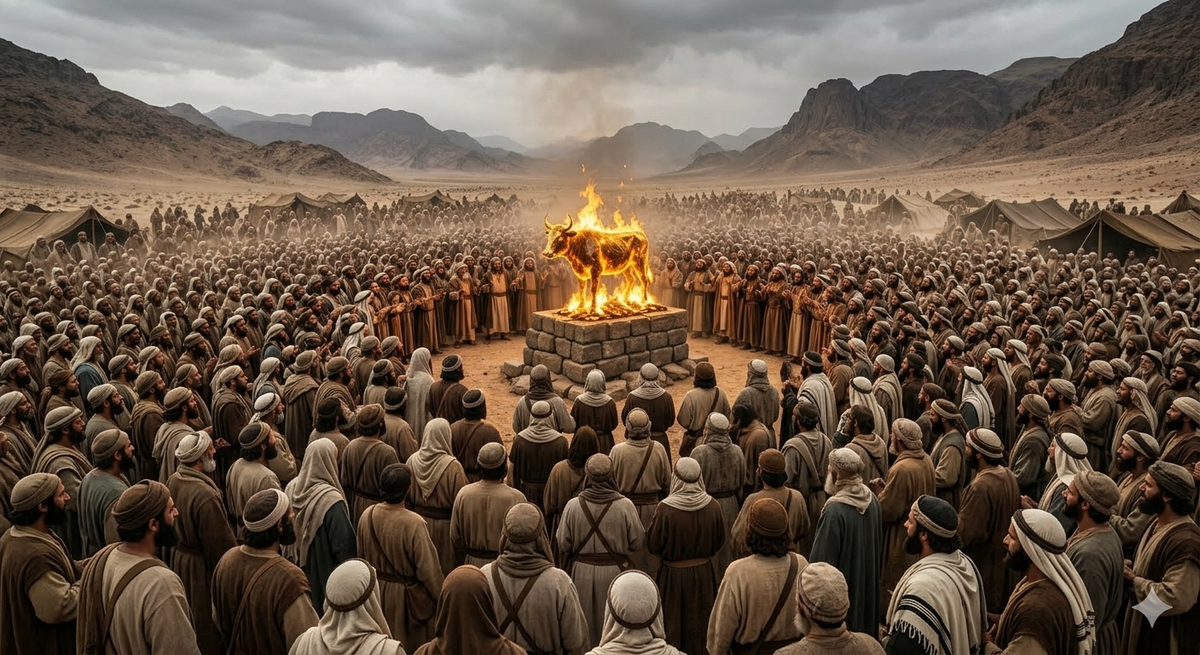
Why did the Jewish people make a Golden Calf and say, "These are your gods, O Israel" (Exodus 32:4)? What does "These are your gods, O Israel" mean? Did these nose-rings take us out of the land of Egypt? How could that be? Because the women did not want to bring them their nose-rings, but not because they were stingy; for later we see regarding the Mishkan (Tabernacle) that they brought a mountain of gold, until Moshe said: "Enough, stop, there is no need to bring anymore" (Exodus 36:6). So what were they thinking - that this calf took us out of the land of Egypt? But the calf would speak. They would ask it questions and it would give them answers, because they had the engraving tool of Enosh there. It is written: "And he fashioned it with an engraving tool" (Exodus 32:4). The Zohar says that this was the engraving tool of Enosh - that Enosh had a tool, a scalpel with which they would make idols, and the idol would speak. They would ask it questions and it would answer.
Was Balak the son of a bird?
Just like with Balak, where it is written: "Balak the son of Tzippor (bird)." Was Balak the son of a bird? What does "the son of a bird" mean? He wasn't the son of a bird. Rather, the Zohar says that Balak had a bird made of silver wings, with a head of gold, and it had a golden tongue. They would place it for seven days facing the sun and seven days facing the moon, and he had a golden needle, and he would place the needle on the bird's tongue, and it would speak and answer all his questions. Whatever he asked it, it would answer him. It told him not to go fight against the Jewish people. He said: "The Jewish people, 'Behold, a people has come out of Egypt' (Numbers 22:5) - they are just some rabble." But it answered him: "The Children of Israel are not just some rabble." He said: "Behold, they have covered the eye of the earth" (ibid.), they are like locusts...
Moshe chose the Plague of Locusts
Just like Pharaoh who called them locusts - they come, they push. So Moshe says: "You call them locusts? I will show you what locusts are. They do not push." Pharaoh says: "They push" - no, they will come like locusts; and therefore Moshe brought upon them the Plague of Locusts.
The Kol Simcha says that Hashem did not tell him (Moshe) which plague to bring upon them; Moshe brought this on his own, because Hashem "no longer had the strength" after seven plagues... He says: "Choose whatever you want - whichever plague you want." Because it is not written that Hashem told him which plague he was going to give. So Moshe chose to bring him locusts; he said to Pharaoh: "You said they are like locusts - I will show you what locusts are. They come in an orderly fashion, they do not push, and they destroy everything; they leave nothing."
It is written in the verse: "And no man shall thrust his brother" (Joel 2:8). This is in Joel. Joel the son of Pethuel - he was the son of Samuel the Prophet; he lived for four hundred years. Now he says: They come like locusts, they come in billions, they do not push. Not like in Shuvu Banim, here - everyone pushes; they push Eliyahu Sukkot all the time. It is written: "They shall not thrust one another, 'each man shall walk in his path, and they shall not break their ranks'" (Joel 2:7-8).
Now it is Bein HaZmanim (the intersession between yeshiva terms) - there are no studies until Pesach because of the war - so one can study Joel. Now Khamenei fired missiles; this morning, at five-thirty, there were missiles. (The Rav turned to one of his grandsons:) Where were you at five-thirty? If you had woken up early you would have seen the fireworks show that was here; there was truly a spectacular show here. People wait from the morning to see this. But with Hashem's help, there won't be anymore. They intercept the missile at a distance of five hundred kilometers. A missile travels at a speed of... per second, and the radar that detects the missile operates at a speed of twenty thousand kilometers a second. But Khamenei is still alive; he is hiding in bunkers underneath the yeshiva. He heard that on Monday there is a wedding, and at the wedding, one can perform the resurrection of the dead; so he asked to come and that they should revive him in the dance of the resurrection of the dead. The question is whether Dovaleh agrees to revive him in the dance of the resurrection of the dead... You don't agree? Then we need to inform him that there is no point in him coming. He wants to arrive through the back door. Shimon Treisman did agree, so he will arrive at 12:00 through the back door and he will distribute blessings to whoever wants. The Zionists said they killed him, but he is hiding in the tunnels under the yeshiva. All of Jerusalem, throughout the entire Old City, has tunnels underneath. Jerusalem was built layer upon layer - there are seven layers - so there are many tunnels. All of Jerusalem is full of tunnels, even down here everything is full of tunnels. This is how they transferred the ammunition during the War of Independence; they transferred it through the tunnels.
The self-sacrifice of R' Hirsh Leib
Yisrael Lipel (the son of R' Hirsh Leib) was in the Etzel (the Irgun underground). Anyone who was in the Etzel could not leave them. Whoever does not put on tefillin - then his children will no longer be part of the Jewish people, and he is cut off from the Jewish nation. Whoever does not keep Shabbat - his children end up marrying non-Jews, and he is expelled from the Jewish people. So Hirsh Leib took him out. He had several friends who were killed in the Etzel - one was a Gur Chassid and a few others. So Hirsh Leib went; he had a doctor friend in Givat Shaul, so he wrote that he was unfit, that he had gone crazy, and that is how he got him out of the Etzel and got him out on the last convoy from the Old City. In the merit of this, we had Yisrael Lipel, who secured budgets for our yeshiva. Later he was paralyzed - and it doesn't matter - but one needs to know all the stories of Hirsh Leib; all these stories of Hirsh Leib need to be printed.
So he (Hirsh Leib) walked twice on foot to the Land of Israel. He walked across all of Russia to Persia, there in the Caucasus, in order to reach the Land of Israel, and they sent him back twice: he arrived and they sent him back. He walked with another friend. He asked Yankel from Zhitomir for his boots; he told him: "You are here in Uman, you don't need boots, I am walking on the roads on the way - so I need boots." So he gave him his boots, and that is how they walked.
And they took upon themselves a resolution that they would not give up on immersing in the mikveh every day - no matter how many (degrees) minus 20, minus thirty, minus fifty - they would not give up on the mikveh every day. They would break the ice and go immerse. And they walked for six hours in the wrong direction, and then had to walk back for six hours. They reached a certain village, and went to immerse in the river there, and it was minus 50 (degrees), and in minus fifty you cannot get dressed afterwards - maybe you can, but Shuvu Banim guys cannot get dressed in minus fifty. So they went in to immerse; they couldn't get dressed. Then they saw a hut, and they ran into the hut, and they jumped into the hut. It was a house belonging to Russians, and there was an old man and an old woman there. Suddenly they see two men without clothes jumping into their house. They said: "They must be demons! Maybe they came from the moon, from Mars - what are these people?" And the old woman jumped out the window, and the old man fled through the door, and she broke her arm. Later they brought them a hundred rubles in compensation, and there it was already less cold inside the house, so they were able to get dressed.
And then they began to pray - six hours of prayer - and the whole village came to see that aliens had arrived from the moon, and this is how they pray. Until there was one person there, and he told them: "No, I was once in Kiev and I saw people like this there - they are Jews." And that is how they prayed.
Afterwards, the whole village escorted them, and then they traveled by train to Persia. And there, at the border of Persia, it is all mountains, so the train travels slower there. So they planned that at the last village before the border they would jump from the train. But then the nachalnik (officer) caught them, and he was a Jew. So he told them: "I know that you want to smuggle across the border and go to the Land of Israel, so I am giving you twenty-four hours to go back, and if not - I will put you in the dungeon." And so they had to go back - that was one time, and there was another time that they arrived and also had to go back - they were caught.
Later, when he arrived in Israel, he heard that there was a grandson of Reb Noson buried on the Mount of Olives, so he immediately bought the grave next to him - there was a spot next to him - because he said that he wanted to be buried next to a grandson of Reb Noson. So he is indeed buried on the Mount of Olives next to Rabbi Natan the son of Rebbe Nachman (of Dmitrovka).
This was in the year 5690 (1930), there was Rabbi Shmuel Horowitz; his father-in-law was named Nachum Wallerstein. He was not against Breslov, but his mother-in-law was against Breslov, because he argued with her about who was greater - Rebbe Nachman or the Chofetz Chaim. So he told her: "Of course Rebbe Nachman is greater." So she said to him: "Is that what you say? The Chofetz Chaim! Get out of the house!" She threw him out of the house. But one shouldn't get into these arguments; we don't enter into such arguments. So he wanted to travel to Uman, and he had a British passport. So they went to the consulate so that they wouldn't let him leave for Russia, because he wanted to reach Russia on foot. So he went to Jaffa, to the port, and he saw a ship there. So he said to the captain: "Where are you traveling to? Can I join you?" So he tells him: "Yes, come - you will wash the floor, work in the kitchen, cook." And that is how he traveled. He arrived at the port in Romania, in Constanța; from there he continued to Warsaw, and then he arrived in Łódź.
The Tikkun HaKlali Instead of a Passport
(Returning to tell about Rabbi Hirsh Leib:) And the story of the passport - that he presented The Tikkun HaKlali - this was the story when he smuggled across the border from Poland to Ukraine, because he did not have a passport. At that time in Poland, there was Rabbi Aharon Leib Zigelman. He was the greatest genius, he was the greatest scholar. So he and Rabbi Yitzchak Breiter made a decree that it is forbidden to travel to Uman, it is forbidden to smuggle across the border, because several young men were killed there at the border - they were shot. So they said that people should no longer travel to Uman, and instead they should study two pages of Likutey Halachos and two teachings in Likutey Moharan every day. So Rabbi Hirsh Leib said to Rabbi Yitzchak Breiter: "Can you promise me that you will bring me into the Garden of Eden? That you will take me out of Gehennom (Hell)?" So he said to him: "Who am I that I can promise? How can I promise such a thing?" So he said to him: "If you cannot promise me - then how can you tell me not to travel to Uman?"
So they traveled to Uman. But he didn't have a passport, so he traveled with The Tikkun HaKlali. And then they were caught in the village near the border - a policeman caught them, and he was a Jew. So he asked them for passports. So he handed him The Tikkun HaKlali. And he (the policeman) asked them: "What are you doing here?" So they said that they got lost on the way here. Then he saw The Tikkun HaKlali there, so he said to them: "I know that you are traveling to Uman and you didn't get lost on the way; I saw The Tikkun HaKlali here. Go back quickly."
Just like that man from Kibbutz Keshet whom we visited. He told us stories, and he survived the Holocaust. We sat with him at night and we thought he was going to die that very night, so he told us that he was saved three times. Because he was in France, and the French collaborated with the Poles and with the Nazis, and any Jew they caught - they would immediately transfer him and send him to extermination camps. So they arrived one time and caught them, they surrounded them in the street and asked for an ID card. So he had The Tikkun HaKlali - it was a small Tikkun HaKlali the size of an ID card, but there was no picture on the outside - so he handed them The Tikkun HaKlali and they released him. He didn't even open it. That was one time.
And there was another time when they also caught them, and then he suddenly saw a Nazi officer there looking at his watch and saying: "Well, it's late for me, I have to go." So he said: "I will do the same thing." He looked at his watch and told them: "It's late for me, I have to go." And that is how he walked away - they thought he was a German officer. And there was a third time that he was also saved; that one I don't remember anymore how it happened.
They Wanted to Make the Ox in the Chariot
So now (in the Torah portion) we read about the Golden Calf that they made. They made a calf - they wanted to draw down the Ox from the Divine Chariot. "Tetramulin," the Midrash calls it "Tetramulin" (a four-faced chariot). So they made a calf. They said: "This will conquer the land for us, it will fight for us in the land." Because Moshe had not returned and forty days had already passed. They said: "Another day and Moshe has not returned - surely he will not return anymore." So Hashem wanted to flood the ocean and drown everyone. (The Rav turned to one of his grandsons: "Do you know what an ocean is? There is such a thing - it's called an ocean.") But they made the calf because Moshe was not there, and therefore with the calf they could still be understood, because they did not have Moshe. That is why they made the calf, and therefore Hashem ultimately forgave them for this and did not kill them, because they did not have Moshe, and they wanted something to go with them to conquer the land for them. But later, with the sin of the Spies - there Moshe was indeed present, and they have Moshe Rabbeinu and they have the Clouds of Glory - so there when they sinned, Hashem no longer forgave them for it; they all had to die for it - there is no forgiveness. Because you have Moshe, and you go without Moshe? For this Hashem did not forgive. Because if they had been with Moshe, Hashem would have forgiven everything.
When a Person is with the Tzaddik, Hashem Forgives Everything
Subscribe to Our Newsletter
Receive Torah articles and inspiration directly in your inbox