
The Secret of Concealment and Revelation: How a New Day is Created Out of the Darkness
Class No. 164 | Thursday, Parashas Toldos, 30 Cheshvan, First Day of Rosh Chodesh Kislev 5759, Sheva Brachos.
This article explores the secret of concealment and revelation, beginning with the discovery of the Torah scroll during the days of Yoshiyahu after decades of spiritual darkness, and continuing to the immense miracle against the Assyrian camp. Later, it explains the power of The Tikkun HaKlali and true charity to create a new day, as well as the secret of the self-sacrifice of Rabbi Akiva, who merited to reveal the secrets of the letter Aleph out of tremendous humility.
Menashe ruled over Judah for fifty-five years, and after him, his son Amon ruled for two years. During these fifty-seven years, there were no Torah scrolls in the Land of Israel, because Menashe had burned them all. Suddenly, Yoshiyahu, the great-grandson of King Chizkiyahu, ascended to the throne when he was only eight years old. During the first ten years of his reign, there was still no Torah scroll in the land. Yoshiyahu did what was upright in the eyes of Hashem and walked entirely in the path of his ancestor David without deviating to the right or the left, and all this without even knowing of the existence of a Torah scroll. It is impossible to grasp such a thing—throughout all the harsh decrees that befell the Jewish people, there always remained Torah scrolls, a Tanakh, or a Chumash. Yet here, from the age of eight until eighteen, King Yoshiyahu knew nothing.
In the eighteenth year of his reign, Yoshiyahu sent Shafan the scribe to Chilkiyahu the Kohen Gadol (High Priest), to collect the money donated by the people for the renovation of the Holy Temple. The Temple was in a state of advanced decay; Menashe and Amon had not touched it for fifty-seven years, and together with the first ten years of Yoshiyahu's reign, sixty-seven years had passed without any repairs. The plaster had fallen, the walls were collapsing, the bricks were crumbling, and the wood was rotting. The money was transferred to the workmen, the carpenters, and the builders, to buy timber and hewn stones to strengthen the structure of the House.
The Hidden Torah Scroll in the Walls of the Temple
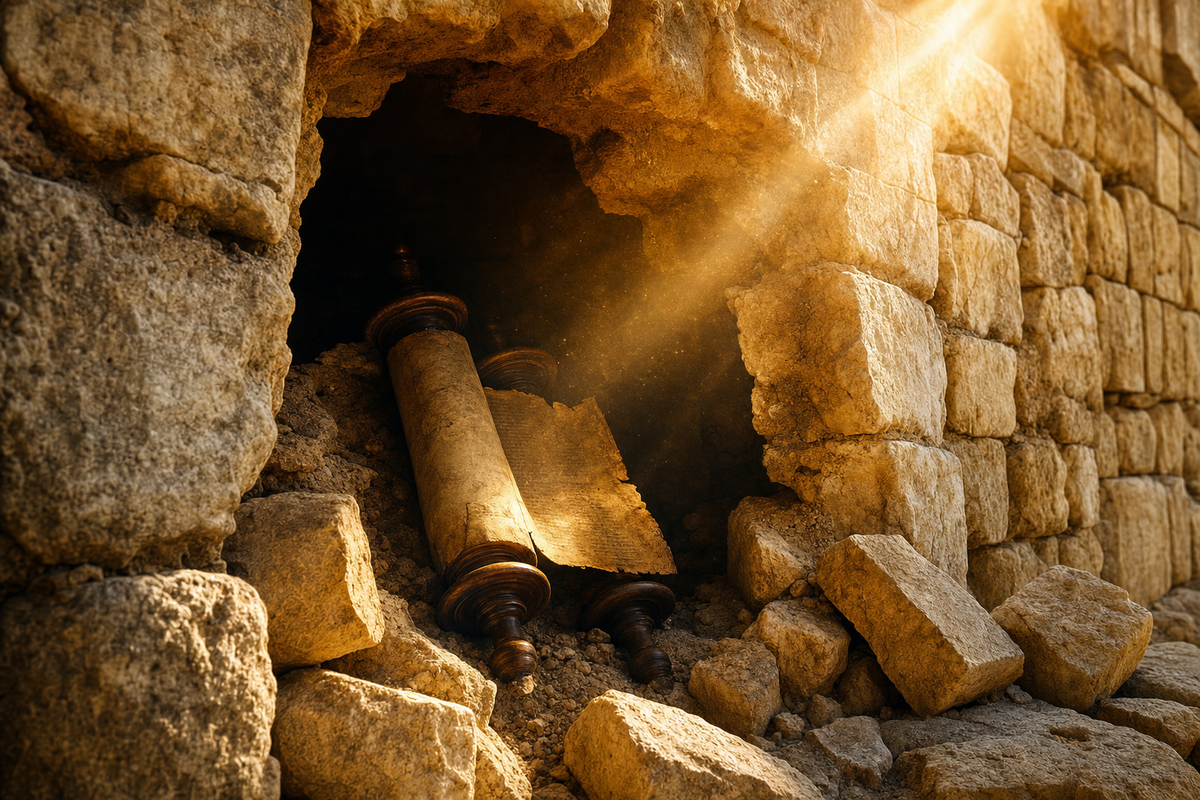
When the workers began to renovate the House, among the crumbling bricks and pieces of rotten wood, a wonder was suddenly discovered. Inside the thick walls of the Holy Temple, which were about six cubits thick, someone had hidden a Torah scroll within the layers of stone. The person who concealed the scroll hoped that perhaps it would be found in a few generations. And so, after sixty-seven years, the Torah scroll was found.
Chilkiyahu the Kohen Gadol said to Shafan the scribe, "I have found a Torah scroll in the House of Hashem." Rashi explains that this was a Torah scroll hidden under the layer of stones since the days of the wicked Achaz, when he burned the entire Torah and left no scroll in the Land of Israel. Hashem arranged that if they burn it here, it will remain somewhere else. He scattered us among all the nations so that the Torah would always remain, but back then everyone was in the Land of Israel, and if Achaz had succeeded in burning everything—we would have been left with no Torah scrolls at all. King Chizkiyahu managed to write Torah scrolls, but Menashe came and burned those too. The scroll that was found was the last remnant from the time of Achaz.
Concealment Within Concealment: The Miracle Against the Assyrian Camp
The wicked Achaz created a situation of concealment within concealment. The Gemara in Tractate Menachos describes the chain of events surrounding Sancheiriv's siege of Jerusalem. Sancheiriv saw that the Jews were a stiff-necked, stubborn, and rebellious people. He realized that in the time it would take him to conquer Jerusalem, he could meanwhile conquer a hundred other countries. Therefore, he left Ravshakeh with an army to continue the siege, and traveled to conquer Egypt and Kush.
Sancheiriv conquered Egypt and Kush, and brought all their inhabitants and kings as captives in golden wagons to the gates of Jerusalem. But then, in one night, an angel of Hashem went out and struck down one hundred and fifty-eight thousand generals in the Assyrian camp, who commanded a massive army of about two billion, six hundred million soldiers. In the morning, the Egyptian captives woke up and saw all the generals dead.
From this we learn a tremendous principle: The greater the concealment we see, and concealment within concealment, the greater the revelation will be afterward. All the Egyptian captives who witnessed the miracle returned to Egypt and decided to serve Hashem. They went to Alexandria and built a sort of temple to Hashem there. (Non-Jews are permitted to build an altar and offer sacrifices for the sake of Heaven anywhere in the world.) Thus, it turned out that not only did Achaz fail to uproot the Torah, but as a result of his actions, all of Egypt began to serve Hashem and offer sacrifices for the sake of Heaven.
The Secret of The Tikkun HaKlali and True Charity
Reb Noson explains, based on the tale of the "Seven Beggars" from Rebbe Nachman's stories, the secret of the Divine Providence of the "True Man of Kindness." When the day comes to its very end, in the final seconds, when the world faces destruction because people are far from having pure intentions for the sake of Heaven in their prayers—the power of The Tikkun HaKlali is revealed.
"For prayer without intention does not ascend on high; this is the rule written in all the holy books. Who merits to pray with proper intention today? Therefore, the Rebbe revealed The Tikkun HaKlali, ten chapters of Psalms which are the root of all the Psalms, which elevate all the prayers and all the spiritual work a person has done."
A person can go out to the field (for Hisbodedus), scream, and cry for parnassah (livelihood), for his wife, for his children, and for health, and who knows if he even thought about Hashem at all. Meanwhile, he enjoys the fresh air. People do not yet know that the true Garden of Eden in this world is the field. To travel to the field from night until morning—there is no greater Garden of Eden than this. A person who does this will never be sick. He sees the stars dancing in the sky and recites the blessing "Who makes the work of creation."
When the day is about to end, the "Heavy of Speech" beggar appears and grants from his deeds to the "True Man of Kindness," and through this, they create a new day. This is accomplished through one true mitzvah done for the sake of Heaven—through tzedakah (charity). Rebbe Nachman says in Torah 264 that giving charity is literally tikkun habris (rectification of the covenant). A blemish in the covenant means that a person drew spiritual abundance to impure places and to the Sitra Achra (the Other Side), creating naked souls. He extracts all this abundance and these holy sparks back and rectifies them only through charity.
But one must be careful: giving charity to an improper person causes a greater blemish and can bring illnesses and disasters. In contrast, the moment a person gives charity to a synagogue, to elevate the name of Rebbe Nachman and the House of our God, or to a truly worthy poor person—he can sweeten all the troubles and harsh judgments. True charity is what creates the new day.
The Fire of Teshuvah and the Secrets of the Letter Aleph of Rabbi Akiva
In Torah 9, Rebbe Nachman explains the power of a baal teshuvah (returnee to the faith). When a person breaks out of the closure of his heart, a fire so fierce bursts forth from him that it can burn the entire world. This fire within baalei teshuvah is a Divine fire blazing from the Throne of Glory.
Rabbi Akiva was a baal teshuvah, a descendant of converts, who until the age of forty was an ignoramus and did not know how to read or write. In Avos D'Rabbi Noson, it is told that he went to learn Torah together with his young son. He sat in a room with two-year-old toddlers, without any shame, and held the top of the reading board. They learned Aleph, they learned Beis, and by the time they reached Gimmel, he had already grasped the entire Torah.
In the merit of this humility and lowliness, in which he sat to learn the Aleph-Bet with young children, tremendous secrets began to be revealed to him—the secrets of the letters Aleph, Bet, Gimel, and Dalet. Moshe Rabbeinu began the Torah with the letter Bet (Bereshit), because the time had not yet come to reveal the secrets of the letter Aleph. The holy Zohar in Parashat Acharei Mot reveals the secret of the letter Aleph:
"When a young child utters the letter Aleph from his mouth, the supernal angels and the highest of the high, all the angels in the worlds of Briah (Creation) and Yetzirah (Formation) tremble. One thousand four hundred and five worlds stand upon this, heaven and earth stand upon it, the Throne of Glory stands upon the Aleph, and from this are drawn the 32 paths of wisdom and the 50 gates of understanding."
Rabbi Akiva merited to reveal the secrets of the tagin (crowns) of the letter Aleph, and he illuminated all the way to the letter Tav (as he expounded on the word "Et" in the verse "You shall fear Et Hashem your God"—teaching that it comes to include Torah scholars). The letter Tav is close to the kelipos (impure forces), which draw their sustenance from its crooked leg, and no one succeeded in illuminating it until Rabbi Akiva came. As the true baal teshuvah (master of return), he became the head of all the Tanna'im and of all generations.
The Humility of Moshe and the Scent of the Garden of Eden of the Tzaddik
In order to contain this tremendous fire of teshuvah (repentance) without burning up the world, we need the aspect of Eliyahu HaNavi, who knows how to constrict and channel the fire, along with the humility of Moshe Rabbeinu. Moshe said, "I am not a man of words"—he felt that he had never accomplished anything on his own. He felt that all his talents and heavenly spiritual attainments were simply given to him as a free gift, and that he was just born that way. Therefore, he merited to become "the most humble man on the face of the earth."
This is also the secret of Rebbe Nachman. In the book Chayei Moharan, it is brought that all the tzaddikim are holy and pure, the holy of holies. But to be absolutely, completely clean, without a single trace of a blemish remaining, where his entire being is nothing but the sweet fragrance of the Garden of Eden—this is only Rebbe Nachman.
Yaakov Avinu entered with the scent of the Garden of Eden, and may we all merit to enter the Garden of Eden in the month of Kislev, the month of miracles, the miracles of Chanukah, in those days and at this time.
Lesson No. 164
Subscribe to Our Newsletter
Receive Torah articles and inspiration directly in your inbox