
The Secret of Erech Apayim (Divine Patience) and the Control over the Heavenly Spheres
Lesson No. 141 | Wednesday, the eve of 18 Iyar, Parshas Behar - Lag BaOmer 5758
Why does a person feel that he can manage in life on his own, and how is this feeling connected to the klipah (impurity) of the snake? The article reveals the secret of the...
Why do people not travel to the tzaddik? Because they lack emunah (faith). If a person truly knew what a tzaddik is, he would travel to him every moment and every second. The reason a person does not stand before his Creator properly stems from sadness, heaviness, and mainly from a lack of faith. A person feels that he is "managing wonderfully" on his own. He feels like a millionaire, that he needs nothing. This is our great lament: If we were to stand even once with true intention, the Mashiach would come today, at this very moment.
This lack of faith is drawn from the klipah of the snake, about which it is said:
"And dust is the snake's bread"
Just as the snake finds its food wherever it crawls, so too the person immersed in this klipah finds parnassah (livelihood) and money, and it seems to him that he does not need the Creator of the world. Hashem is simply waiting for us, wanting to bestow upon us immense abundance and bring the Geulah (Redemption), but He is waiting for one broken heart, for one utterance spoken word by word. The moment a person thinks he does not need to ask, he loses his connection to the Source of Life.
The Secret of Erech Apayim (Divine Patience) and Absolute Nullification
For this reason, we travel to the tzaddik, to Rabbi Shimon bar Yochai. We travel to receive a spark of faith, a spark of intention, in order to merit standing and unifying our hearts for at least five minutes during every blessing. The Baal HaTanya said that if it were possible, he would stand in a single Shemoneh Esrei prayer for twenty-four consecutive hours. However, since one must study Torah and maintain a daily schedule, we do the best we can. Our entire spiritual work is to merit the aspect of "Erech Apayim" (Divine patience and long-suffering).
Moshe Rabbeinu wanted to enter the Land of Israel for this exact purpose—to attain the aspect of Erech Apayim. When a person loses this aspect of bittul (self-nullification), he loses his hold on the Land of Israel. Therefore, a person is exiled from the Land, so that he may return to it with new yearning and longing to achieve this nullification. The Talmud discusses what Moshe Rabbeinu saw when he ascended to the Heavenly heights:
"And Moshe hastened, bowed his head toward the earth, and prostrated himself" - What did he see? One sage said he saw Truth, and another said he saw Erech Apayim.
Seemingly, this is a dispute, but in reality, "Erech Apayim" is the ultimate, greatest truth of all. To be patient means never to get angry, never to hold a grudge against anyone in the world. When a judge judges a case with absolute truth, he becomes a partner with Hashem in the act of Creation, and through him, new heavens and a new earth are created every second.
Moshe Rabbeinu's Test at the Waters of Meribah
Moshe Rabbeinu, who attained immense spiritual heights and merited all the supernal levels, saw that there was a level of "Erech Apayim" that was still not fully within his grasp. The Midrash relates that for forty years, Moshe knew the moment would come when the Jewish people would rise up against him. Just as Pharaoh's astrologers saw that his ultimate downfall would be through water, Moshe knew that his greatest test would be with water, right on the border of the Land of Israel.
On the day Miriam passed away, this moment arrived. The Jewish people stood on every rock and stone, as the Yalkut Shimoni describes, and began to mock him: "Moshe, let's see you bring forth water for us from this rock!" At that moment, Moshe Rabbeinu realized that everything he had achieved thus far was as nothing compared to true Erech Apayim. He wanted to reach the ultimate truth of "There is none besides Him," to the absolute recognition of "I do not exist at all." This is the secret of bittul—to stand in the King's palace and see only the King before your eyes.
The Wisdom of Holiness vs. the Wisdom of the Snake
Rabbi Shimon bar Yochai merited that same Erech Apayim and all the levels we have discussed. So much so, that the Rashbi said things about himself that Moshe Rabbeinu did not reveal in his generation, because in every generation new spiritual levels are revealed. The body of the Rashbi remained in this world as the root of all souls, the aspect of the "Foundation Stone" (Even Shetiyah) that sweetens all harsh judgments and draws down all salvations.
When a person nullifies himself to the tzaddik, he merits the faith of absolute unity (Emunas HaYichud). He understands that Hashem guides the world, and not luck or his own personal wisdom. Because wisdom without bittul is simply the "wisdom of the snake." The nations of the world are also wise and understanding, but their intellect comes from the side of the snake, about which it is said:
"Now the snake was more cunning than any beast of the field"
Wisdom (represented by the Hebrew letter Chet) is worth nothing without bittul (represented by the letter Nun of "Before the sun, his name is Yinnon"). If wisdom does not come from the side of bittul, from the recognition of "he has nothing of his own," then it is a wisdom that falls into the klipos (forces of impurity) and gives them life. Such a person boasts of his wisdom and causes others to fall, giving power to the wicked kingdom.
The Leaders of the Heavenly Spheres
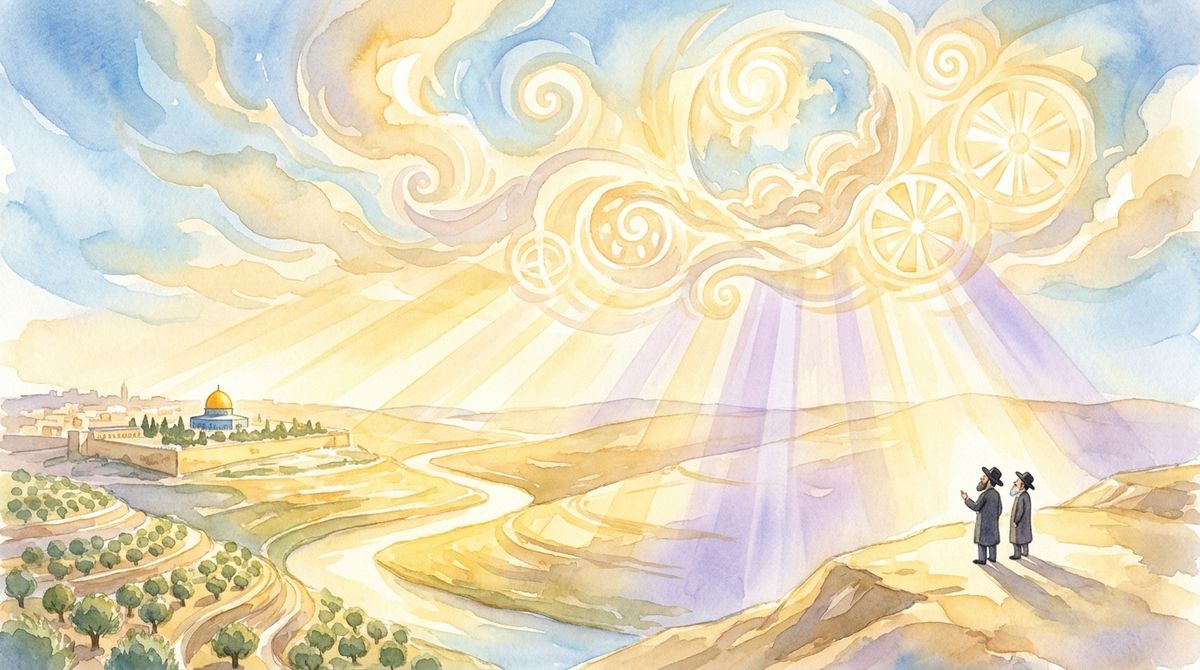
In contrast, when a person merits true self-nullification (bitul), he connects to the tzaddik who is the aspect of the "Gulgalta" (the skull/crown) – the one who turns and leads all the heavenly systems. The Sages of Israel knew how to turn the systems, as Rabbi Yehoshua ben Chananya said to the Emperor: "If you are a god, move the sun for me! Change its course so that it rises in the west and sets in the east." Regarding such a tzaddik, it is said that he can decree:
"Sun, stand still upon Gibeon, and Moon in the valley of Ajalon."
The tzaddik controls the spheres of the firmament. As we saw on the day of the histalkus (passing away) of Rashbi (Rabbi Shimon bar Yochai), the sun did not set until he finished revealing the secrets of the "Idra Zuta," and fire licked the house. The tzaddik is not turned by the systems of nature; rather, he is the wheel that drives them, and through him all the shidduchim (marriage matches), healings, and salvations are drawn down.
These giant souls were not born with a body different from ours. They merited a pure and refined body only through toil, tears, and yearning. Through connecting to the soul of the tzaddik who merited patience (Erech Apayim), we too will merit complete emunah (faith), and the verse "And I will lead you upright" will be fulfilled within us, and we will merit the coming of Mashiach ben David, the building of the Holy Temple, and the resurrection of the dead in the blink of an eye, Amen.
Part 3 of 3 — Lesson No. 141
All parts: Part 1 | Part 2 | Part 3 (Current)
Understanding Erech Apayim: The Power of Divine Patience
To truly grasp the secret that Moshe Rabbeinu sought, we must first understand the literal and spiritual meaning of erech apayim. Translated directly as "slow to anger" or "long-suffering," it is one of the Thirteen Attributes of Mercy revealed to Moshe at Mount Sinai. However, in the teachings of Chassidut, it is not merely a description of Hashem's boundless patience with our shortcomings; it is a profound spiritual vessel that a Jew must actively acquire. When a person embodies erech apayim, he learns to take a "long breath"—to pause, endure difficulties without frustration, and wait patiently for Hashem's salvation rather than demanding immediate results.
מורנו הרב (Rav Berland) frequently emphasizes that acquiring this trait is the ultimate antidote to the klipah of the snake. The snake represents the illusion of instant independence and the immediate gratification of one's desires. In contrast, erech apayim requires absolute bittul (self-nullification). It means recognizing that we are entirely dependent on the Creator and accepting that His timing is perfect. When a person is tested with delays in his livelihood, challenges in his Torah study, or friction with his family, his ability to remain calm and avoid anger is the true measure of his faith.
This aligns perfectly with the teachings of Rebbe Nachman of Breslov, who explains that anger and strictness drive away the Divine Presence, whereas patience draws down infinite compassion. Rabbi Berland teaches that by practicing erech apayim, a person actually gains control over the Heavenly spheres. Instead of reacting with harshness, which awakens strict judgment Above, a person who remains patient and forgiving sweetens the judgments at their root. He mirrors the Creator's own patience, thereby unlocking gates of abundance that were previously sealed.
Ultimately, this is why the tzaddikim dedicate their entire lives to this single trait. They understand that the Geulah (Redemption) cannot unfold through force or frustration, but only through the quiet, enduring strength of a patient heart. By attaching ourselves to the tzaddik and internalizing the attribute of erech apayim, we learn to stand before Hashem not with the arrogance of someone who "has it all figured out," but with the pure, unwavering trust of a child waiting for his Father.
Subscribe to Our Newsletter
Receive Torah articles and inspiration directly in your inbox