The Secret of Guarding in the Street: The Spiritual Battlefield
Shiur No. 273 | Shiur 1 - Motzaei Shabbos Kodesh Parashas Vayeira, Eve of 21 Cheshvan 5761 - Yeshiva Ketana "Ohr Torah"
When a person goes out into the public domain, he must know that he is entering a spiritual battlefield where he must guard himself with utmost vigilance. This article explains the words of the Heichal HaBracha and the Rambam.
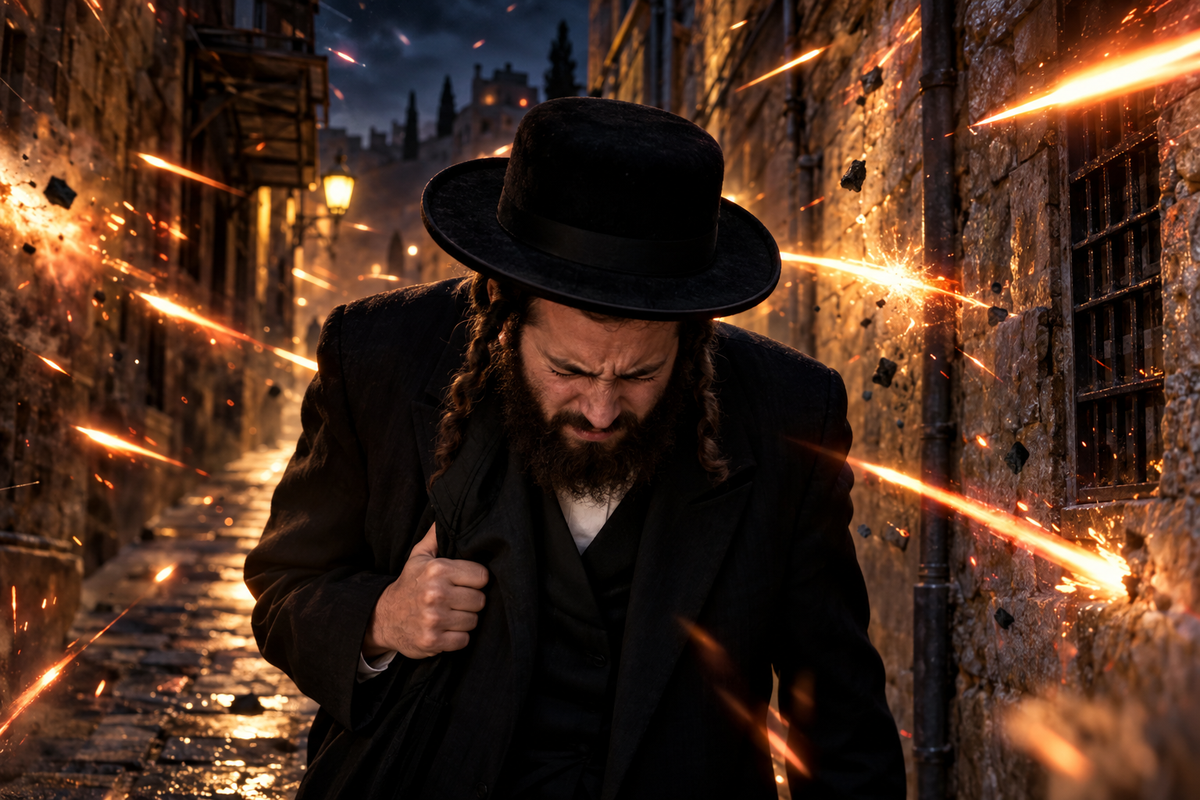
When a person goes out into the street, he needs to bend down and lay flat, because he must know that he is being shot at. A person should not wait for the enemies to shoot at him physically, because by then it will be too late. He needs to feel that at every single moment, he is literally being fired upon.
Just as in a time of danger it is forbidden to stand at the window and look outside because they are shooting into the window, so too, it is impossible to stand and look at the street. The immodesty and forbidden sights in the street—these are the gunshots, these are the shells and cannons of the Yetzer Hara (evil inclination).
The Opposite Spiritual Work: Closing the Eyes
The Heichal HaBracha (at the end of Parashas Miketz) discusses this point. When a person walks in the markets and streets, he often has no choice. He needs to go to the grocery store, to the yeshiva, to the mikvah, or to pray Minchah and Maariv. Hashem created the world in such a way that one must pass through the public domain, through the place of the klipos (spiritual impurities). The goal is to eradicate the klipos, and by a person not looking—he eradicates them.
The Heichal HaBracha explains that when a person walks in the street, he must know that Hashem is found there too, except that there, the spiritual work is the exact opposite. In the yeshiva, a person sees Hashem by opening his eyes—through learning the Gemara, the books of Rebbe Nachman, and the prayers. But when he walks in the street, his spiritual work is to close his eyes. Regarding Avraham Avinu, it is said:
"On the third day, Avraham lifted his eyes."
Only on the third day did Avraham lift his eyes; until then, he did not lift them at all. There is no such thing as looking around in the streets. When a person looks, he sees impurity and immodesty; he is simply burning his own eyes.
The Root of the Troubles: The Sins, Not the Enemies
The street is literal fire. Ultimately, this spiritual fire turns into physical fire. We see apartments burning, bombs exploding, and families being harmed. People flee from place to place, but they discover that there is nowhere to run. One must know that there is nowhere to run, because it is not the enemies who are chasing us—it is the sins! The sins are what bring about the troubles.
Therefore, when a person goes out into the street with no choice, for example, when the evening study sessions end and he returns home, he must be "mighty as a lion," in the words of the Heichal HaBracha. He needs to walk with closed eyes and a bowed head, exactly as if he is being shot at. At the time when he walks in the markets to seek his livelihood, he is obligated to say, "The world was created for me." He cannot exempt himself and say, "What does this have to do with me? Is guarding the eyes really for me?" The Torah explicitly commands:
"And you shall not wander after your hearts and after your eyes."
A Danger Even to the Greatest
The Rambam (in the Laws of Teshuvah) lists twenty-four things that hold back teshuvah (repentance). One of them is a person who belittles the negative commandment of "you shall not wander," who says to himself that it does not apply to him or thinks that it does not harm him. Regarding this, the Sefer HaChinuch says: Do not believe that it does not harm you; it absolutely harms you! The forbidden sights cause damage even to the greatest tzaddikim.
The Gemara in Tractate Kiddushin tells of the Amoraim, Rav and Rabbi Yehudah, who were walking in the street, and illustrates just how great the danger is. Ever since the sin of Adam HaRishon with the Tree of Knowledge, the street has become a place of klipos (spiritual impurities). Were it not for the sin, this would not have happened. A person might think to himself: "I am already a great Rav, I am a Chassid, this will not harm me." But the Gemara teaches us that no person is immune to the spiritual hazards of the street, and caution is required from everyone without exception.
Part 2 of 4 — Shiur No. 273
Subscribe to Our Newsletter
Receive Torah articles and inspiration directly in your inbox