
The Secret of Self-Nullification and the Path of the Shepherds of Israel
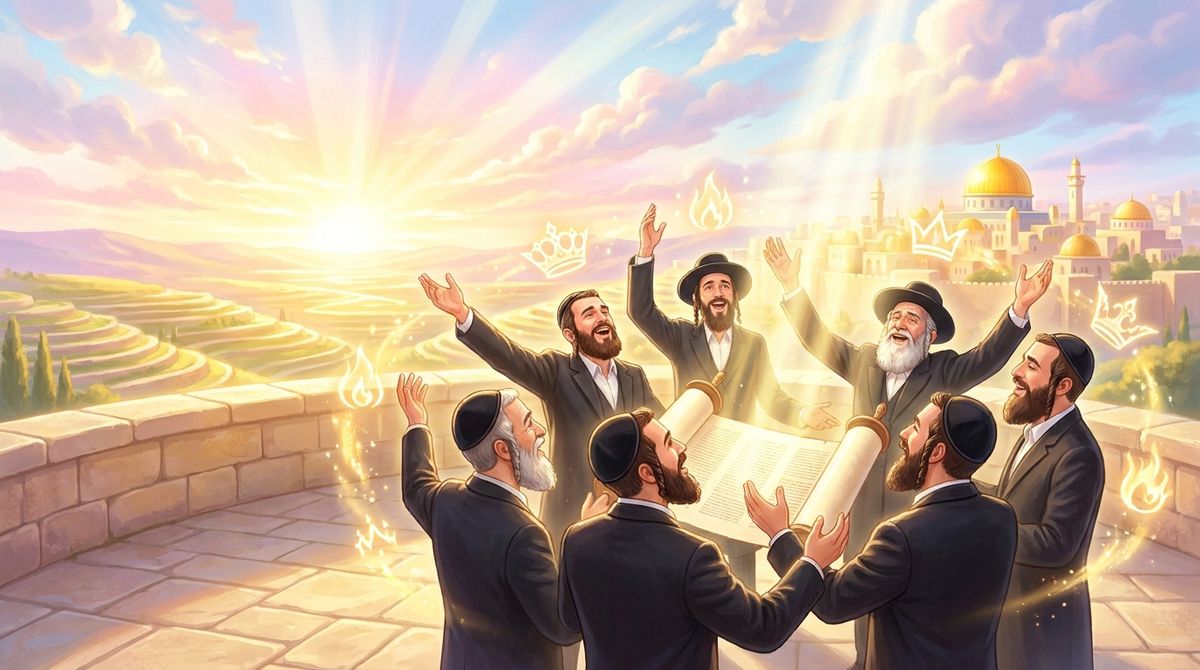
Lesson No. 71 | Yahrtzeit (anniversary of passing) of the Holy Rebbe, Monday, the eve of 18 Tishrei 5757 Continuation of Lesson No. 70 on the yahrtzeit of the Holy Rebbe.
An in-depth article on the character refinement of the true tzaddikim, starting from the ultimate humility and self-nullification of Moshe Rabbeinu and King David, to the mesiras nefesh (self-sacrifice) of the holy Patriarchs. How breaking one's pride, guarding one's eyes, and pure emunah (faith) lead a person to absolute devotion to the Creator.
When people talk about a person day and night and he does not open his mouth to respond, this is the aspect of Mashiach, through which we merit to bring the complete Geulah (Redemption). Who truly knows what a human being is? Yet, through true Hisbodedus (secluded prayer), a person merits true self-nullification and empties his heart to become like nothingness. Rebbe Nachman of Breslov says that a person must believe that he is nothing, that he is truly a zero of zeros. "I am the biggest zero" – and only then does the soul ascend to its root, to the Tree of Life.
To ascend to the root of the soul means to ascend to the Tree of Life, to the Heavenly Jerusalem, and to literally cleave to Him, may He be blessed, in the secret brought down in the Zohar: "He and His vessels are one" in the World of Atzilus (Emanation). In order to merit such true Hisbodedus, where a person is incorporated into the root of his soul, he must reach a state where he knows nothing, sees nothing, and feels nothing—a state where he has completely nullified all pride and all honor.
The Awesome Work of Ultimate Nothingness
Specifically then, when a person feels that he has rectified himself, he is left with an awesome work regarding his pride, because pride can actually increase. A person might think: "I have no desires, I have no blemishes of the covenant, everything is already equal to me," and from this, he can fall into immense pride. Here begins an entirely new work.
Rebbe Nachman says that this is an awesome work – to believe that I am less than every Jew in the world. Even less than a Jew who has not yet merited to guard his eyes, who has not yet merited to guard the covenant, and who has not yet merited all sorts of things that I have already merited. Who says he is not greater than me? Who says he does not work harder than me and have higher spiritual attainments? On the contrary, he is in a state of humility and I am in a state of pride – and for that alone, he is already greater than me. He knows that he is nothing, and I do not know that I am nothing, so he is certainly greater than me.
The entire spiritual work of the holidays of Tishrei is to reveal the true tzaddik who is completely in the aspect of "ayin" (nothingness). A tzaddik whose entire life was an aspect of nothingness, and who merited the ultimate nothingness because he believed that every Jew was better than him. Regarding Moshe Rabbeinu it is said: "Now the man Moshe was exceedingly humble, more than any person on the face of the earth." He never had any strictness, anger, or wrath toward any Jew. When it is written "And Moshe was very distressed" during the dispute of Korach, the meaning is not that he was angry at Korach himself, but rather it distressed and pained him that Korach was descending to Gehenna.
Imagine a person standing in prayer facing the Western Wall, facing the Gate of Heaven and the Holy of Holies, and one day they throw him out of there, they throw him out of Jerusalem. This is a terrible sorrow and a cause for great weeping! It is like a person who stood next to a box full of diamonds and was thrown away from there. The diamonds remained; thank Hashem we have the diamonds, but we cry for the other person who lost them. It breaks the heart to see how the effort a person invests over many years goes down the drain because of a single dispute, and suddenly he descends to the lowest depths. Regarding such spiritual work and levels, the Talmud says: "Woe for such beauty that is swallowed in the earth."
A Basket of Reptiles: The Secret of King David
The true tzaddik merited perfect humility. He never held any strictness against anyone in the world, and he never thought he was better than anyone else. Even though he performed all the spiritual devotions, he never had a passing thought that he was superior. He says to himself: "I was born to good parents, I was born with a good nature, and therefore I merited what I merited."
King Saul was the holy of holies, from the tribe of Binyamin, the son of Kish – all of them great tzaddikim. Regarding him it is said: "Saul was a year old when he began to reign," meaning he was as free from sin as a one-year-old. In contrast, where did King David come from? From Ruth the Moabite, from Moab, from Balak. Ruth converted, and in the merit of her mesiras nefesh (self-sacrifice), she merited to establish the lineage of King David. The self-sacrifice of a convert sometimes earns them more than what the most righteous Jew in the world merits.
Every person is born with different starting conditions: one is born with a certain nature and another with a different nature, one with a certain heart and another with a different heart. Specifically the one who is born with the worst heart will ultimately merit the highest levels. Our Sages say: "We do not appoint a leader over the community unless a basket of reptiles hangs behind him" (meaning he has a lowly background to keep him humble). King David, who is the aspect of Mashiach, is the tzaddik who constantly sees a "basket of reptiles" behind him. He does not see his own virtues, he does not see his spiritual levels, and he does not feel that he has merited anything. He only sees his flaws. Through this humility, he merits to be King David and the true tzaddik.
Avraham Avinu: Breaking the Idols and Illuminating the World
The path to reaching these levels of humility and self-nullification passes through the character refinement of the holy Patriarchs – the seven Ushpizin (supernal guests of Sukkos). Each of us must strive to see the Ushpizin, just as the great tzaddikim merited. The Vilna Gaon related that on the third day of Sukkos, he saw Yaakov Avinu in the sukkah and received a kiss from him. Who can merit to see them? Only one who merits to be like them, for the entire world and all generations until the coming of Mashiach stand upon them.
Therefore, in the Shemoneh Esrei prayer, it is an obligation to say "God of Avraham, God of Yitzchak, and God of Yaakov" with deep intention. If a person does not pray in their merit, his prayer does not ascend on high. Avraham Avinu is the pillar of loving-kindness. Even as a child, he broke his father's idols and was thrown into the fiery furnace. Whoever breaks all the idols and all the nonsense of this world breaks terrible kelipos (spiritual impurities), and they merit to have all the secrets in the world revealed to him. Avraham recognized his Creator at the age of three, because a person's soul tells him everything, and Hashem speaks with everyone, guiding them to distance themselves from spiritual poison.
Avraham would pray for the entire world. In the merit of his prayer, no ship would sink at sea. He even prayed for the non-Jews to live, as we say: "Who is like You, merciful Father, who remembers His creatures for life in mercy." To be a man of loving-kindness like Avraham, one must study a great deal of Torah. Avraham possessed Chochmah, Binah, and Daas (Wisdom, Understanding, and Knowledge), and from this, he reached immense loving-kindness.
When Hashem took the sun out of its sheath (making it intensely hot) so that Avraham would not be bothered by guests, Avraham was unable to rest. He could not eat or drink alone. He sent his servant Eliezer to look for guests in the terrible heat, and when Eliezer returned empty-handed, Avraham told him that there is no faith in slaves and went out himself into the blazing heat. When Hashem saw that Avraham would not give up, He sent down angels in the form of men from heaven. Even when he was wounded and suffering terrible agony on the third day of his circumcision, he ran over the mountains to look for guests.
Yitzchak and Yaakov: Holiness of the Eyes and Faith Above Nature
Yitzchak Avinu symbolizes guarding the eyes. It is said of him: "And his eyes became dim from seeing." From the day he was born, he guarded his eyes and did not look at the vanities of this world, until his eyes went blind. He knew that this world is nothing, and there is nothing to look at in the streets. King David prayed: "Avert my eyes from seeing vanity." It is better for a person to be like a blind man and not see forbidden things, because if a person opens his eyes to forbidden sights, his entire Torah loses its value.
It is told of Rabbi Tzvi Harker, who was one of the leading tzaddikim in Tiberias and a student of Rabbi Menachem Mendel of Vitebsk. Once, he arrived at a hotel and saw a slight lack of modesty—a sleeve that was rolled up slightly—and immediately began to vomit out of sheer disgust. When asked where he learned this, he replied that he learned it from his Rebbe, who would teach his students that if one sees, Heaven forbid, an immodest sight, they must feel actual physical disgust. This was the trait of Yitzchak Avinu (our Patriarch Isaac).
Yaakov Avinu (our Patriarch Jacob) teaches us the power of emunah (faith) in the face of deceit. Lavan the Aramean deceived him time and time again. Yaakov worked for him for twenty years, and Lavan changed his wages "ten times"—countless times. Every time Lavan saw that the flock was about to give birth according to the signs Yaakov had set, he rushed to change the agreement. But Yaakov said, "I do not care what you want to change; I walk with Hashem." And indeed, the angels ensured that the flock would be born exactly according to the newly established sign.
Yaakov allowed himself to be deceived and laughed at. He experienced "stolen by day and stolen by night," yet he never lacked sheep. He knew that for every beast of prey—a lion, wolf, or leopard—Hashem appoints its food and determines from which flock it will eat. Everything is overseen with precise Divine Providence, and whoever walks in pure faith with Hashem will never lose.
Part 3 of 4 — Lesson No. 71
Subscribe to Our Newsletter
Receive Torah articles and inspiration directly in your inbox