The Secret of the Chalakah: The Virtue of the Peyos and Entering the World of Torah
Wednesday, Parashas Bamidbar, 1 Sivan 5761, Chumash Party at the Talmud Torah
An article explaining the spiritual depth of the custom of the Chalakah (first haircut) and leaving the peyos (sidelocks) for a three-year-old boy. The Rav explains how this day is considered a personal Mount Sinai experience, the immense importance of guarding the child's eyes on this day, and the Kabbalistic secrets hidden within the peyos that connect the child to the supernal worlds.
When a child begins to learn Torah, we start him with the Book of Vayikra (Leviticus), the laws of the Kohanim (priests), with the miniature letter Aleph. We make a seudah (festive meal) of joy for him, and this is considered as if he is being brought before Mount Sinai. The Torah says that the words of Torah must be in our eyes every day as if they are brand new, as if they were given today. Therefore, we feed the child fruits and various delicacies, in memory of the delights with which the Jewish people were pampered in the desert. All this sweetness is a remembrance of the Manna, the quail, and the Well of Miriam. Everything eaten on the day of the Chalakah is like the honey that flowed from the rock, fulfilling the verse, "Honey and milk are under your tongue."
The reason we begin teaching young children specifically from the Book of Vayikra is because Hashem said:
"Let the pure ones come and engage in matters of purity."
A child at this age is pure and holy; his soul comes from the World of Atzilus (the highest supernal world of Divine Emanation). Bringing him into the study of Torah is considered as if a sacrifice was just offered in the Holy of Holies in the Holy Temple.
As If Given Today: The Child's Mount Sinai Experience
There is a custom to seek out a Torah scholar to lead the child to school, because at the Giving of the Torah, Hashem sought out Moshe Rabbeinu, who was a very great and humble man. The main essence of Torah study is humility and lowliness, because the entire essence of Moshe Rabbeinu's spiritual level is humility.
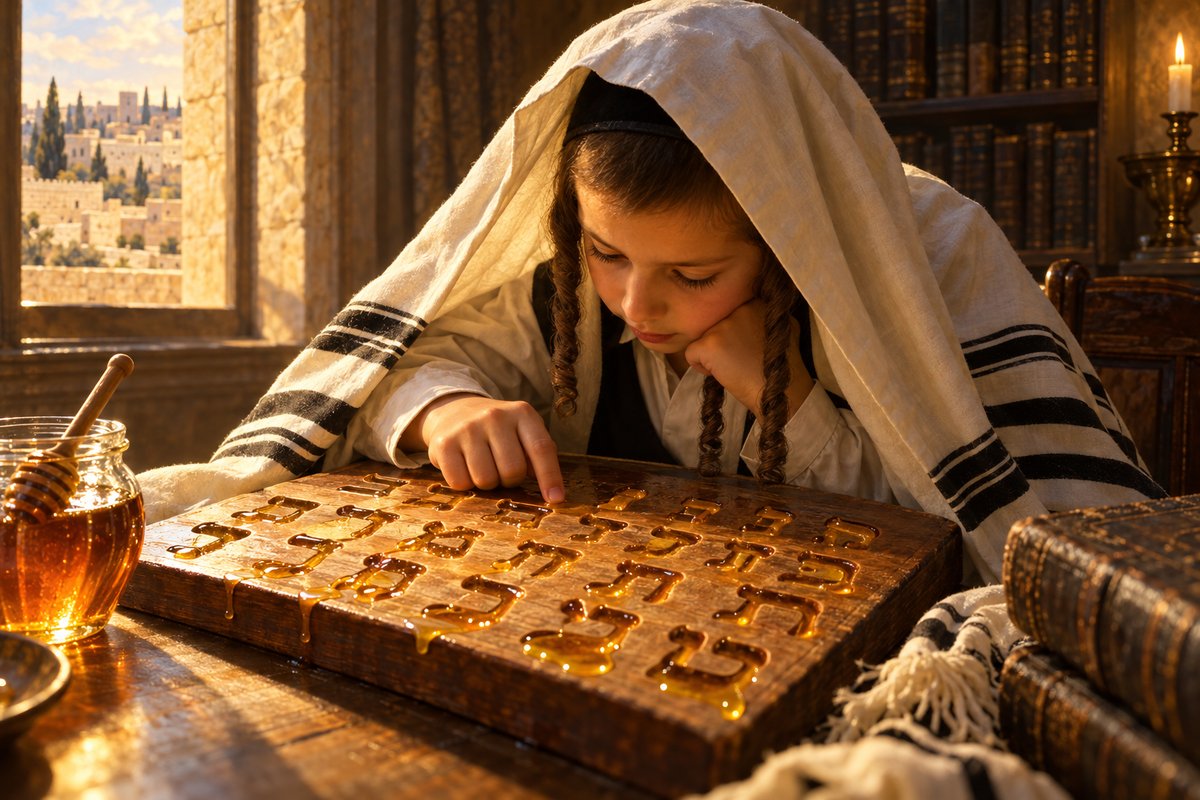
In order to educate the child in Torah out of humility and modesty, we cover him under the corners of the tallis (prayer shawl). The child must always be covered under the tallis, because the Torah brings one to humility and modesty, as it is stated:
"And so that His fear may be upon your faces, so that you do not sin."
The goal is for him to have awe and a sense of holy shame so that the Torah will be sustained within him. There were places where the children were wrapped in a tallis for twenty-four hours, so that this holiness would take hold of them for their entire lives.
Additionally, we cover the letters with honey and let the child lick them, so that the words of Torah will be sweeter than honey in his mouth. We are careful that only males knead the challahs for the Chalakah. We give the child a small tap with a strap, in memory of what is written at the Giving of the Torah, "And you shall be to Me a kingdom of priests," and through this, he fulfills his obligation for all future punishments and will not need to receive any more punishment, but only to receive reward, fulfilling the concept of "He who sacrifices to any god shall be utterly destroyed, save to Hashem alone."
We accustom the young children to sway their bodies while studying Torah. A Jew always sways when he learns, because he has a soul, as it is written regarding the Mount Sinai experience:
"And the people saw and they trembled (swayed)."
King David said, "Serve Hashem with awe," and our Sages expounded on the verse, "His lips are like roses (shoshanim), dripping with flowing myrrh" – do not read it as "roses" (shoshanim) but as "rejoicing" (sesonim). "Flowing myrrh" (mor over) hints at the fear and awe (mora) with which one must stand before the Rav. The day a person brings his son into the Talmud Torah is before Hashem exactly like the Giving of the Torah. They are standing literally at Mount Sinai and there is a revelation of Godliness.
The Custom of the Elders of Jerusalem and the Power of the Voice of Yaakov
The custom of the Chalakah and bringing the child into the Cheder (Torah school) is an ancient custom. They already wrote about it eight hundred years ago, and this is how they practiced in Jerusalem even in the days of the First and Second Holy Temples. They would go up to Jerusalem and bring the child to all the great sages. Every elder and great Torah scholar in the city would bless the child that he should merit Torah, the marriage canopy, and good deeds. Even a great man would stand up from his place before someone greater than him, bowing before him so that he would pray on behalf of the child.
In the book Kav HaYashar, it is brought down that when a mother goes with her child to the melamed (Torah teacher), she must know that she is going to the house of the Shechinah (Divine Presence). When they come with the child to do the Chalakah, the holy Shechinah enters. If a person is holy and pure, the Torah strengthens him. Only with the voice of Yaakov from these young children is it possible to nullify all harsh decrees and subdue all enemies. When we see troubles, there is no other advice besides the voice of Torah from the tinokos shel beis rabban (young schoolchildren).
Humility, Purity, and Guarding the Eyes
There is tremendous meticulousness on this day. The first time the father takes the child out to the street, they must cover him. This is how the Jewish people have practiced for thousands of years. The street is the public domain, and that is where all the kelipos (spiritual impurities) from the sin of Adam HaRishon are found. Therefore, for twenty-four hours from this moment, the child must be covered so that he does not see anything impure.
If he does not see anything impure on this day, he will be holy for his entire life. At the age of three, the Sitra Achra (the Other Side) intensifies in order to cause the child to stumble, but by covering him and guarding him on that day, he is protected for his entire life and the Shechinah (Divine Presence) will always shelter him. Care is also taken that on that day no strange woman touches him.
There is a custom brought down in the holy books that the father and mother of the child fast on this day, so that the child will grow up in Torah and good deeds. Towards evening, after the fast, they make a seudah (festive meal) for the poor according to their means. A house where Torah is studied will be a great house in the World to Come.
The Secret of the Peyos: Ascending to Atika Kadisha
When we perform the chalakah (first haircut) and leave the peyos (sidelocks), we ascend to the highest supernal worlds. When we reveal the peyos, we simply ascend to Atika Kadisha (the Holy Ancient One). The peyos allude to the Name of Hashem of the Thirteen Attributes of Mercy. In the Siddur of the Arizal zt"l, there is a special illustration directed toward the peyos, which explains the intention of the study and the secret of Atzilus (the World of Emanation).
The peah is the conclusion of the forehead, and it symbolizes the sefirah of Malchus (Kingship) of the skull. In gematria (numerical value), the word 'peah' equals 86, which is the number of the Name 'Elokim', representing the sefirah of Malchus. However, since we are now ascending to the world of 'Arich Anpin' (the Divine countenance of infinite mercy) – a world where there are no harsh judgments at all – the Name of Hashem transforms through the Atbash cipher into the Name Matzpatz (מצפ"ץ).
The Name Matzpatz has a gematria of 300 (Mem=40, Tzadi=90, Peh=80, Tzadi=90). This number is exactly equal to the Name 'Elokim' in its expanded spelling with Yuds (Aleph-Lamed-Peh, Lamed-Mem-Daled, Hei-Yud, Yud-Vav-Daled, Mem-Mem), which also equals 300.
The letters Mem and Tzadi of the Name Matzpatz together equal 130, which is 13 times 10. This number alludes to the 13 Tikkunei Dikna (the Thirteen Attributes of Mercy of the Holy Beard) that emerge from Kesser (Crown) and Chochmah (Wisdom). The peah includes within it all 13 of these rectifications. Even though a beard (dikna) only begins to grow at the age of Bar Mitzvah, the peah is greater and already includes the entire 'Dikna Kadisha' (Holy Beard).
By cutting the hair and leaving the peyos, the child takes upon himself all of this immense holiness, and connects to the highest supernal worlds of mercy and loving-kindness.
Subscribe to Our Newsletter
Receive Torah articles and inspiration directly in your inbox