The Depth of the Mitzvah of Honoring Parents and the Secret of Protecting Jewish Children
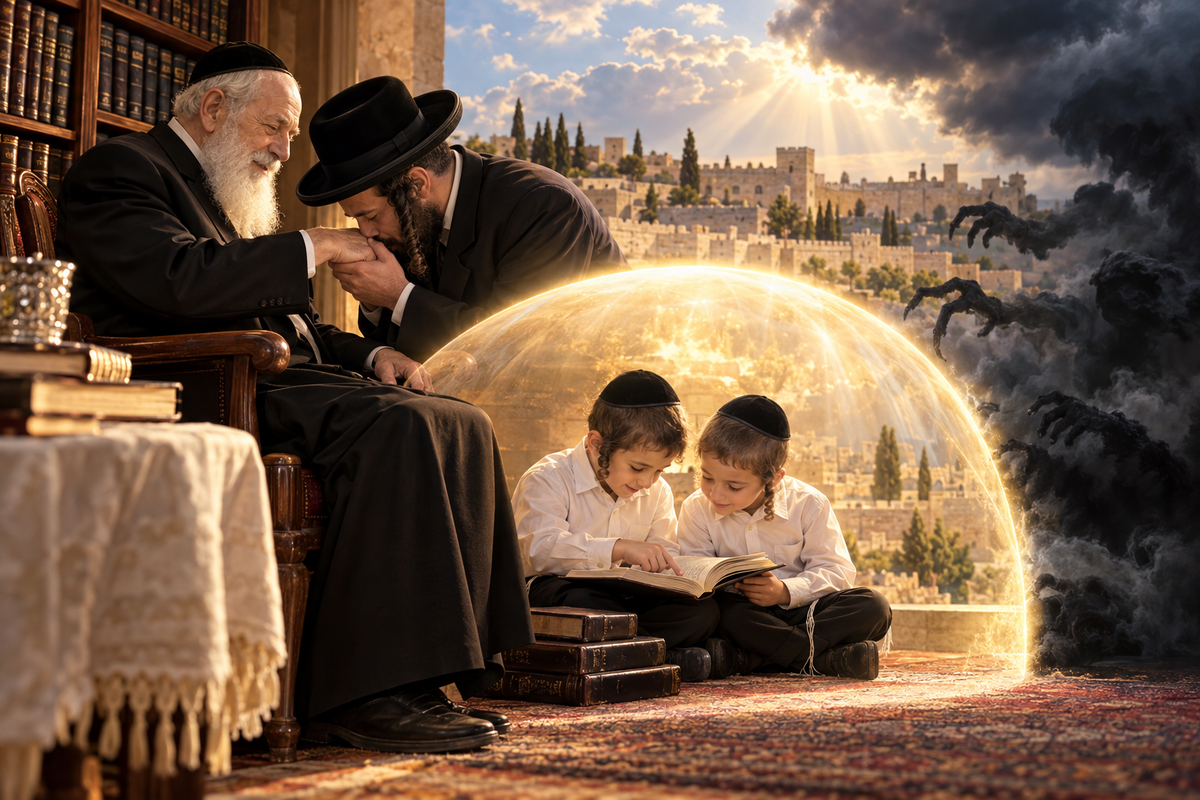
Tuesday night, the eve of the 2nd of Teves, the eighth candle of Chanukah 5758 - A class for the "Yeshivas Erev" and "Kruvei HaNachal" groups.
An article explaining the importance of guarding children's eyes from a young age and the spiritual remedy of wrapping them in a tallis (prayer shawl). Through the story of Avraham Avinu (our Patriarch) and his confrontation with Terach and Nimrod, the depth of the mitzvah of honoring one's father and mother is revealed, along with its connection to the Ten Commandments.
The primary power of the evil kingdom stems from the shattering of the vessels (a Kabbalistic concept referring to the primordial spiritual collapse), and from there they draw their main sustenance. Therefore, from a very young age—at three, four, or five years old—a child must begin to overcome evil desires. A child must guard his eyes, not gaze into the streets, and not look at anything impure. The moment one opens their eyes and sees something impure in the street, the Sitra Achra (the Other Side, forces of impurity) immediately gains strength.
For this reason, when making a "chalakah" (first haircut) for a child, we cover him with a tallis. In truth, a person should walk under a tallis for all one hundred and twenty years of his life, in order to be protected from the evil desires through which the forces of impurity try to overpower the Jewish people. The sefer "Kol Bo" states that we cover the child with a tallis so that he may merit the humility of Moshe Rabbeinu. A person must be humble and lowly, always hiding under the tallis, never acting with arrogance or slandering others. The wicked Haman and Antiochus exist in every single generation; although their bodies were destroyed, their souls return and attempt to abolish the Jewish people's service of Hashem. The protection against them is through the trait of humility and nullification to the tzaddik.
Please forgive the iniquity of this nation
The days of Chanukah are capable of bringing about atonement just like Yom Kippur. On Yom Kippur, we pray:
"Please forgive the iniquity of this nation in accordance with the greatness of Your lovingkindness, and just as You have forgiven this nation from Egypt until now."
There is a hint to Chanukah in this verse: The words "hazeh Hashem" (this nation, Hashem) have the numerical value (gematria) of 17, "k'godel chasdecha" (in accordance with the greatness of Your lovingkindness) hints to 28, and "ka'asher nasata" (just as You have forgiven) hints to the letters Vav and Nun—forming the acronym for Chanukah. Already on Yom Kippur, we pray for the spiritual illumination of Chanukah, because we are all in need of forgiveness and atonement.
We are all reincarnated souls, and sometimes we carry blemishes from previous lifetimes. The sefer "Megaleh Amukos" explains that Moshe Rabbeinu asked Hashem for suffering like that of Iyov (Job) in order to atone for his blemishes. On the verse, "And I pleaded with Hashem at that time, saying," the "Megaleh Amukos" explains that Moshe begged to receive suffering, since there is no person who does not have sins or blemishes. However, Hashem replied to him, "Are you Iyov?" Iyov was actually a reincarnation of Terach, the father of Avraham, who had angered Hashem.
The self-sacrifice of Avraham Avinu
Terach infuriated and angered Hashem, to the point that he handed his own son, Avraham Avinu, over to the fiery furnace. When Avraham was a child, he smashed all of his father's idols. When Terach asked him who did this, Avraham placed the stick in the hand of the largest idol and said, "The idols fought with each other, and the largest idol killed them." Terach became angry and said, "Can idols move or kill?" Avraham replied to him:
"They have hands but cannot feel, feet but cannot walk"—and you still bow down to them?
Terach was furious at his son's audacity and argued with him: "Where is your honoring of your father and mother? Is this how the Torah taught you to be insolent to your father?" He took Avraham to the wicked Nimrod so that he would judge him for failing to fulfill the mitzvah of honoring his father and mother, as this is one of the Ten Commandments. Nimrod ruled that a wicked child who does not listen to his parents is condemned to be thrown into the fiery furnace. They lit a massive bonfire for three days to cause him the greatest possible suffering, solely on the claim that he was being "insolent" to his father and mother.
The hardest and greatest mitzvah
From here we learn just how great the mitzvah of honoring one's father and mother is. It is brought down in "Tanna D'Vei Eliyahu" that this is the most difficult mitzvah in the world. To listen to the voice of one's father and mother, and especially to the voice of a mother who constantly asks, "Do this, wash the dishes, wash the floor, help the little children"—this requires tremendous self-nullification. However, precisely because it is the hardest mitzvah, its reward is also the greatest in the world.
This is the reason why the mitzvah of honoring one's father and mother is juxtaposed in the Ten Commandments to the most severe prohibitions: "You shall not murder," "You shall not commit adultery," and "You shall not steal." If a person does not honor his parents, it is as if he is stealing from them. Your parents feed you, give you to drink, sit by your bed day and night when you are sick, run with you to hospitals, and lose sleep at night for you. If, after all this, you do not listen to them, you are transgressing "You shall not steal."
Furthermore, the "Tanna D'Vei Eliyahu" says that when you cause them sorrow and do not listen to them, you transgress "You shall not murder." A mother experiences terrible suffering when she is not listened to, and it is as if you have murdered her. Therefore, the Torah placed honoring one's father and mother next to "You shall not murder," to teach you that even a small child who already understands a little, if he does not listen to his mother—whether she asks him to eat, drink, or wear a sweater when it is cold—he is considered, Heaven forbid, like a murderer before Hashem.
When parents provide a child with all his needs, buy him the most beautiful clothes, and care for him with devotion, the child's obligation is to run and do their will. He must come home and immediately ask, "Mother, what needs to be done?" and not wait to be asked. This is the essence of the mitzvah, and through it, a person builds his holiness and purity.
Part 1 of 4
Subscribe to Our Newsletter
Receive Torah articles and inspiration directly in your inbox