
The Secret of the Dust of the Mishkan: The Power of Humiliation to Recreate a Person Anew
Shiur No. 15 | Shiur 1 - Sunday Morning, Parashas Nasso, 28 Iyar 5755 - At the Yeshiva (Continued from No. 14)
The portion of the Sotah (the suspected adulteress) conceals within it a tremendous secret regarding the power of bizyonos (humiliation). When a person transforms himself into dust and ashes, he merits to be recreated anew from the dust of the Even HaShetiyah (the Foundation Stone of the world) and to ascend to the highest spiritual levels.
Every day, as the day comes to a close, a person must engage in cheshbon hanefesh (spiritual accounting) and shed a river of tears: "I did not learn enough, I did not pray properly, I did not study Shivchei HaRan, Sefer HaMidos, Sfas Emes, or Gemara Tractate Sotah."
We must study all the Gemaras and Midrashim in order to understand, for example, what the portion of the Sotah is truly about. It speaks of a woman who, in truth, did not sin. Although she is somewhat at fault for not listening to her husband and causing him to become strict and resentful, through the terrible bizyonos (humiliation) she endures, she attains tremendous spiritual heights. After such humiliation, one merits indescribable levels, to the point that she merits to reach the level of Avraham Avinu and give birth to a son like him.
The Power of Humiliation
The Sfas Emes on Parashas Nasso explains the ultimate purpose of a person and how a Jew should conduct himself. Every Jew descends into this world in order to rectify the entire creation, and the way to accomplish this is specifically through bizyonos (humiliation). When a person becomes like dust and ashes, only then can he produce fruit.
Regarding the Children of Israel, it is stated:
"And you shall be a land of delight."
All the promises given to Avraham Avinu were given to the Children of Israel: "And your offspring shall be as the dust of the earth." The rule is simple: If there is no dust, there is no grain. The entire spiritual work of a person in this world is simply to become dust. Therefore, we ask at the end of the Shemoneh Esrei prayer: "And let my soul be as dust to all." It is not enough to recite this request merely three times a day; rather, one must repeat it constantly, every five minutes: "And let my soul be as dust to all."
The summary of the words of the Sfas Emes is that the Jewish people are called "Adam" (Man), but when do they merit this title? Only when they are in the state of dust and ashes. This is the role of man, and this is the way to rectify the entire creation. Whoever merits to be dust and ashes protects the entire world and saves it from every harsh decree. Whoever is dust and ashes guards the trait of Yesod (the foundation of purity), and in his merit, no country will perish.
To Be Recreated Anew from the Dust of the Foundation Stone
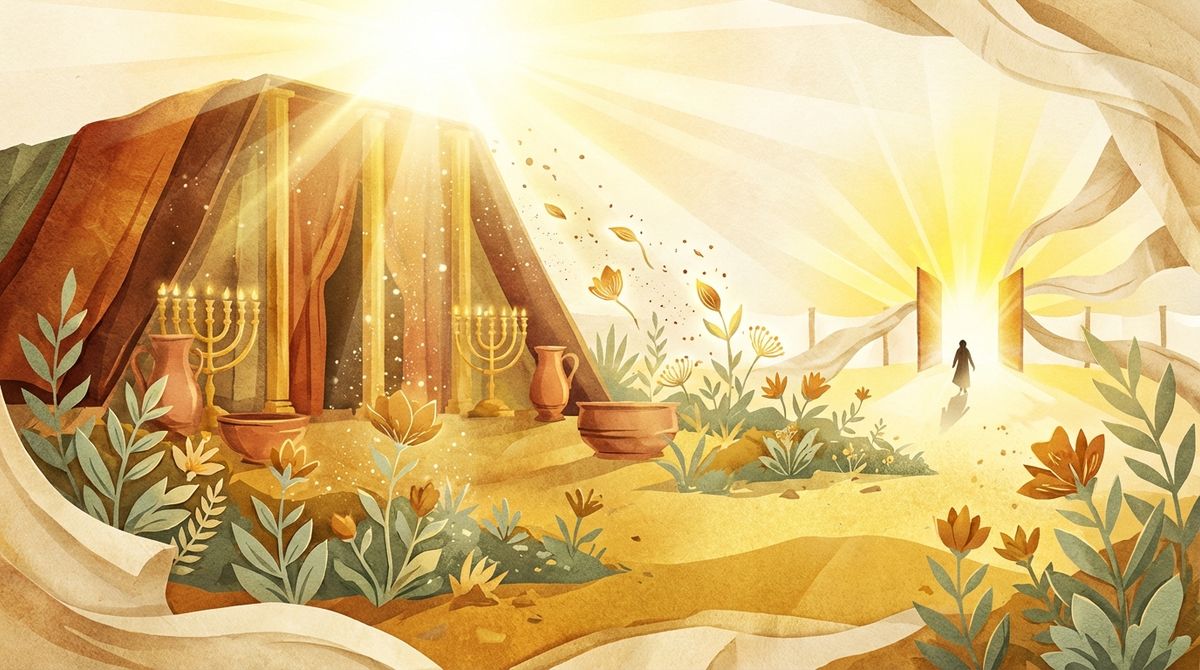
Only one who is like dust can guard his Yesod (personal purity). For this reason, in the purification process of the Sotah, they specifically take from the dust of the Mishkan (Tabernacle). The dust of the Temple Mount and the Holy Temple is not ordinary dust; rather, it is dust from before the existence of creation, the very dust from which Adam HaRishon (the First Man) was formed—the dust of the Even HaShetiyah (Foundation Stone).
When they give the Sotah to drink from the water mixed with this dust, they are essentially telling her: "Now you are going to be recreated anew." True, she acted improperly; she did not listen to her husband and caused him to become angry. Even if everything was entirely innocent and pure, a woman should have compassion on her husband and not provoke him. However, since she has endured this entire ordeal of bizyonos (humiliation), she now merits to be recreated anew.
Imagine to yourselves: Who in the generation merits to drink from the dust of the Temple Mount? Who merits to place the dust of the Holy of Holies into their mouth? Yet here, they give her the greatest privilege there is. They lift the marble slab in the Heichal (Sanctuary), and they take dust from right inside the Heichal.
"And the Kohen shall take holy water in an earthen vessel, and of the dust that is on the floor of the Mishkan the Kohen shall take, and put it into the water."
From this dust, from which the entire creation was formed, they are now recreating her completely anew and transforming her into a completely righteous woman. Through this process, she ascends to the level of Avraham Avinu, literally to the root of creation.
She ascends from the World of Asiyah (Action) to the World of Yetzirah (Formation), and she merits to become a part of the Holy Temple herself. She becomes the Holy Temple itself, and she has the power to atone for all the sins of the Jewish people. May we merit, in this merit, the complete Geulah (Redemption) speedily in our days, Amen.
Part 1 of 4 — Shiur No. 15
Subscribe to Our Newsletter
Receive Torah articles and inspiration directly in your inbox