The Secret of the Eternal Spark: The Power of the Chanukah Candle to Illuminate the Greatest Darkness
Tuesday, Parashas Miketz, 26 Kislev 5766 - General Class
A fascinating article on the power of the days of Chanukah to draw down salvations, heal illnesses, and open all the gates. Through the deeply moving stories of Yakum Ish Tzroros and Yosi Meshisa, it is revealed how the Jewish spark is never extinguished, and how it has the power to awaken in a single moment of teshuvah (repentance) and mesirus nefesh (self-sacrifice).
Rebbe Nachman of Breslov delivered the Torah lesson on Chanukah (Likutey Moharan, Part II, Torah 3) a year before his histalkus (passing away). The central verse there is: "For He who has compassion on them will guide them." The Rebbe revealed that with this Torah, one can draw down all salvations. Whoever needs parnassah (livelihood), children, or healing from illnesses—can be healed through this Torah. The eight Chanukah candles are capable of healing all illnesses, and wherever a person goes, all the gates will open for him. This is the Torah that opens all the gates in the world.
A Time for the Atonement of Sins and the Downfall of the Wicked
On Chanukah, one can merit to see the Throne of Glory, to merit a shidduch (marriage match), and to build the Holy Temple. If we were pure, the Holy Temple would already be built on the eighth candle. On Chanukah, all sins are atoned for, as it is stated: "Please forgive the iniquity of this people according to the greatness of Your lovingkindness." One can merit righteous children and be freed from all the judgments in the world; the case files vanish, and the judges are struck with blindness.
All concealments are erased, and the wicked, such as Antiochus, fall into the great abyss without any revival. The Sitra Achra (Other Side) receives its power from the blemish of the tzaddik, and thus Hitlers, Antiochuses, and Hamans arise in every generation. It is the exact same soul that reincarnates from generation to generation, like the soul of Sisera. However, Chanukah is the time when all the kelipos (spiritual husks) and all the Hamans and Hitlers are burned away.
The entire spirit of life that a person breathes, his thoughts, and his words—everything comes from the tzaddik who breathes the breath of life into him. On Chanukah, this spirit of life is renewed every single second, exactly as the Hasmoneans received a new spirit of life to defeat the Greeks after a century of despair.
Two Words That Awaken the Soul
During the era of the Hellenists, they executed Yosi ben Yoezer of Tzreidah, who was the first of the Zugos (Pairs of Sages). They crucified him with terrible tortures. His nephew, Yakum Ish Tzroros, who was in charge of the execution and had informed on him, rode on a horse on Shabbos and taunted him moments before the hanging. He said to him: "Look how much Hashem loves me, how wealthy I am, I have a house of gold and a decorated white horse. And look what kind of horse Hashem prepared for you—the crucifixion pillar."
Yosi ben Yoezer answered him with a single sentence, a simple kal v'chomer (a fortiori argument): "If it is so for those who transgress His will, how much more so for those who perform His will." He was telling him: Make a quick calculation, what kind of horse is prepared for you? You committed all the sins, you converted and Hellenized, so what kind of horse is prepared for you? These two words, which emerged from the mouth of a true tzaddik completely clean of any blemish, penetrated his heart. It is impossible to know when a person will catch himself, but with two simple words, one can awaken the most wicked and apostate person in the world.
Yakum Ish Tzroros caught himself, ran home at top speed, and carried out upon himself the four death penalties of the Beis Din (stoning, burning, decapitation, and strangulation) out of profound teshuvah (repentance). Yosi ben Yoezer, who was dozing at that time and saw everything through Ruach HaKodesh (Divine Inspiration), began to smile. When his students asked him why he was beaming with pleasure a moment before his crucifixion, he answered them: "That nephew of mine, for whom I have only been crying day and night since the day he apostatized—behold, the gates of Gan Eden (the Garden of Eden) are now opening for him. In a brief moment, he has preceded me into the life of the World to Come."
The Secret of the Menorah and the Spark of Yosi Meshisa
With a Jew, one never knows when the Godly spark, hidden beneath billions of concealments, will awaken. There is absolutely no despair regarding any Jew in the world. So it was with Yosi Meshisa, who joined the Romans. When they entered to destroy the Holy Temple, the Romans were afraid to enter the Holy of Holies lest they be burned. They said to Yosi Meshisa: "You go in, and whatever you take out first will be yours." He went in and brought out a golden Menorah.
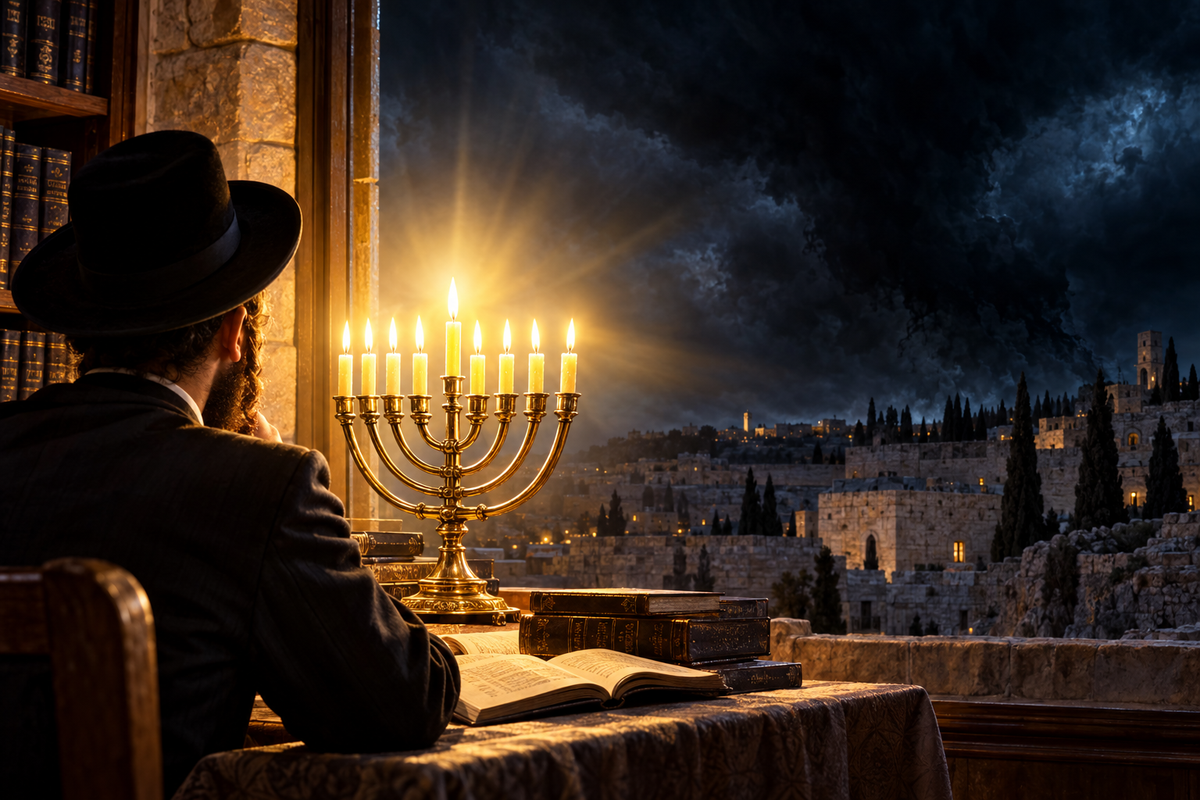
When the Romans told him that the Menorah was too valuable and that he should go in again to take something else, the spark suddenly ignited within him. The moment he held the Menorah, which is entirely light, the Jewish spark was kindled in him. When we light the Chanukah menorah, we are lighting the Menorah of the Holy Temple. We sing, "Maoz Tzur Yeshuasi, Lecha Na'eh Leshabe'ach" (O Mighty Stronghold of my salvation, to You it is fitting to give praise). The word "Na'eh" (fitting) has the gematria (numerical value) of fifty-six. In the future to come, when the Holy Temple is built, we will light fifty-six candles, and this is the secret of the verse, "And the night will shine like the day (kayom)," because the word "Yom" (day) has the gematria of fifty-six. Today we light thirty-six candles, because we proceed slowly, step by step, but it was the light of the Menorah that ignited the spark in Yosi Meshisa.
He adamantly refused to go back inside and said: "You will not get the Menorah under any circumstances! You can cut me into pieces, but I am returning to Judaism." The Romans placed him in a carpenter's vise and began to saw him. Amidst the agony, he only cried out from the sheer delight of teshuvah (repentance): "Woe to me that I angered my Creator!" He felt immense delight from the very knowledge that the Jewish people are eternal and Hashem is eternal.
Chanukah arrives, and the entire Jewish people awaken. There is no Jew who does not light a Chanukah menorah. We take all the lights of mesirus nefesh (self-sacrifice) and place them into a small candle. The Chanukah menorah is the light that awakens all the baalei teshuvah (returnees to the faith), reminding us that even from the darkest situations, the Jewish spark always remains whole and can illuminate the entire world.
Part 1 of 5
All parts: Part 1 (Current) | Part 2 | Part 3 | Part 4 | Part 5
Subscribe to Our Newsletter
Receive Torah articles and inspiration directly in your inbox