The Secret of the Fire and the Flame: The Power of Studying Gemara and Holy Practices
Lesson No. 17 | Friday, Parshas Nasso, 4 Sivan 5755 - Morning class in the Yeshiva
A profound discourse explaining how studying Gemara and avoiding jealousy protect a person, and why it is impossible to merit a true burning passion for Hashem without filling the mind with Torah. Through stories of tzaddikim and holy practices, the secret of mesirus nefesh (self-sacrifice) and spiritual protection is illuminated.
A person must record all of his sins, every single day until the end of his life, to cry and express remorse over them, and all the more so if he has hurt a friend. He should write down in a notebook his Torah insights, his transgressions, and the novel Torah concepts that he hears.
The Secret of the Bones That Do Not Decay
The Gemara in Tractate Shabbos relates a story about Rav Acha bar Yoshiya. When workers were digging in the courtyard of Rav Nachman, they suddenly discovered a man buried in the earth. The man began to shout, "Stop digging! What do you want, to kill me? This is a matter of pikuach nefesh (saving a life)!" The people were terrified and ran to Rav Nachman, thinking they might have encountered a demon. Rav Nachman went there himself and asked the figure, "Who are you?" He replied, "I am Rav Acha bar Yoshiya."
Rav Nachman was astounded, as Rav Acha bar Yoshiya was a Tanna (Mishnaic sage) who had lived hundreds of years before him! He asked him, "How have you not decomposed? After all, Rav Mari said that tzaddikim are destined to turn back into dust!" Rav Acha answered him, "Who is Mari? I do not know him. I am a Tanna; what connection do I have with Rav Mari, who lived generations after me?" Rav Nachman challenged him, "But there is an explicit verse in Koheles: 'And the dust will return to the earth as it was'!" Rav Acha replied, "The one who taught you Koheles did not teach you Mishlei. For in Mishlei it is written: 'Jealousy is the rotting of the bones'—meaning, whoever harbors jealousy in his heart, his bones will rot, but whoever is free of jealousy, his bones will never decay."
From this, we learn that a person must read a chapter of Tanach every day, so that he will be familiar with the books of Mishlei and Koheles. If a person reads just one chapter a day, within thirty-one days he will complete the book of Mishlei and understand what constitutes a sin and what the upright path is. Korach, for example, fell entirely because of jealousy. He saw that Elitzafan ben Uziel was given a position of authority, and he wanted to be the leader instead. An upright person, when someone else receives a position, does not fall into depression or become bedridden; rather, he rejoices in his own portion.
The True Healing: Studying Gemara
To truly understand the book of Mishlei, one should also read the book 'Yemei Shmuel' by Rabbi Shmuel Horowitz, to see how a true Jew conducted himself. He did not descend from heaven as an angel; he was born to a father and mother. When he was a young boy and they celebrated his 'chalakah' (first haircut) in Meron, he contracted smallpox. What does one do when a child falls ill? Today, people rush to doctors and emergency rooms. But his father, Rabbi Shmuel Heller, made a vow to study Gemara without uttering a single mundane word. He pinned a note to himself asking others not to speak with him, and he sat down to study for twelve consecutive hours.
This is the true healing. A child is sick? You open a Gemara and study. No other segulos (spiritual remedies) are necessary.
"He sends His word and heals them, and delivers them from their graves"
Anshei Shlomeinu (our Breslov brethren) interpreted this verse as follows: Doctors often only cause damage and ruin. However, the Gemara is the true healing. In the merit of studying Gemara, we will be saved from the harm that doctors inflict upon us.
A Flaming Fire for Hashem
Rabbi Shmuel Horowitz writes about himself that wherever he studied, he was the most outstanding student. He was a Breslover child burning like a flaming fire for Hashem. But you must know, if the mind is empty, it is impossible to burn with passion for Hashem. All those whose minds are empty cannot recite The Tikkun HaKlali, and they cannot wake up in the morning for the Vatikin (sunrise) prayer, simply because they do not study Gemara. That is the entire issue! Everyone wants to pray, but if the mind is empty, waking up in the morning is impossible.
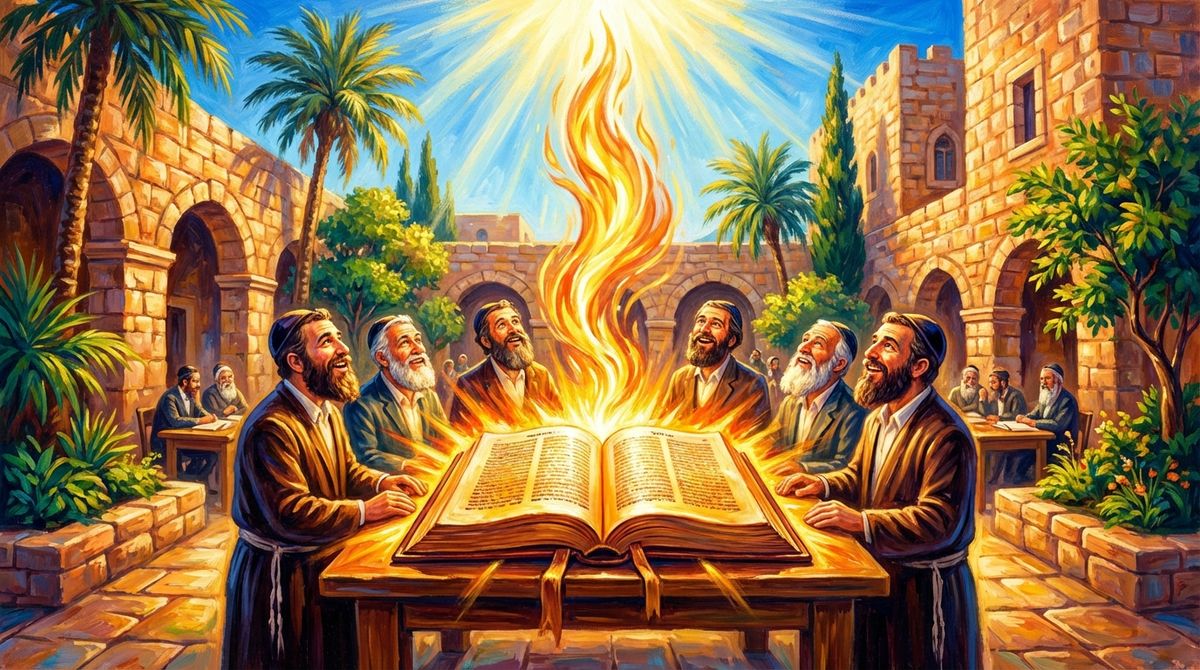
Rabbi Shmuel burned for Hashem with a flaming fire until his very last day. I merited to know him personally. Out of all the elders, he was the only one who remained completely lucid, with a face shining and glowing like fire, immersed in Gemara study and the service of Hashem. When he would emerge from the tziyon (tomb) of Rabbi Chanina ben Dosa, his face would literally radiate light. When will we merit such a state? He achieved this because, until the age of seventeen, he studied Gemara day and night, mastering entire tractates by heart with immense depth. Only after he had filled his belly with Shas (the Talmud) did his heart open up to discover Rebbe Nachman, embracing the spiritual work of crying out and praying with fiery enthusiasm. The Torah is fire, and every single letter is a blazing flame. If one does not study these letters, there is simply no fire.
The Call of the Rooster
When he studied in the cheder (Torah school), he was so sharp that he would grasp the meaning of the Gemara before the melamed (teacher) even finished explaining it. Because he was such a prodigy, when he was just seven years old, his melamed warned him, saying, "If you don't want to be thrown out of the cheder, tell everyone you are twelve!" At the age of seven, his comprehension and excellence surpassed that of twelve-year-old boys.
Today, a new generation has emerged that thinks Breslov is just about sitting around and drinking Coca-Cola. But what is Coca-Cola? In Hebrew, Coca-Cola is an acronym for: *Kol Korei Hatarnegol, Kumu La'avodas Haborai* (The voice of the rooster calls out: Arise to serve the Creator)! People need to start studying Torah, and through that, they will be able to cry out to Hashem. The true spiritual work is to cry out to Hashem unceasingly, but it is impossible to cry out if one does not study twelve hours of Gemara. The remainder of the day is divided between sleep, Hisbodedus, and prayers, and during the rest of the time, one simply cries out to Hashem until all the impure blood is expelled.
Cold Mikvahs and Holy Practices
To truly burn for Hashem, one must immerse in freezing cold mikvahs. Rebbe Nachman never turned on a heater during the winter. He would run to a freezing mikvah, and even when it was minus forty degrees outside, he would remain in the water for two hours until it literally began to boil from his body heat. The Kotzker Rebbe expounded on the verse, "By day the scorching heat consumed me, and the frost by night"—if you immerse yourself in the "frost" at night, then you will merit the "scorching heat," a blazing passion for Hashem. But if you avoid the frost, you will never be able to burn. Here, people walk around in heavy coats and fur hats when it is a mild ten degrees Celsius outside. It is a shame and a disgrace; it merely proves that their hearts are not burning with holy fire.
Beyond this, there are holy practices that must be instilled from a young age. Rabbi Eliyahu Lopian related that the Chasam Sofer would test every shochet (ritual slaughterer) before giving him semichah (rabbinic ordination). Once, he entered the bedroom of a brilliant and meticulous shochet on the night before his ordination, and saw that he did not have water for netilas yadayim (ritual hand washing) next to his bed. The Chasam Sofer said to him, "You are disqualified!"
Similarly, it is told about the Tzemach Tzedek that his wet nurse would ensure he did not go bareheaded even as a baby. From the moment a baby is born, one must put a kippah on him and wash his hands. These things sanctify a person in his youth and cause him to have yiras Shamayim (fear of Heaven). Baalei teshuvah (returnees to Judaism) need to take the books of tzaddikim, learn them, and teach their wives these simple practices, which were customary in every Jewish home for generations.
The Ten Commandments and Mesiras Nefesh (Self-Sacrifice)
Rabbi Pinchas of Koretz would read the Ten Commandments before dawn. In the book Kav HaYashar, it is brought down that one should recite the Ten Commandments from Parashas Yisro (corresponding to the attribute of day - "Remember") at dawn, and the Ten Commandments from Parashas Va'eschanan (corresponding to the attribute of night - "Keep") before sleep, after reciting the Bedtime Shema. Whoever does this merits two crowns on his head. When the soul ascends Above at night, the demons try to throw it down and strike it because of the sins committed during the day (and this is what a person experiences as nightmares and blows during sleep). Reading the Ten Commandments causes the angels to escort the soul and elevate it safely to the Supernal Chambers.
When a person leaves his home, he should say three times over the mezuzah: "Hashem will guard my going out and my coming in for life and for peace, from now and forever," and also three times the verse: "In all your ways know Him, and He will make your paths straight" (which contains twenty-six letters, corresponding to the numerical value of Hashem's Name, Havayah).
He should tilt his head to three directions and intend to offer his soul with mesiras nefesh (self-sacrifice) to Hashem. A person must, in every blessing, at every moment, not let an hour pass without intending to surrender his soul to death—stoning, burning, beheading, and strangulation—for the sake of Hashem, May He be blessed. Primarily, one should have this intention when saying "Hashem is One" and during Tachanun (falling on one's face in supplication), and then he is included in the Tree of Life and all his sins are forgiven. May Hashem help that there will be a complete Geulah (Redemption) speedily in our days, Amen.
Part 2 of 2 — Lesson No. 17
All parts: Part 1 | Part 2 (Current)
Subscribe to Our Newsletter
Receive Torah articles and inspiration directly in your inbox