
The Secret of the Hidden Light: From the Wisdom of Avraham Avinu to the Good Eye of Rachel
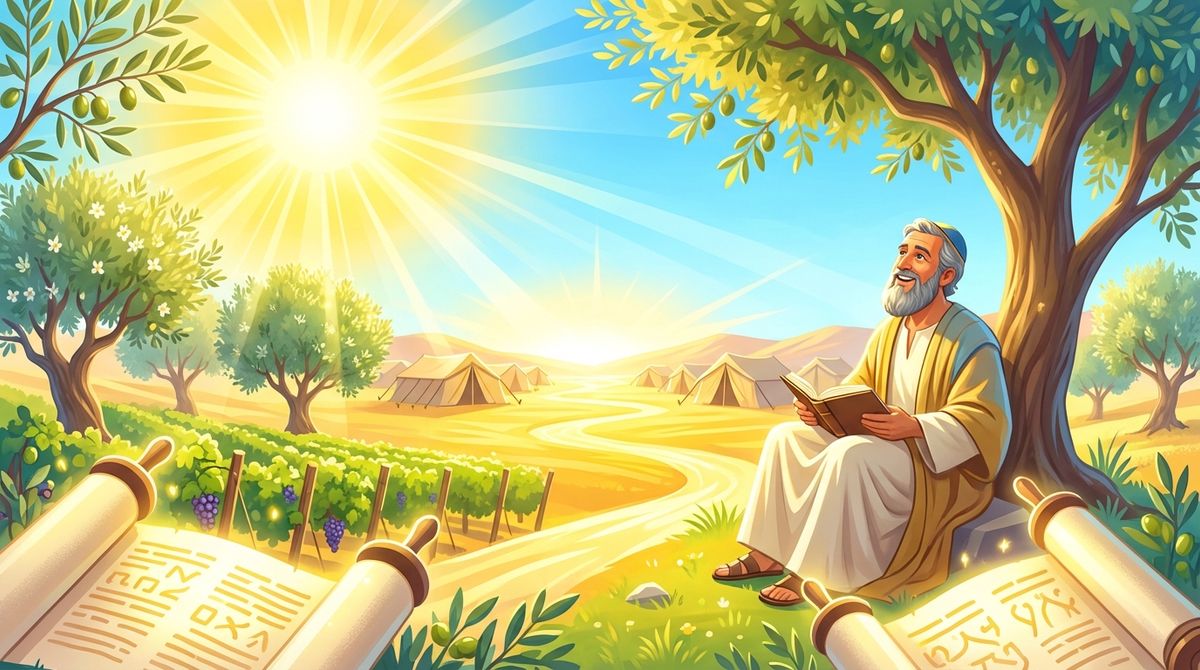
Lesson No. 31 | Part 1 - Thursday Morning, Parashas Matos, 22 Tammuz 5755 at the Yeshiva
An in-depth article explaining the secret of the purchase of the Cave of Machpelah, the mistake of Og King of Bashan, and the true essence of Hisbodedus (secluded prayer). Through Midrashic stories, it is revealed how true greatness is hidden specifically in humility, guarding one's eyes, and judging every Jew favorably.
Darkness and Gloom or the Entrance to the Garden of Eden?
When Avraham Avinu (our Patriarch) bought the Cave of Machpelah for four hundred silver shekels, the place was filled with kelipos (impure spiritual forces). The kelipos wanted to attach themselves to Avraham, but they were nullified, as it is written: "And the field of Efron rose up" – it experienced an elevation. As long as the cave was in Efron's possession, the kelipos heavily surrounded it, and therefore, under Efron, darkness and gloom prevailed there.
When the people of Chevron came to Avraham, they were astonished: "You want to sell Sarah out, to bury her in a dark cave filled with darkness and gloom? What happened to you? Have you become a miser, or did you quarrel before her passing and now you want to take revenge on her? This makes no sense!" They did not understand the secret of the cave. After all, the greatest figures of the world attended Sarah's funeral: Avimelech, Og King of Bashan, and Shem the son of Noach. Shem lived for six hundred years, and he merited this longevity in the merit of coming to Sarah's home. Everyone who was in Sarah's home merited a long life; they merited to also be in Avraham's home and to live long days after him.
The Mistake of Og King of Bashan
Og King of Bashan was one of Pharaoh's advisors. The Midrash relates that when Yaakov Avinu went down to Egypt and blessed Pharaoh, Og was sitting there. Pharaoh turned to him and said, "Look, see how Yaakov Avinu has arrived with seventy souls. This is not what you used to say! You used to say about Avraham, 'He is like a barren mule and cannot beget children.'" Og had wanted to kill Avraham and looked for schemes to do so. Why didn't he actually kill him? He thought to himself, "He is an old man; let the drunkard fall on his own. He has no children, so let him scream 'Hashem, Hashem'—let him scream." Og was certain that Avraham would depart from the world without continuity, and he hoped to marry Sarah out of "pity" for her being a barren woman married to a man whom he considered cruel.
When Yitzchak was born and weaned, Avraham made a great feast attended by all the leaders of the generation, including Og. Everyone said to him, "Look, where is your prophecy? You said, 'A barren mule who cannot beget children!'" Og scoffed and said, "What is his gift? Just a tiny little boy. Whenever I want, I can put my finger on his nose and he will choke." Hashem said to him, "You despise My gift? By your life, you will see thousands upon thousands and myriads upon myriads descending from his children, and that man's end will only be to fall into their hands" – into the hands of Moshe Rabbeinu.
The Power of Babies in the Past
The Midrash reveals to us that Avraham Avinu was the first to invent the baby cradle. Until then, no cradle had ever rocked in the world. In the past, when a baby was born, he would immediately start walking, jumping, and running. A mother would give birth alone, in a dark room at night, and the baby already wanted to dance. The mother would say to him, "Wait a moment, we need to cut the umbilical cord. Go bring scissors from the kitchen." If it was daytime, the baby would manage and find them. But at night, in the dark, the mother would send the newborn baby to bring matches and light a candle.
A story is told of a woman who gave birth at night and sent her baby to light a candle so she could cut the umbilical cord. On his way, he was confronted by none other than Ashmedai, the king of the demons. The baby, who had been born just five minutes earlier, wrestled with Ashmedai all night until dawn and the crowing of the rooster. Ashmedai said to the baby, "Go tell your mother that if the rooster hadn't crowed, I would have killed you." The baby answered him, "Go tell your mother that it is a miracle for you that my mother hasn't yet cut the cord I am tied to, otherwise I would have slaughtered you!" This was the power of children in the past – a one-minute-old baby could kill a destructive demon. Therefore, when Og saw Yitzchak in the cradle, he scoffed, not understanding the immense power hidden within him.
The Wisdom of Avraham Avinu
The holy Zohar states that Avraham Avinu needed tremendous wisdom to purchase the Cave of Machpelah. The children of Ches said to him, "In the choicest of our graves bury your dead." They wanted to give him the most beautiful grave, in a grove on the mountain, as long as he did not bury Sarah in the darkness and gloom of the Cave of Machpelah. They exerted control over him, saying, "You are a prince of God among us, but you will receive the grave where we decide."
What wisdom did Avraham employ? He did not ask for the cave directly. He said to them, "I only want the privilege of burying her in the prince's plot, for the sake of Sarah's honor." On that very day, Hashem performed a miracle and they appointed Efron as their prince. Efron, as the prince, offered his worst and darkest plot – the Cave of Machpelah – at the exorbitant price of four hundred silver shekels. Avraham agreed immediately. This was the immense faith of Avraham Avinu in a land that was not theirs, in an exile where strangers dictate what to do.
The Ramak (Rabbi Moshe Cordovero) explains that if the people of Israel had not tasted the impurity of Egypt, the decree of four hundred years could have been fulfilled in the Land of Israel in a single day. Moshe Rabbeinu would have been born in the Land, the Torah would have been given in the Land of Israel, there would have been no sin of the Golden Calf, and there would have been no more exile in the world. But since they went down to Egypt, everything unfolded from there. The secret of Moshe Rabbeinu is hinted at in the letter Vav of the word "Gachon" (belly), and therefore he was buried in a valley (Gai) – "Gai-Chon." Moshe is found in a supernal chamber called Gichon, and there he received his holy body.
The True Essence of Hisbodedus
Moshe Rabbeinu had no grasp or attachment to this world; all of his 248 limbs were completely holy. A person might think, "If I also go to practice Hisbodedus (secluded prayer) for eighty years in the desert like Moshe, the Divine Spirit will be revealed to me too." But this is a mistake. Bilaam also went to the mountains and secluded himself. The truth is that a person could practice Hisbodedus for millions of years in the deserts and not even come close to the ankles of Moshe Rabbeinu.
Moshe Rabbeinu said, "I have not yet done teshuvah (repentance)." True Hisbodedus is to do teshuvah, to overlook one's own grievances, to forgive everyone, and to believe that everyone is better than me. Reb Noson of Breslov explains that one must know that all the tzaddikim are infinitely greater than me. Who am I, after all? I haven't even changed a single worldly desire.
A Good Eye: The Secret of Rachel Choosing Rabbi Akiva
People tend to judge the wicked favorably, yet they search for flaws in the tzaddikim. This is a severe sin. A person must not stumble in spreading slander, for one who spreads slander loses all his spiritual awareness. Chassidus teaches a person to love everyone and to know that he is lower than every single Jew. Lashon hara (evil speech) is more severe than forbidden relations, which is the greatest evil inclination. Why? Because lashon hara stems from arrogance – everyone thinks he is the "chad bedara" (the sole leader of the generation) in his own traits, and he nullifies the rest of the world. This is the secret of the Breaking of the Vessels (Sheviras HaKeilim).
Tosafos asks regarding Rabbi Akiva, who before he did teshuvah (repentance) would say: "Who will give me a Torah scholar so that I may bite him like a donkey." How did Rachel, the daughter of Kalba Savua, choose him out of all the Torah scholars in Jerusalem? What was so special that she found in a man who hated Torah scholars?
Tosafos explains: Rachel saw a shepherd, albeit an illiterate one, but "modest and excellent" – possessing absolute guarding of the eyes and good character traits. She understood that his hatred for Torah scholars did not stem from evil, but from a mistake. He thought that the Torah scholars were haughty about their Torah and despised the unlearned masses, as was customary then that "the garments of an unlearned person are considered ritually impure (midras) to the separated ones (Perushim)." Rachel saw his pure inner essence, the hidden light within the darkness, and in the merit of her good eye – the world merited the Torah of Rabbi Akiva.
Part 2 of 2 — Lesson No. 31
All parts: Part 1 | Part 2 (current)
Subscribe to Our Newsletter
Receive Torah articles and inspiration directly in your inbox