
The Secret of the Tears of Tisha B'Av: The Path to the Fiftieth Gate and the Resurrection of the Dead
Lesson No. 604 | Lesson 1 - The Night of Tisha B'Av 5769
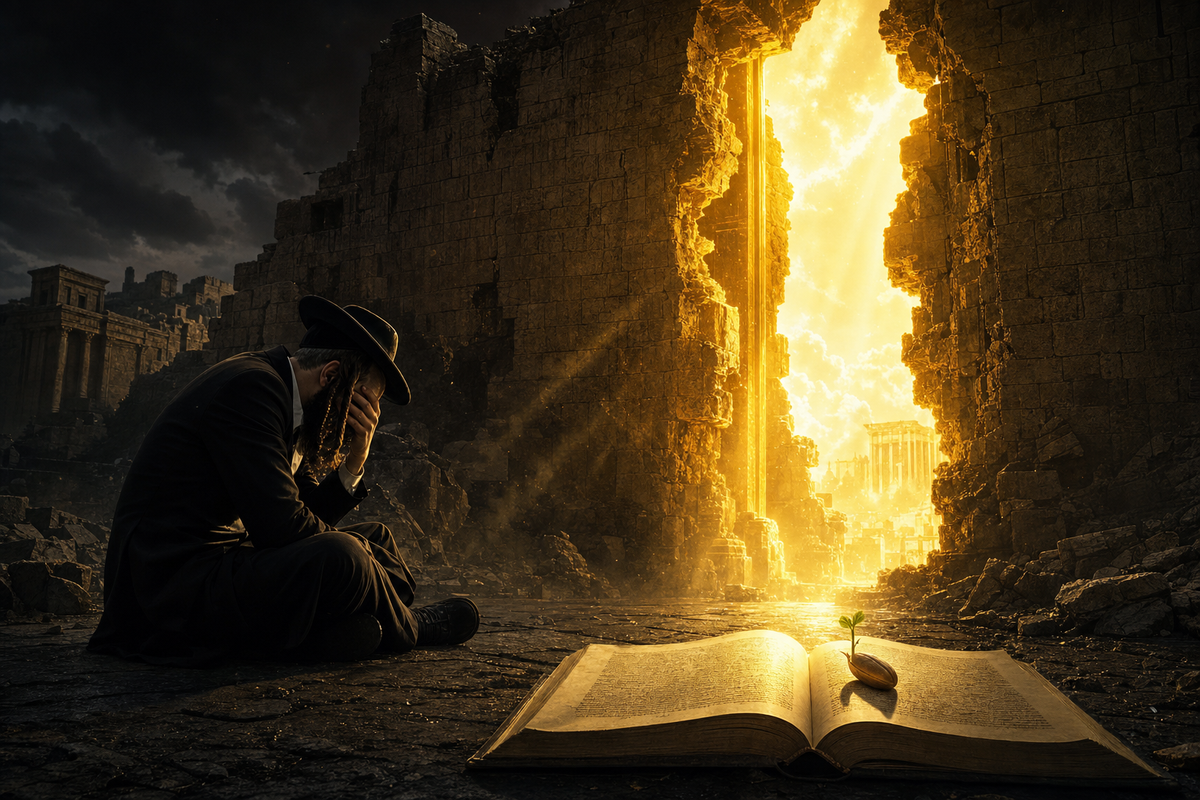
Within Tisha B'Av lies the power to transform the kinos (lamentations) into a tikkun (rectification) and to draw down the Fiftieth Gate of Holiness through genuine weeping over the sorrow of the Shechinah (Divine Presence). Through the secret of the luz bone (the indestructible bone from which the body is rebuilt), the spiritual aspect of Leah, and the guarding of the eyes of Yosef the tzaddik, we can merit the rebuilding of the Holy Temple and the resurrection of the dead in the blink of an eye.
Throughout all generations, all the calamities and holocausts came into the world to rectify the sin of the spies. Now, through the weeping that we cry on Tisha B'Av, Rebbe Nachman explains (in Likutey Moharan, Torah 247) that we transition from a state of "Teiku" (an unresolved Talmudic question) to a state of tikkun (rectification). The Talmud frequently concludes complex discussions with "Teiku" because the Fiftieth Gate of Understanding has been hidden from us.
Through the lamentations and weeping of Tisha B'Av, it is possible to reach the revelation of the Fiftieth Gate. The Hebrew letter Nun (which has the numerical value of fifty) is missing from the word "Teiku" (תיקו), because after the Children of Israel acted like a child running away from school and lusted after physical desires, the letter Nun disappeared from them, and the Fiftieth Gate was concealed. Those Nuns became inverted, and these are the inverted Nuns found in the Torah portion of "And it came to pass when the Ark set forward," which we rectify on Tisha B'Av.
The letter Nun of the "Teiku," which represents the Fiftieth Gate, was transformed into a bent Nun—these are the kinos (lamentations). However, when we conclude the lamentations with liturgical poems of Geulah (Redemption), we will merit that the lamentations will transform into a tikkun (rectification), and through this, the complete Geulah (Redemption) will arrive. Everything depends on how seriously a person takes Tisha B'Av, shedding genuine tears and truly feeling the pain of the destruction. Just as a person mourns for Jerusalem, so too will he merit to see its joy.
Rectifying the Sin of the Spies and Drawing Down the Tree of Life
The primary spiritual work is to rectify the sin of the spies, who refused to believe in Moshe Rabbeinu. The entire essence of faith is "And they believed in Hashem, and in Moshe His servant." Even if a person believes in Hashem, he must also believe that there is a Moshe in every generation. If he only believes in Hashem and not in Moshe His servant, this is not true faith—he essentially only believes in himself.
The entire test of the spies was to see if they believed in Moshe, who told them to check, "Whether there is a tree in it or not." The holy Zohar explains that Moshe wanted them to draw down the spiritual illumination of the Tree of Life. On Tisha B'Av, through the lamentations and weeping, we draw down the Tree of Life. The sin of the spies caused the destruction of the Holy Temple, and Moshe's entire question of "Whether there is a tree in it" was not asking if there were physical trees there, for it was already stated that it is a land flowing with milk and honey. Moshe wanted that after the Nuns were inverted following the sins of the complainers and the mixed multitude, we would restore the Gate of Nun (the Fiftieth Gate), the gate of Geulah (Redemption).
The weeping of the spies was a weeping in vain, and weeping in vain causes a concealment of the Divine Countenance. Hashem told them: "You wept a weeping in vain; I will establish for you a weeping for all generations"—and that night was the night of Tisha B'Av. Now, through our genuine weeping, the prayer of "Please forgive" is fulfilled, and all of a person's sins from all of his reincarnations are atoned for.
The Secret of the Luz Bone and the Spiritual Aspect of Leah
On Tisha B'Av, the truth is revealed. When a person merits truth, he breaks free from all physical desires and can bring about the Geulah (Redemption). A man of truth, Rebbe Nachman explains, is someone who performs all the mitzvahs in the innermost chambers exactly as he performs them in public. He prays the Shemoneh Esrei prayer for three hours alone between himself and his Creator, focusing on every word and every letter with the utmost perfection and precision. When everything comes from the One, with the pure intention of "for His Name's sake with love," the spiritual union of Rachel and Leah is created, and through the "Luz" (the indestructible core), one enters Beis El (the House of God).
There are twenty-one days between the fast of the 17th of Tammuz and Tisha B'Av. These days hold the spiritual capacity to merit the rebuilding of the Holy Temple and the resurrection of the dead. Whoever rises at Chatzos (midnight), sits on the floor, and weeps over the destruction, rectifies the spiritual aspect of the "Luz." The Torah calculated exactly 21 days, which is the time required for the growth of the hazelnut (called luz in Hebrew), hinting at the luz bone from which a person is rebuilt during the resurrection of the dead.
The Luz represents the spiritual level of our Matriarch Leah. If we want to enter the Holy Temple, Rebbe Nachman explains in Likutey Moharan (Torah 85), we must first rectify the spiritual aspect of Leah. Rachel is the lower spiritual aspect, and she is included within Leah (the Hebrew name Rachel [רחל] is an acronym for Rachel Chatzi Leah—Rachel is half of Leah). On the night of the Passover Seder, we merited the aspect of Rachel, but now, specifically on Tisha B'Av, we merit the aspect of Leah, through which we enter the Holy Temple.
The Mandrakes, the Cherubim, and the Holy of Holies
Immediately after Tisha B'Av, we reach "Shabbos Nachamu" (the Sabbath of Consolation). "Comfort, comfort My people" (Nachamu nachamu ami)—the word "nachamu" (נחמו) has the numerical value of 104, and twice "nachamu" equals the numerical value of twice "kodkod" (crown of the head). This is the secret of "and on the crown of the head of the one separated from his brothers," representing the spiritual aspect of Yosef the tzaddik and Mashiach ben Yosef, through whom the Geulah (Redemption) will come. Yosef merited to guard his eyes, and thereby he sanctified the entire atmosphere of the world.
It is written that Leah lost the mandrakes and gained tribes, whereas Rachel lost tribes (Yissachar and Zevulun) but gained the mandrakes. How could Rachel, who saw from one end of the world to the other with Divine Inspiration, give up tribes in exchange for mandrakes? The holy Zohar explains that these mandrakes were the secret of the Cherubim of the Holy Temple (representing the supernal angels Metatron and Sandalphon).
Rachel prayed all her days: "She considers a field and buys it." The field is the field of Zion, the site of the Holy Temple. She saw that Leah was taking most parts of the Holy Temple—the Women's Courtyard, the Priests' Courtyard, and the Israelites' Courtyard. Yehuda received a strip of land that entered the Altar, and Rachel begged that at the very least, the Holy of Holies would be in her portion. The mandrakes were the secret of the Ark of the Covenant and the Cherubim that would reside in Rachel's portion.
Now, in the lamentations of Tisha B'Av, we mention the Ark and the Cherubim and weep for their return. The Ark and the Cherubim did not disappear; they are merely hidden beneath the Temple Mount. Our entire intention in these terrible cries is that they will float up, ascend, and settle back upon the Foundation Stone.
Lie Down Until the Morning: The Wait for the Resurrection of the Dead
Leah is the "Alma D'iscasya" (the Hidden World), the secret of the Fiftieth Gate and the luz bone of the resurrection of the dead. Rebbe Nachman explains in Torah 85, a brief teaching that encompasses the entire Tree of Life and the secrets of the Geulah (Redemption), how one reaches the Holy Temple and the resurrection of the dead. The secret lies in the verse, "Lie down until the morning," which hints at the time of the resurrection.
To merit this, Rebbe Nachman explains in Torah 51, we must be careful that our weeping over the destruction is pure. "Do not say, 'water, water'" - God forbid we should not cry over personal troubles, over debts or illnesses, but solely over the sorrow of the Shechinah (Divine Presence), over the destruction of the people of Israel who are in exile.
Hashem is only waiting for one genuine tear. Esau cried two and a third tears, and to this day we suffer from it. With one genuine tear over the destruction, it is possible to nullify the tears of Esau. Every day, Hashem sheds two tears into the Great Sea, because we do not cry properly. The awakening from above exists, but an awakening from below is required.
Guarding the Eyes and Bringing the Geulah (Redemption) Closer
The Geulah (Redemption) will come through the aspect of Yosef, who merited guarding his eyes and withstood terrible tests. The eyes are the greatest wonder in the human body; they are literally Godliness - "The eyes of Hashem are toward the tzaddikim." Everyone needs to pray during the Kinos (lamentations) that his eyes will be restored to him, that the eyes of Hashem will clothe themselves within his own eyes, in the mystical secret of "For they shall see eye to eye when Hashem returns to Zion."
The Zohar explains that the eyes must be clean from any redness, which indicates strict judgment, in the mystical secret of "washed with milk" - that the eyes should be white as milk, the supernal whiteness of mercy. King Solomon merited to build the Holy Temple because his eyes were transformed into the supernal whiteness. In order to rebuild the Holy Temple, we must draw down the illumination of the supernal eyes.
For this purpose, we must integrate ourselves with the true tzaddikim (such as Rebbe Nachman, the holy Arizal, the Baal Shem Tov, and Yosef HaTzaddik), who are the aspect of "pure gold" that contains no trace of impurity. It is over them that we cry in the Kinos: "How the gold has become dim, how the most pure gold is changed." The tzaddikim have already prepared everything through their prayers, and our role is only to bring it from potential into actuality.
When a person stands and prays the Shemoneh Esrei, recites Tehillim, or learns Torah with awe and love, word by word - with every single letter, a soul is awakened to teshuvah (repentance). Hashem wants to build the Holy Temple even more than we want it, just as more than the calf wants to suckle, the cow wants to nurse. He is only waiting for one genuine tear from us. On Tisha B'Av, we are given the opportunity to shed tears of truth, and through this, we will merit the building of the Holy Temple and the Resurrection of the Dead in the blink of an eye.
Lesson No. 604
Read more
Subscribe to Our Newsletter
Receive Torah articles and inspiration directly in your inbox