
The Secret of the Water-Drawer
A Story About the Greatness of Enduring Humiliation, as The Rav Rabbi Eliezer Berland shlit"a Teaches Us
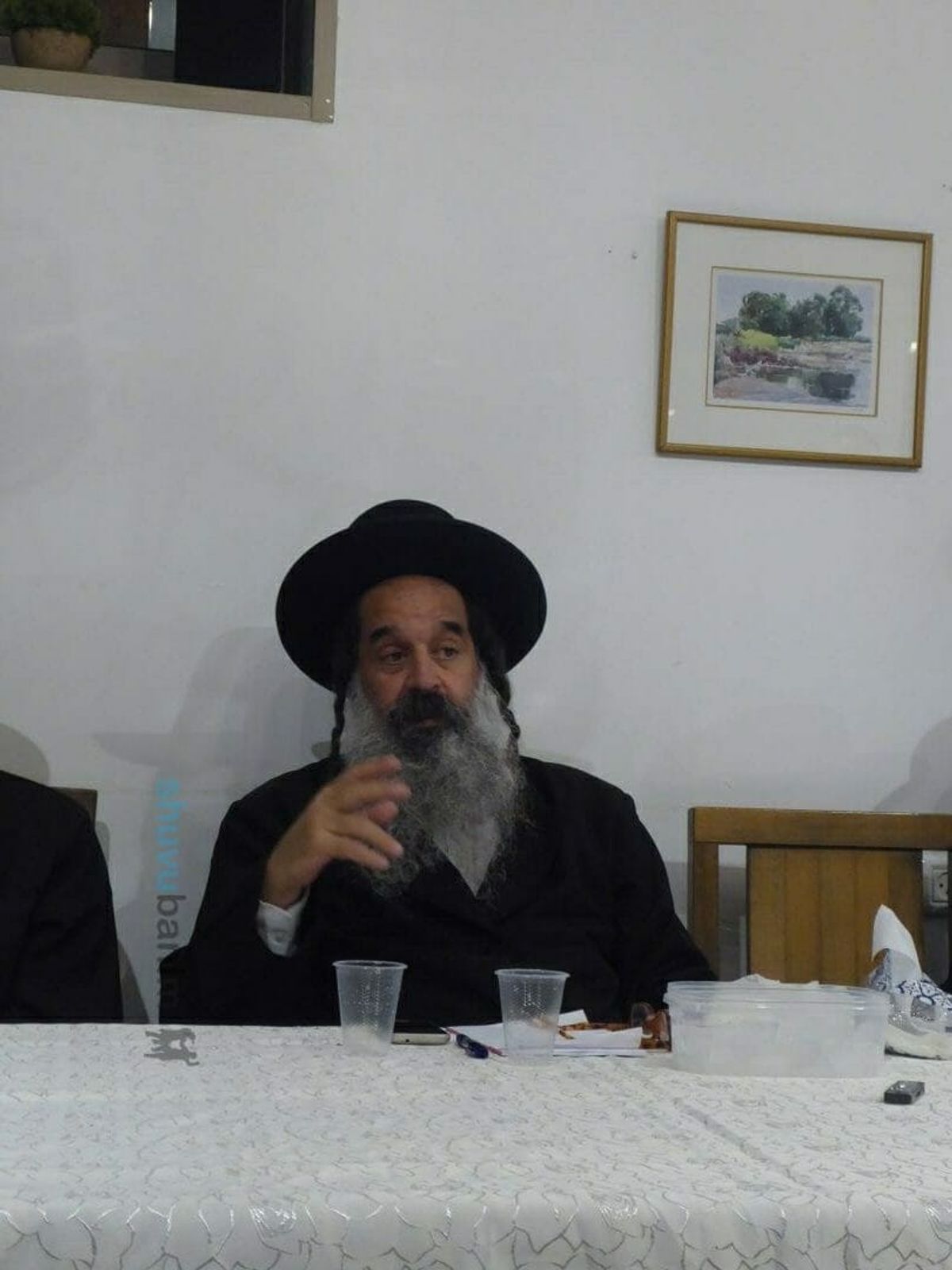
Rabbi Yalon Yitzchaki, one of the veteran and greatest students of Rav Berland, in a particularly strengthening article in honor of the holiday of Purim >>> The story of the hidden water carrier >>> And the powerful lesson on accepting humiliation with love as taught by our teacher, Rav Berland
What a person works for his entire life
Since we are before Purim, and since our desire for publicity knows no bounds, as R' Levi Yitzchak zt"l said, "A person works for what will be written on his tombstone"... I bring before you a story that begins on Purim and ends on Purim, opened by the 'Chatam Sofer' zya"a, and concluded by the author of 'Torat Chesed', R' Schneur Zalman of Lublin zya"a. The powerful title of this wondrous story, which is known under the heading 'When wine enters, the secret emerges', is 'Walk humbly with your G-d'.
Rabbi Baruch Mordechai
And here is the story before you: (From 'Yerushalayim Shel Ma'ala') For a month, the 'Zuckermandel' glass factory in the small town of 'Yargin' near Pressburg was locked tight. A son was born to the factory owner, the wealthy R' Nissan Zuckermandel, who in his youth was counted among the students of the yeshiva of the great 'Chatam Sofer'. Many years of childlessness had passed for him, and now, in his great joy, he abandoned all his businesses for a month. On the day of the holiday of Purim 5583, the Brit was held, with the 'Chatam Sofer' serving as the Mohel. A sublime joy rested upon the face of the 'Chatam Sofer' during the Brit, and his students initially attributed this to the intensity of the day of Purim. But when, after the circumcision, their teacher offered his finger dipped in wine to the newborn and remarked, contrary to his custom, "When wine enters, the secret emerges," everyone understood that there was more to it. But they did not dare to ask. The baby was named according to the theme of the day: Baruch Mordechai.
Years passed; Baruch Mordechai grew and became a youth, his appearance sturdy as an oak, a young man like a cedar. His teachers testified that he was a G-d-fearing man who excelled and was diligent in his studies, but to everyone's sorrow, he did not see success in his labor; his tests were among the worst, and his learning was quickly forgotten. When he was 15, on the Fast of Gedaliah 5598, he received a special blessing from the 'Chatam Sofer'. It was when rain and hail were falling intensely, and the streets of the city had become a pool of water. The 'Chatam Sofer' was walking on his way, his feet mired in mud. Baruch Mordechai, who was passing by, did not hesitate for a moment; he took his teacher upon his shoulders and carried him to the yeshiva building. "With what shall I bless you?" his teacher asked. "That I may be saved from pride," the youth replied, and he received the blessing of the great man of Israel. More years passed, and among the children of Pressburg, he was known by the nickname 'the ignorant Chassid'—ignorant because he did not know how to learn, and a Chassid because he prayed with intention and bitter tears.
In the year 5601, after a fire consumed his father's factory and they were left destitute and lacking everything, Baruch Mordechai went to his teacher, the 'Ketav Sofer' (son of the 'Chatam Sofer' who had already passed away). He poured out his sorrow before him and was met with the tempting advice to go up to the Holy Land and live in Jerusalem. "There," the Rabbi encouraged him, "close to the gates of heaven, your fate will surely improve, and you will also find your shidduch (marriage match)." And so, with financial help from his uncle, he went up to the land, equipped with a recommendation from the spiritual supervisor R' Shraga Feldheim. He settled in the home of the holy Gaon Rabbi Yeshaya Bardaki, who on one hand saw his special fear of Heaven and his heartfelt prayers, but on the other hand also saw his lack of knowledge in learning. He took pity on him and appointed him as the 'shammash' (attendant) of his study hall, and later even arranged a shidduch for him with an orphan, with all the residents of Jerusalem and all its notables attending the wedding in honor of R' Yeshaya.
In the year 5627, Rabbi Yeshaya passed away, and Baruch Mordechai was forced to find a new job. Thus, with his wife's encouragement, he began to work as a water carrier. There were twelve water carriers in Jerusalem, but many chose Baruch Mordechai specifically, mainly due to his great honesty. For forty years, he held this position, in which he engaged with great joy. The only one who did not agree to use his services was the Maharil Diskin zt"l. This was in the early days of his arrival in Jerusalem. Baruch Mordechai, in his holy custom of offering himself to Rabbis and Torah scholars as their water carrier so that he might merit the 'service of Torah scholars', went to the residence of the Maharil, but was met with a refusal: "This Baruch Mordechai shall not bring water to my house," said the Rabbi of Brisk. Baruch Mordechai asked for his forgiveness, ran home, grabbed a book of Psalms, and began to mutter, "Who knows what this tzaddik saw in me; after all, I am covered in sins," he said to his wife.
Years passed, and Purim 5653 arrived. A large crowd gathered in the home of the author of 'Torat Chesed', the Gaon and tzaddik Rabbi Schneur Zalman of Lublin, to rejoice together in the joy of the day. Among the crowd was Baruch Mordechai. He pushed through everyone and approached the Rabbi of Lublin for a 'L'chaim' blessing. To everyone's astonishment, this silent man opened his mouth and addressed the Rabbi directly: "Rabbi, today marks seventy years since the day I entered the covenant of our father Abraham!" The crowd burst into laughter, but the Rabbi did not laugh at all. He took Baruch Mordechai's words with great seriousness. "If so," he turned to him, "you deserve a larger cup." Baruch Mordechai sipped from the cup, finished it all, the wine began to affect him, and he began to dance and leap. "Instead of acting wild," the Rabbi said to him, "it would be better if you said some good words of Halacha and Aggadah before the crowd." "On what subject does the Rebbe want me to speak?" Baruch Mordechai asked. "On the subject of the day," the Rabbi replied. "Purim matters... ha... ha... ha... there is a whole tractate on that," Baruch Mordechai said. "And what does the Gemara say there?" the Rabbi asked. And here, Baruch Mordechai began to lecture on entire pages of Gemara with the commentary of Rashi and Tosafot, explained with good taste and wisdom. He stood on the table; the whole crowd huddled in amazement, no one moved from their place, everyone was in shock. And the Rabbi did not let up; from the Megillah, he moved to Shabbat, and from there to Bava Batra and Bava Metzia, and Baruch Mordechai answered him with immense expertise in all the chambers of the Torah. He uprooted mountains and straightened paths. Afterward, when he was completely intoxicated to the point of losing his senses, he fell to the ground and was rushed to the 'women's section', where he slept for several hours until the Mincha prayer.
It did not take long before all of Jerusalem was in an uproar. Baruch Mordechai the water carrier was a tremendous genius, and for all his days for seventy years! He had deceived everyone. Baruch Mordechai's sorrow knew no bounds; his secret was revealed, and the residents of Jerusalem no longer allowed him to work as a water carrier, and instead, students began flocking to his house.
Then everyone understood in retrospect the holy words of the 'Chatam Sofer': "'Wine' (=70) entered, 'secret' (=70) emerged." The wine entered and revealed the seventy-year-old secret. And now everyone also understood why the Maharil Diskin did not want to use the services of this hidden Torah scholar. And when Rabbi Baruch Mordechai passed away, the great Kabbalists of Jerusalem whispered behind his bier that he was one of the 36 hidden tzaddikim of the generation.
If only we could be students of the Rabbi
And now, my dear friends of the yeshiva, look and listen, how terrible this story is! Imagine the daily nuances that this tzaddik Zuckermandel had to deal with for seventy years, and what about us? After all, they ask me, and I don't know how to answer? Surely I will answer! R' Avraham b"r Nachman (Chazan) zt"l said that when they give him honor, it is like "stabbing me with knives," and we, alas, humiliation is like knives, and honor is like delicacies. So perhaps Rav Berland does not need the opposites like us, to stand on our heads, in order to speak to us... And from now on, if a person asks you if you are a Chassid of Rav Berland shlit"a, tell him, 'If only I were worthy,' because where am I and where is Rav Berland, and like a convert coming to convert, 'I know and I am not worthy.' Happy Purim!
Subscribe to Our Newsletter
Receive Torah articles and inspiration directly in your inbox