
The Secret of Waking Up Early: Recreating the Dawn
Lesson No. 30 | Tuesday, Parashas Matos, 20 Tammuz 5755 - Morning Lesson at the Yeshiva
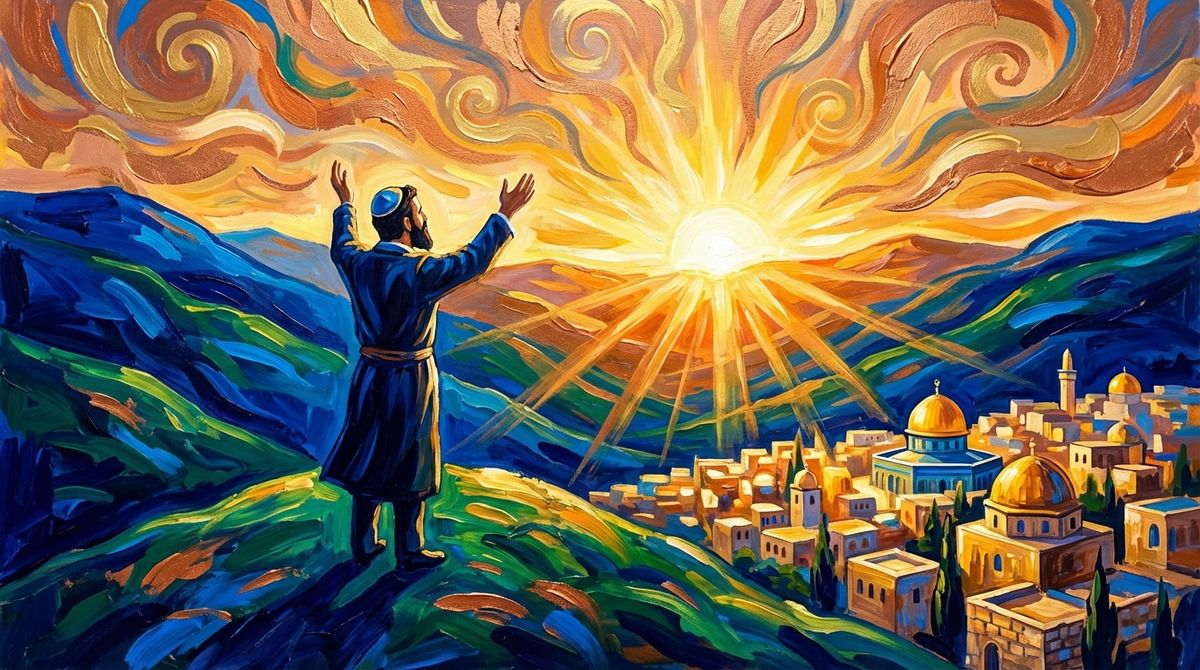
A person does not merely wake up to the morning; rather, they have the power to recreate the dawn. Through waking early for the service of the Creator, through song and prayer, we rectify the Supernal Chariot and draw down the resting of the Shechinah (Divine Presence), whose holiness has remained eternal in Jerusalem since the days of King Solomon.
"He should strengthen himself like a lion to stand up in the morning for the service of his Creator, so that it is he who awakens the dawn" (Shulchan Aruch, Orach Chaim 1:1).
When a person rises in the morning to serve Hashem, he does not merely overcome his physical nature; he enacts a tremendous tikkun (rectification) in the upper worlds. With every prayer throughout the day, we rectify a different aspect of the holy Chayos (angelic beings) of the Supernal Chariot: During the Shacharis (morning) prayer, we rectify the face of the lion in the Chariot; during the Minchah (afternoon) prayer, we rectify the face of the ox; during the Maariv (evening) prayer, the face of the eagle; and by rising for Chatzos (midnight prayer), we rectify the face of the man upon the Throne.
Through this overcoming and rising, a person merits to attain the state of "awakening the dawn."
Recreating the World Every Day
It is a mistake to think that the world was created once at a specific starting point and simply continues to run on its own until it reaches its end point. The truth is that the world is recreated every single day, and the morning is recreated every single day.
Who creates the morning? Those who rise and wake up early. The moment a person rises to awaken the dawn, he literally creates it. The dawn is created by those who wake up in the morning, who play music, who sing, who pray, and who cry out to Hashem, may He be blessed.
The conduct of the entire world depends on those early risers. The more people there are praying, singing, crying, and playing music to Hashem in the morning, the more the world will run in its proper order. Everything is determined and influenced by the intensity of the morning service of the Jewish people.
The Eternal Holiness of Jerusalem
When we pray, and especially when we pray in Jerusalem, we must focus our intentions and connect to the eternal holiness of the city. The Rambam in Hilchos Beis HaBechirah (Laws of the Chosen Temple, end of Chapter 6) explains the tremendous difference between the holiness of Jerusalem and the Temple, and the holiness of the rest of the Land of Israel regarding the mitzvos dependent on the Land, such as Shemittah (the Sabbatical year) and Ma'asros (tithes).
There are different types of holiness. The holiness of the Land of Israel that was sanctified by those who came up from Egypt under the leadership of Joshua bin Nun was dependent on conquest and on the Jewish people living in the Land. The moment the Jewish people were exiled during the destruction of the First Temple, this holiness was nullified. In contrast, the holiness with which King Solomon sanctified Jerusalem and the site of the Temple is the original sanctification, which sanctified it for its time and sanctified it for the future to come.
Why is the holiness of Jerusalem never nullified? Because the holiness of the Temple and Jerusalem stems from the resting of the Shechinah (Divine Presence). The Shechinah does not depend on whether the Jewish people are living there at that particular time or not.
"And I will make your sanctuaries desolate" - Holiness Even in Desolation
The moment the First Temple was built by King Solomon, the Shechinah descended to the world and rested in that place. The Rambam rules: Since the Shechinah descended, it has never departed from there. The Shechinah is present within the walls, in the place that King Solomon undoubtedly sanctified.
This holiness existed even from the time of the creation of the world, but through the building of the Temple, it was strengthened with even greater force and might. Since then, the holiness continues to grow stronger day by day, more and more, through the prayers of the Jewish people.
Even during the time of the destruction, the Shechinah is not nullified. The Torah says:
"And I will make your sanctuaries desolate" (Leviticus 26:31).
And our Sages expound: Even though they are desolate, they retain their holiness. The Shechinah has not moved from its place, and it waits for us to awaken, to rise early, and to recreate the dawn through song and divine service, until the complete rebuilding, speedily in our days.
Part 1 of 2 — Lesson No. 30
All parts: Part 1 (current) | Part 2
Subscribe to Our Newsletter
Receive Torah articles and inspiration directly in your inbox