
The Supreme Pleasantness • For the Great Day of Hillula of the Author of the
Noam Elimelech, the Tzaddik Rabbi Elimelech of Lizhensk, zy"a
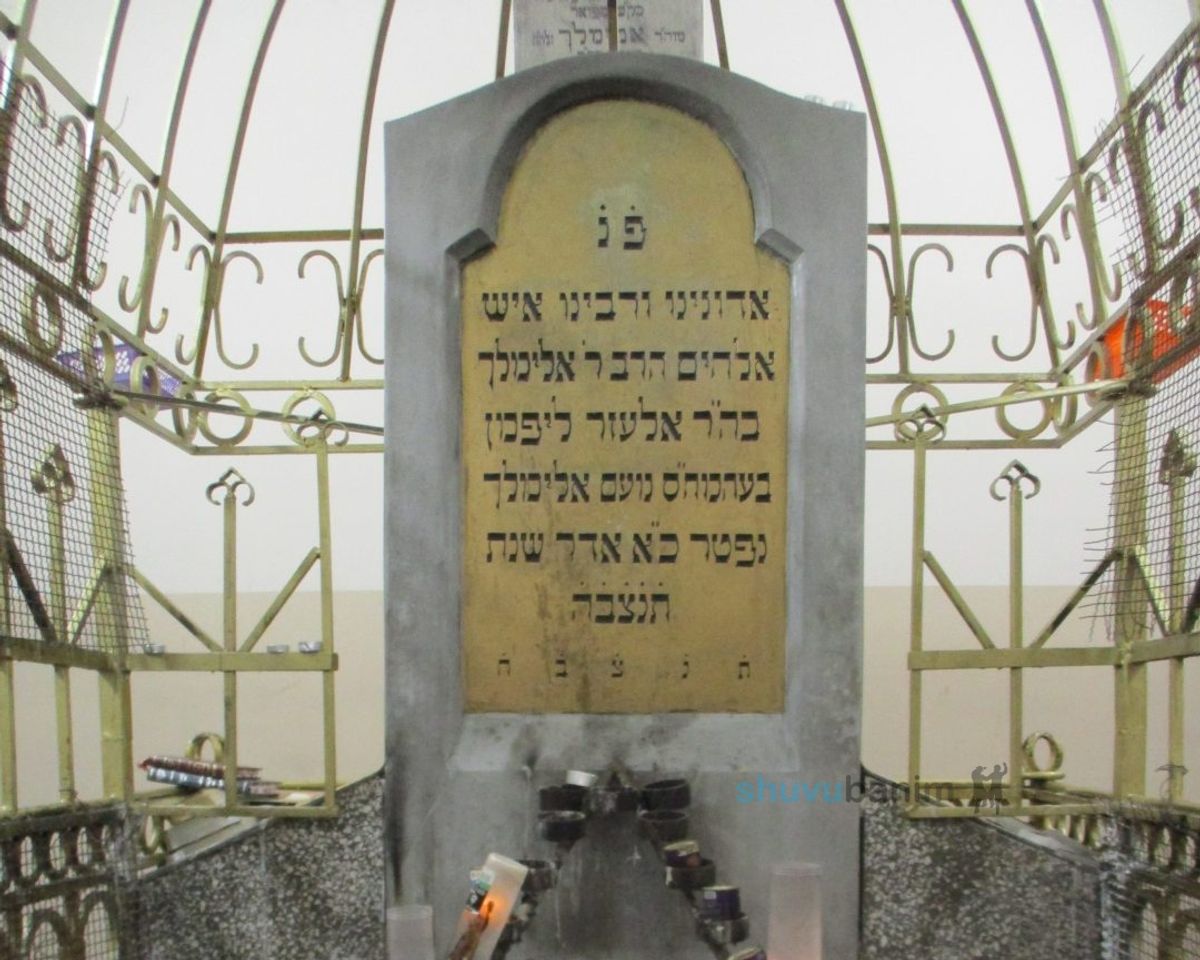
Today, the 21st of Adar, is the yahrtzeit (anniversary of passing) of the author of the Noam Elimelech—the Tzaddik Rabbi Elimelech of Lizhensk, zy"a (may his merit protect us). Before you are highlights of his life, sayings, teachings, and stories from the giants of Chassidus about the Rebbe, Reb Elimelech, zy"a.
His Life:
The Rebbe, Reb Elimelech, was born to his father Rabbi Eliezer and his mother Mrs. Mirel Mirish Lipman in the year 5477 (1717) and was named after his grandfather, R' Elimelech Lipman, zt"l (of blessed memory). He was privileged to grow up in the city of Lapchai in Lithuania, and later moved to study in Tiktin under the Mahar"m Tiktin. There, even in his youth, he ascended and merited to reach lofty spiritual levels that a human being normally cannot attain. It is told that even during those years, he merited a revelation of the angel appointed over the night. When he was 17 years old, his brother R' Zusha of Anipoli was born, and at that time he also married his first wife, Mrs. Gitel. After his father's passing, he lived for a period in the city of Shinova; then his wife passed away, and he married Mrs. Shprintza, the daughter of R' Aaron Margolis, at which point he moved to the city of Rovno in Ukraine. One day, R' Elimelech saw that his brother had returned from the Maggid of Mezeritch with his face radiating a wondrous light. Once he understood that his brother had drawn close to Chassidus, R' Elimelech demanded to be taken to his brother's Rebbe. There, his connection to Chassidus became a burning fire that continues to blaze to this day. R' Elimelech, together with his brother R' Zusha, took upon themselves a "galus" (exile) of eight years to atone for sins, during which they suffered many humiliations and reached a state of literal poverty, living on a crust of bread.
His Greatness and Stories from the Giants of Chassidus Regarding His Stature:
“The soul of the Rebbe, Reb Elimelech, did not taste from the Tree of Knowledge and did not participate in the sin of Adam HaRishon (the first man) like the rest of the souls of Israel.” When the Great Maggid of Mezeritch, zy"a, passed away, he divided his lofty spiritual levels among several of his greatest students: his visionary eyes he bequeathed to the Seer of Lublin, who as is known could see from one end of the world to the other; his mind he bequeathed to the Baal HaTanya, known for his deep teachings; and his heart he gave and bequeathed to the Rebbe, Reb Elimelech, zy"a.
Rabbi Yitzchak Isaac of Ziditchov said that the Rebbe, Reb Elimelech, possessed levels that had not existed in the world since the days of the Prophets (the ten "tzachtzachot" - supernal lights). The body of the Rebbe, Reb Elimelech, was refined to the level of a soul; his holy body shone like a thousand souls, his two hands were like the two Tablets of the Covenant, and his ten fingers were like the Ten Commandments (R' Yisrael of Ruzhin, R' Yitzchak Isaac of Biala, Taharas HaKodesh, Orach L'Tzaddik). Five hundred years before his birth, the world was sustained and abundance descended in his merit (R' Yisrael of Ruzhin). The Rebbe, Reb Elimelech, extracted the Temple vessels from exile and built the Altar (Zera Kodesh, Parshas Ki Seitzei). Rabbi Avraham Azulai—author of Chesed L'Avraham and great-great-grandfather of the Chida—appeared to the Rebbe, Reb Elimelech, and asked him: 'I authored ten books and they are very significant in Heaven, so why are all the worlds making such a noise over your movements down below?' (Shivchei HaBaal Shem Tov 54). On Erev Shabbos Kodesh (Friday afternoon) after his immersion in the Mikvah, the Rebbe, Reb Elimelech, could not hear well because of the sound of the many heralds making proclamations in Heaven.
The Rebbe, Reb Elimelech, performed the "Teshuvah of the Kaneh" [fasting for six consecutive years] several times (The Klausenburger Rebbe). The Rebbe, Reb Elimelech, said: "We wonder how the Tannaim and Amoraim (Sages of the Mishnah and Talmud) said through Ruach HaKodesh (Divine Inspiration) that there would be troubles and suffering—the birth pangs of Mashiach—before the Redemption, yet they did not see through their Ruach HaKodesh that there would be an Elimelech in the world who would nullify those birth pangs of Mashiach" (The holy Rav of Komarno, Nesiv Mitzvosecha). The Rebbe, Reb Elimelech, and his brother Rabbi Zusha afflicted themselves on behalf of all Israel, even for future generations, so that anyone who wishes to return in teshuvah (repentance) and sanctify himself would not need to practice self-affliction (Chidushei HaRim, Derishos Lechem Shlomo, Beiso Naveh Kodesh Belz).
The Rebbe, Reb Elimelech, performed a great teshuvah for having hit his mother in his infancy while nursing from her (Divrei Chaim, Parshas Ki Savo). The Rebbe, Reb Elimelech, would not go to sleep if any money remained with him that had not yet been distributed to tzedakah (charity) (Iggeres HaKodesh). Whatever Jews remain in the world—it is through the power of the Rebbe, Reb Elimelech (The Mahar"i of Biala). His student R' Menachem Mendel of Riminov boasted before him that he saw the angel who "rolls away the light before the darkness"; the Rebbe, Reb Elimelech, answered him, "I saw him in my childhood." When he spoke words of Torah, his students would hear voices and lightning; he was accustomed during his life to practice self-sacrifice and pray for Israel to nullify harsh decrees (Ohel Elimelech, Introduction to Iggeres HaKodesh, Kuntres Me'iras Einayim).
The Book of Tzaddikim – The Holy Book "Noam Elimelech"
There were Tzaddikim who were careful not to enter a house that did not contain the book "Noam Elimelech." The Chasam Sofer, after seeing his book, said, "We are woodchoppers compared to him" (Vayaged Yaakov). On every line, one could write a full page of commentary (Ohel Elimelech). In one segment, I found a full page of explanation from the book Pri Etz Chaim (Devarim Areivim). Only someone who can revive the dead can truly understand the book Noam Elimelech (Ohel Elimelech). Everyone, according to their level, can find themselves in his book just as in Tehillim (Psalms). Everyone, according to their deeds, will taste the holiness of his words (Melitzei Esh, Introduction by his son). The holy Rabbi Menachem Mendel of Riminov said of himself that on Erev Shabbos after immersing in the Mikvah, he could well understand the meaning of the book Noam Elimelech; that is a time propitious for understanding his holy book (Even Shetiyah Kassov). Whoever studies this book will merit parnassah (livelihood), and if one studies it on Shabbos, he will merit a Neshamah Yeseirah (an extra soul) (Ma'adanei Melech). Studying the book is a tikkun (rectification) for the soul like the Zohar, and its study is a segulah (spiritual remedy) for Torah and fear of Heaven (Davar Chana, R' Shayala of Kerestir).
Regarding our holy and awesome teacher, Rebbe Nachman of Breslov, it is told: "When he saw the holy book 'Noam Elimelech,' he was greatly amazed and said that the holiness of the level of the holy Rav, Rabbi Elimelech of blessed memory, is loftier and higher than what is seen and understood from his aforementioned book. And he also spoke very, very highly of the holiness of his brother, the holy Rav Rabbi Zusha of blessed memory, etc., as is known among us" (Chayei Moharan 553).
His Holy Gravesite
Today, the grave of Rabbi Elimelech is located in the town of Lizhensk, which is about an hour's drive from the city of Przemysl, situated on the Poland-Ukraine border.
The Rebbe, Reb Elimelech, promised that anyone who comes to prostrate on his grave will not die without teshuvah (repentance) (Tiferes Shlomo). The Rebbe, Reb Elimelech, stands over his grave on the day of his Hillula (anniversary of passing) and blesses all who come with both hands, just as he did during his actual lifetime (Tiferes Shlomo). It is a segulah for fear of Heaven to be at the gravesite of the Noam Elimelech (R' Meir of Premishlan). It is a segulah for an awakening of teshuvah to be at the gravesite of the Noam Elimelech (R' Menachem Mendel of Riminov). Whoever knows the reason why a great Hillula is made specifically for Rabbi Shimon bar Yochai and not for other Tannaim and Tzaddikim, knows the secret of the Hillula in Lizhensk (Tiferes Shlomo). The Rebbe, Reb Elimelech, acted so that he would have a connection with this world at all times, and one can always come to his grave; the Rebbe, Reb Elimelech, requested that they not raise him too high in Heaven because he wants to remain connected to the community of Israel (Otzar Yisrael, 13 Oros Sanz). His gravesite is fenced off due to the great holiness of the place where he saw in his lifetime—after prayers for this—a revelation of the soul of the holy Baal Shem Tov [whose soul was already in the celestial hidden treasuries], and therefore he requested to be buried specifically in this place (Gedulas Yehoshua, Approbation of the Spinka Rebbe to the book Baal Shem Tov Al HaTorah, and there are several other versions of this).
Segulos (Spiritual Remedies)
It is a segulah to speak of the holy Baal Shem Tov, the Rebbe Reb Elimelech, and Rabbi Levi Yitzchak of Berditchev every Motzaei Shabbos (Saturday night); speaking of them is a segulah for fear of Heaven (Otzar Yisrael, and Beis Yisrael Ruzhin).
Melaveh Malkah (the post-Shabbos meal) is a segulah for an easy birth, and one should say it is for the sake of the mitzvah of Melaveh Malkah (Divrei Yitzchak Munkatch).
The book Noam Elimelech from the first printing is a segulah for an easy birth if it is placed under the head of the woman in labor (Ohel Elimelech). Indeed, today in hospitals owned by Torah-observant Jews, there are already Noam Elimelech books in all the delivery rooms. May his merit protect us, Amen.
Before you is a prayer written by The Rav, Rabbi Eliezer Berland shlit"a, for the day of his Hillula:
Master of the Universe, Almighty One, today is the yahrtzeit of the "Noam Elimelech," who merited the aspect of "I beheld until thrones were placed and the Ancient of Days sat, His garment was white as snow and the hair of His head like pure wool." In the merit of the "Noam Elimelech," may we merit to see from one end of the world to the other, like Hannah who saw from one end of the world to the other. "The bows of the mighty are broken"—these are the Greeks; "and those who stumbled are girded with strength"—these are the sons of the Hasmoneans. "Those who were full have hired themselves out for bread"—these are the seventy sons of Haman who came to ask forgiveness from Mordechai; "and those who were hungry ceased"—these are Mordechai and Esther, of whom it is said, "In the morning he shall devour the prey, and at evening he shall divide the spoil." "Benjamin is a wolf that tears"—this is Saul, who is hinted at in the verse "And Methuselah lived seven and eighty years and a hundred years and begot Lamech," the initials of which spell Saul (Shaul), for Saul was a reincarnation of Lamech who killed Cain. Of him it was said, "If Cain shall be avenged sevenfold, then Lamech seventy and sevenfold." Therefore, the Courtyard of Israel was one hundred and eighty-seven cubits long, and Lamech lived seven and seventy and seven hundred years, for the gematria (numerical value) of Light (Ohr), Water (Mayim), and Firmament (Rakia) = 677. Add to this one hundred blessings and the one hundred stones that are read on the yahrtzeit of the "Noam Elimelech" = 777, upon which the Mishkan (Tabernacle) stands. At the moment the "Noam Elimelech" completed the one hundred stones, the entire world was established upon its foundation—heaven and earth, the Temple above and the Temple below.
Subscribe to Our Newsletter
Receive Torah articles and inspiration directly in your inbox