The Tzaddik Can Conquer the Entire World • The Central Address from the Gaon
HaTzaddik Rabbi Eliezer Berland shlit"a at the Hilulah of Rebbe Nachman
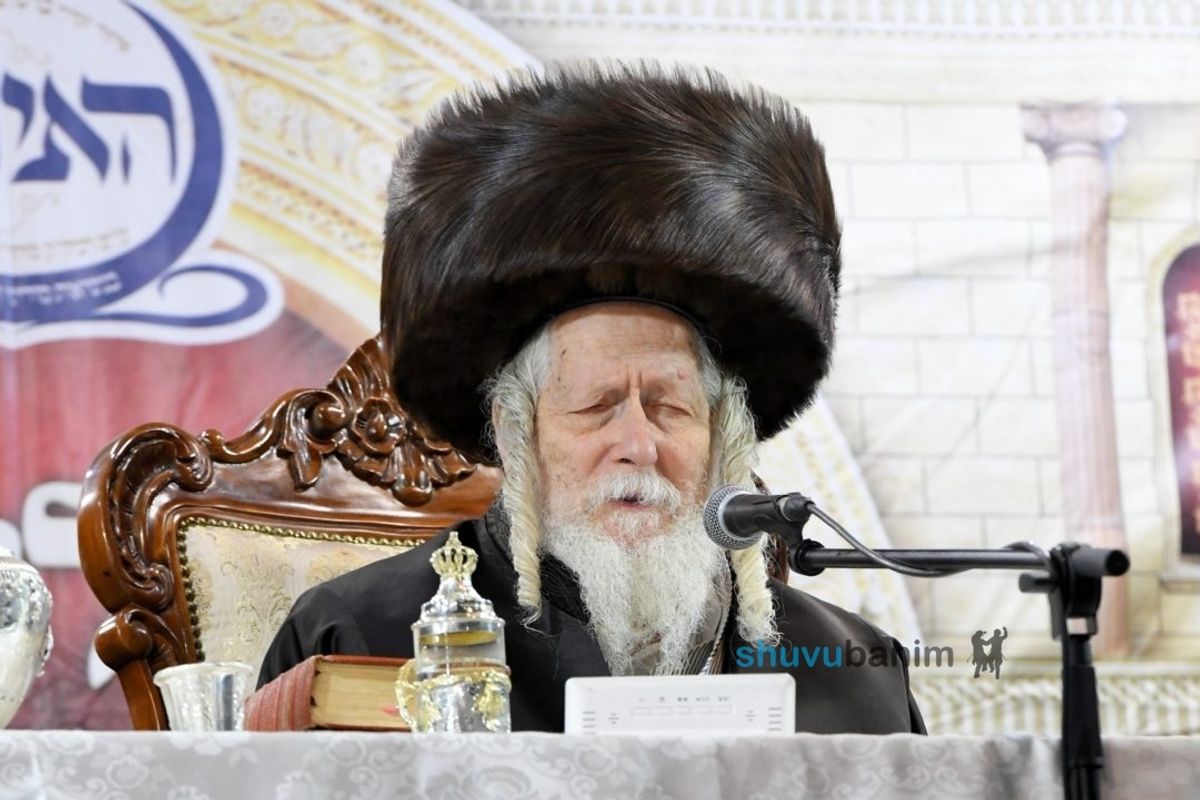
Presented here is a full transcript of the central address, delivered by The Rav, Rabbi Eliezer Berland shlit"a, at the Hilulah of Rebbe Nachman, 5784:
So today Rebbe Nachman is 252 years [since his birth]—from 32 to 84 is 52, plus another 200. And from the passing it is 213; last year [when it completed 212 years since his passing] it spelled the letters of “Rabbi,” and now it is “Ravya” [= 213]. “Ravya” means a baby—the Rebbe was like a baby who has not yet begun to live. The entire avodah of a person is to be like a baby who has not yet begun to live!
Because Rebbe Nachman is the soul of Moshe Rabbeinu—Yechidah. The Rebbe said (Chayei Moharan 267): “I attained Yechidah at the ultimate supernal level—Ein Od Milvado—Yechidah d’Yechidah.” For Rebbe Nachman is the nefesh of Moshe Rabbeinu, and Moshe Rabbeinu is nefesh d’Yechidah. Today is the Ushpizin of Moshe Rabbeinu. We say: “I invite to my meal the exalted Ushpizin…” and all together we say: “I invite to my meal the exalted Ushpizin—Avraham, Yitzchak, Yaakov, Moshe, Aharon, Yosef, and David.” Today is Moshe—the Ushpizin of Moshe Rabbeinu—this is Rebbe Nachman. He is the Moshe: “Enter, Moshe, my exalted guest, and let all the exalted Ushpizin sit with me and with you—Avraham, Yitzchak, Yaakov, Aharon, Yosef, and David.”
So now: Moshe Rabbeinu is nefesh d’Yechidah; Rashbi is ruach d’Yechidah; the Arizal is already neshamah d’Yechidah; the Baal Shem Tov is already chayah d’Yechidah; and now [Rebbe Nachman, holy and awe-inspiring] is Yechidah d’Yechidah. Rebbe Nachman says: “I merited Yechidah d’Yechidah—Ein Od Milvado.” Everything is Yechidah d’Yechidah. The entire avodah of the Tzaddik is Yechidah d’Yechidah—the entire avodah of the Tzaddik is to reach Yechidah d’Yechidah.
And therefore Rebbe Nachman opened the 32 Paths of Wisdom and the 50 Gates of Understanding. Now, at the yahrzeit of Rebbe Nachman, the 50 Gates of Understanding and the 32 Paths of Wisdom are opened. All the 32 Paths of Wisdom and all the 50 Gates of Understanding are opened on this night, and each person can begin to learn Torah.
As Eliyahu HaNavi said (Tanna d’Bei Eliyahu Zuta, ch. 14) to a man who used to catch fish—a fisherman who had nets. He said to him: “Why don’t you learn Torah?” He answered: “I have no seichel.” So [Eliyahu asked him]: “And how do you earn a living?” [He replied]: “I’m a fisherman. I make nets and catch fish.” He said: “To make nets you know how; to take threads and make nets you know how—so how is it that you don’t know how to learn?! How can that be?! You take one letter and another letter, one word and another word, and you combine them. You sit eight hours by the Gemara.”
For Rebbe Nachman said that without learning Gemara it is impossible to reach anything! The Rebbe said this in Torah 1: through Torah, all prayers and all requests are accepted. The Rebbe says: I mean the learning of Gemara. The Rebbe says: from Chumash a person does not become a lamdan. The Rebbe says this in Torah 12: we do not see that a person becomes a lamdan from Chumash; a person becomes a lamdan by building the Gemara—one builds the mind through the Gemara. The Rebbe says (Likkutei Moharan 12:4): what we see—that those who learn argue against Tzaddikim—this is a great intention! It is all so that through this there will be embracing, kissing, and yichud—whose initials are Chani. The Rebbe says that the fact that people argue against the “ben adam” is a great intention! Because the fact that they argue against the ben adam… why do they argue specifically against so-and-so? Because he knows how to elevate the tzerufim.
Because every word a person speaks is tzerufim. Every “Ki Tavo” is blessings—it is not curses. Therefore we read “Ki Tavo” before Rosh HaShanah; Ezra instituted to read “Ki Tavo,” and to read “Bechukosai” before Shavuos. For the Rambam explains that in Eretz Yisrael they would complete the Torah in three years—each parashah they divided into three. But just as Parashas “Zachor” is before Purim, so “Ki Tavo” was before Rosh HaShanah, and “Bechukosai” was before Shavuos, [for the reason:] “Let the year end along with its curses.”
Now all the curses are turned into blessings through the Tzaddik—“They will curse, and You will bless” (Tehillim 109:28), for “Hashem your G-d turned the curse into a blessing for you, because Hashem your G-d loves you” (Devarim 23:6). Every word and every letter that is spoken—he [Bilam] wanted to say “destroy them,” and it became “king” (Tosafos, Avodah Zarah 4b). Every word he said turned around on him; the letters were reversed. Curses are only tzerufim of blessings—blessings in disguise…
“Hashem will bring you back to Egypt in ships” (Devarim 28:68) [which seems like a curse; its meaning is a blessing]—that you will conquer Egypt. “By the way that I told you, you will never again see it.”
So a person comes into the world… King David said: “Master of the world, I want to conquer the entire world; I want to conquer the entire world.” David could have conquered the entire world. Hashem said to him: “I know…” “Who will bring me to the fortified city? Who will lead me to Edom?” (Tehillim 60:11). In Psalm 60 it says “Matzor,” and in Psalm 108 it says “Mivtzar,” because this is Rome. David wanted to conquer Italy, so that there would be no Rome in the world—to nullify Rome. Rome is the source of impurities; the Vatican—there are the Aron, the Mizbe’ach, the Menorah, and all the items are found in the Vatican. That is the root of impurity, and David wanted to clear it out, to nullify it. Devarim Rabbah says that David wanted to conquer Mount Edom: “You have circled this mountain long enough; turn northward” (Devarim 2:3). “Northward” is Se’ir—this means to conquer Rome, to conquer Italy. David wanted to conquer the entire world. He already conquered Damascus; he reached as far as the Euphrates…
David would ask the Urim v’Tumim about everything—whether it was possible to advance another step, another fortress: “Who will lead me to Edom? Who will bring me to the fortified city? Who will lead me to Edom?” He wanted to conquer all of Edom. “Who will bring me to the fortified city”—in Psalm 108 it says “the fortified city”—this is Rome.
So if the Tzaddik wants—the Tzaddik can conquer the entire world! He can bring the entire world back in teshuvah. There is no person whom he cannot bring back in teshuvah. The Rebbe can become spiritually “impregnated” within each person; within each person the Rebbe can become “impregnated,” and each person the Rebbe can bring back in teshuvah! Every person in the world—even non-Jews! He can even bring all the nations close to the faith of Israel (Chayei Moharan 251), so that they will keep the Seven Mitzvos of Bnei Noach, and that all will want to convert. For “All the peoples of the earth will see that the Name of Hashem is called upon you, and they will fear you” (Devarim 28:10), and “All inhabitants of the world and dwellers of the earth—when a banner is raised on the mountains you will see, and when the shofar is sounded you will hear” (Yeshayahu 18:3). “When a banner is raised on the mountains you will see”—on Rosh HaShanah, in Musaf, in Shofaros, we ask that the entire world should hear the sounding of the shofar.
For the sukkah itself is the shofar—the sukkah is the greatest shofar: we go out into the public domain and turn the public domain into the domain of the One. Because most sukkos are built in the public domain—meaning, we take the public domain and transform it into the domain of the One. The Tzaddik can transform the public domain into the domain of the One.
For after there was Sheviras HaKeilim, seven kings were created: Bela ben Be’or, Yovav ben Zerach, Chusham from the land of the Teimani, Hadad ben Bedad, Samlah from Masrekah, Shaul from Rechovos HaNahar—“Shaul from Rechovos HaNahar” is an acronym for Moshe—and after this was created Chanan ben Achbor; they reigned. And after these seven comes the king “Hadar”—King Hadar—whose city’s name was Pa’u, and his wife’s name was Meheitavel. Meheitavel is also MaH and also BaN.
MaH and BaN [five times, as will be explained later] together comes out “Sukkosah.” MeheitavE”L contains the letters of MaH, and after that yud-tes… tes plus alef is 10, and plus yud and lamed comes out 50, and plus beis is 52—so that is BaN: MaH and BaN. MaH and BaN comes out “Sukkosah,” “the sukkos.” Sukkos is to connect MaH and BaN, which is the gematria of “Uman.” Uman is 97—alef-vav-mem-nun is exactly 97. This is the yichud of MaH and BaN. If we take Uman times five—97 times five—we get the word “Sukkosah.” “Sukkosah” is exactly 485. 485 is the multiplication of MaH and BaN five times, corresponding to the five Sefiros.
For it is written [in Ma’aseh Bereishis] five times “light,” five times “firmament,” five times “water,” five times “Sinai.” All of these—why specifically five? Because there are five Sefiros: Chesed, Gevurah, Tiferes, Netzach, Hod.
Now we are in Chesed sheb’Netzach; today we are in Chesed sheb’Netzach. For on the night of Sukkos we entered Chesed sheb’Chesed, and after that on the 16th—which was yesterday—we entered Chesed sheb’Gevurah. Today [17 Tishrei] we were in Chesed sheb’Tiferes, and now tonight we are already in Chesed sheb’Netzach. We reached Chesed sheb’Netzach, which is the sefirah of Netzach—“LaMenatze’ach, a psalm of David.” “LaMenatze’ach”—sing to the One who rejoices when they “defeat” Him. Hashem rejoices when they “defeat” Him; Hashem says: “My children have defeated Me; My children have defeated Me,” when Rabbi Yehoshua stood and said: “It is not in Heaven” (Bava Metzia 59b).
For the halachah is like Rabbi Eliezer in every place. Rabbi Eliezer could make the stream flow backward; he uprooted the carob tree; the walls of the Beis Midrash shifted—he turned everything back.
For Rabbi Eliezer HaGadol can rectify the entire world. He can turn everything back—bring a person back to the day he was born, to the day he was born. From the day a person is born, he can make the waters go backward. This is Rabbi Eliezer HaGadol. And therefore in Heaven they proclaim: “The halachah is like him.” So even though the halachah is like him—like Rabbi Eliezer HaGadol—nevertheless we rule like the majority: when it is an individual against the many, the halachah follows the many. So Rabbi Yehoshua said: “It is not in Heaven.” Rabbi Yehoshua stood on his feet and said: “It is not in Heaven”—the halachah is like the Sages, the halachah is like the Sages [who are the majority].
For the Rebbe says that we must bring as many people as possible close to the Tzaddik. Even though we know that the main thing is quality, nevertheless great quantity brings great quality! The Rebbe revealed that the more people draw close, the more “houses” are multiplied! And when you reach 13, you already reach six billion. Because when we reach seven it is 5040; eight is already 40,000; nine is 360,000; ten is 3,600,000; eleven is already 40 million; twelve is 480 million; and when we reach 13 we are already at 6.2 billion. Meaning: when 13 people reach Rebbe Nachman, they already cover the entire globe—13 people is six billion. And when thousands reach—twenty thousand / forty thousand, or even forty-five thousand—then it is trillions upon trillions upon trillions upon trillions. A person could live a trillion years and still not be able to count how many combinations of “houses” exist through drawing close to the Tzaddik—drawing close to the Tzaddik without end. Every soul that draws itself close to the Tzaddik multiplies the number—multiplies the entire number—each soul.
So now we are here—now we spoke here about Yechidah d’Yechidah. For everyone who comes to the Hilulah of Rebbe Nachman is included in Yechidah d’Yechidah. Each one is included in Yechidah d’Yechidah. The moment we are included in Yechidah within Yechidah, we know that Ein Od Milvado.
So the Rebbe explains in Torah 12: that those who oppose—are doing the greatest good. They draw down all the shefa. “Let my soul be like dust to all”—“Your offspring will be like the dust of the earth” (Bereishis 28:14). Through the “dust”—through meriting to be like dust—one merits “like the dust of the earth,” one merits “Your offspring will be like the dust of the earth.” When one merits “Your offspring will be like the dust of the earth,” one merits that everything becomes dust; the person becomes dust—then “and he has dust of gold” (Iyov 28:6), and then he merits all the wealth in the world! The Rebbe says: I need the wealth of the entire world. So the Rebbe merited the wealth of the entire world—one third in commerce and one third in land, which is wealth. The Rebbe says that a person needs wealth; a person must reach such wealth as has never existed since the creation of the world—all the money and the gold.
For the manna would come down every day for two thousand years: “the matter of each day in its day” (Shemos 16:4)—each “day” is a thousand years; “the matter of each day in its day” is two thousand years. So the manna would come down for two thousand years. Each day, each person would receive manna for two thousand years. Hashem brought down so much wealth that it suffices for two thousand years. But wealth—the Rebbe says (Likkutei Moharan 60:4)—is only for women and those of small da’as. For the Tzaddik is “and now, all” (Bereishis 31:16); he does not need a penny, he does not need a coin. The Tzaddik is “and now, all.” And this is only for women and those of small da’as—“and now, all that G-d has said to you, do” (ibid.).
And this is what is written in Bereishis (ibid.), that Rachel and Leah said: “For all the wealth that G-d has taken from our father is ours and our children’s.” For the whole matter of the shekalim—when a person gives one hundred dollars, he receives on the spot one thousand dollars; if he gives one thousand dollars, he receives on the spot ten thousand; if he gives ten thousand, he receives one hundred thousand; if he gives one hundred thousand, he receives a million. Everything multiplies itself. The more tzedakah a person gives, the more he multiplies himself.
“Forgotten by the foot” (Iyov 28:4)—for the people of Sodom wanted to abolish commerce and trade. For every radish they uprooted from the garden bed, they would find a diamond. The Gemara brings in Sanhedrin 109 that every radish that was uprooted from the garden bed—every pugla (a radish)—they would find a diamond. So they wanted to abolish commerce and trade: from every radish they received a diamond—Odem, Pitdah, Barekes; Nofech, Sapir, and Yahalom. The Rav sings: Odem, Pitdah, Barekes; Nofech, Sapir, and Yahalom; Leshem, Shevo, and Achlamah; Tarshish, Shoham, and Yashpeh…
Subscribe to Our Newsletter
Receive Torah articles and inspiration directly in your inbox