
The Tzaddik Overcomes the Sitra Achra as if it Never Existed
Words of the Esteemed Rabbi Eliezer Berland shlit"a and Scenes from the Wedding of Yitzchak Stern shlit"a
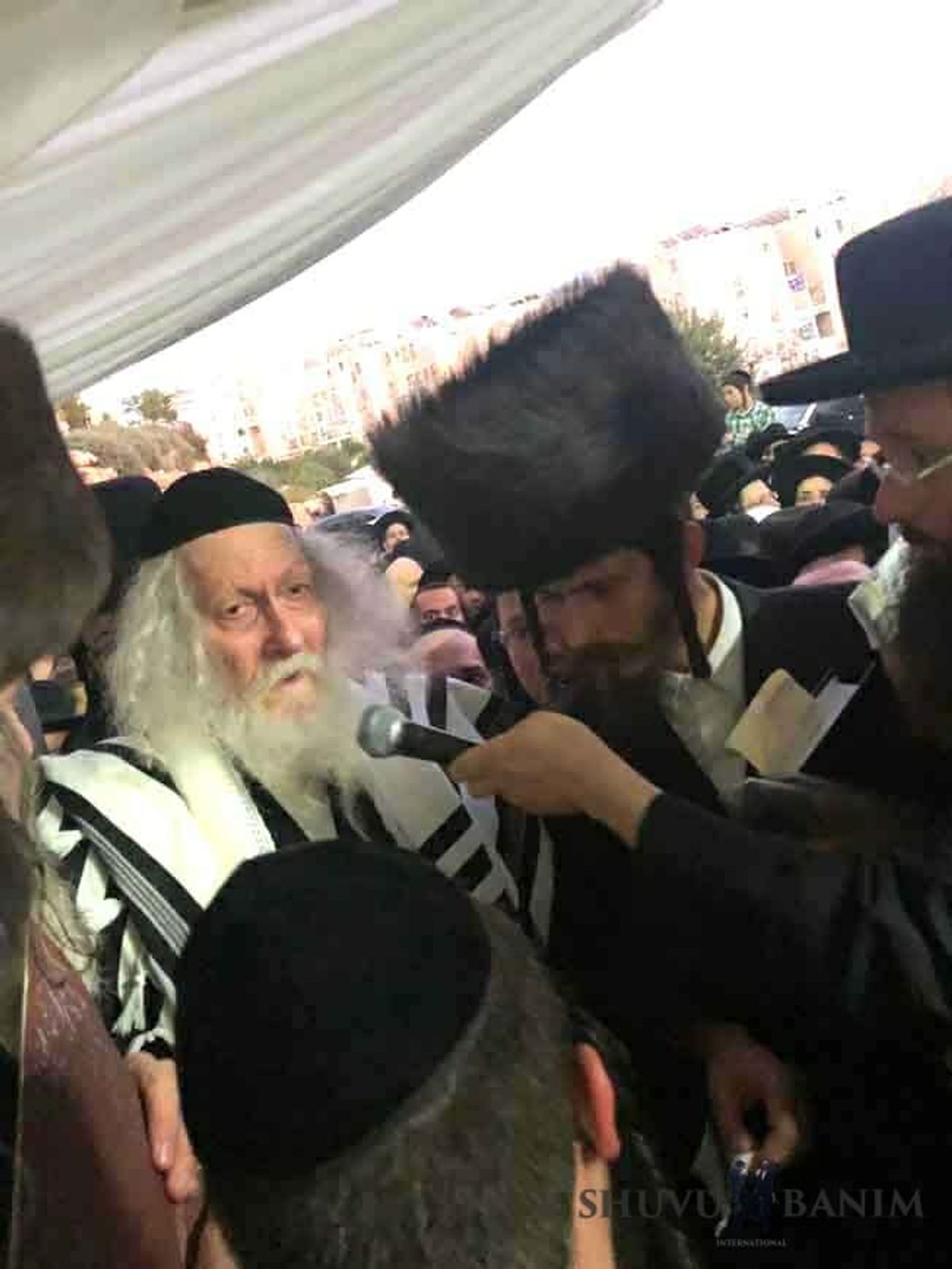
Yesterday, Monday night of Parshat Shoftim, the eve of 1 Elul 5778, the Gaon HaTzaddik Rabbi Eliezer Berland shlit"a arrived at the wedding of Yitzchak Stern shlit"a, son of the Gaon Harav Shmuel Stern shlit"a, head of the Nachalei Netzach institutions. The wedding was held at the Heichal HaNeginah halls at 21 Rashbi Street, Modi'in. Before conducting the chuppah, Rav Berland shlit"a led Mincha and Maariv prayers together with the large crowd, with the stirring moderation and emotional melodies that the Rav is accustomed to in every single prayer.
Words of the Gaon HaTzaddik Rabbi Eliezer Berland shlit"a delivered on the morning of Shabbat Ekev 5778:
"All sins are the 'se'ir' (scapegoat). When they walked with the tzaddik, the se'ir would disintegrate, but when they did not walk with the tzaddik, the se'ir would not disintegrate. In the time of Shimon HaTzaddik, the se'ir would be crushed immediately, but after 40 years, the se'ir would be caught by the 'zizim' (demons), ascend on high, and escape, and the sicarii and murderers would consume it. Whoever goes to Shimon HaTzaddik has all their sins atoned for immediately. Every sin sustains the murderers. The se'ir is the atom."
Every sin without the tzaddik creates an atom. When a person learns without the tzaddik, prays without the tzaddik, it goes to the kelipot (shells), it creates an atom. This Torah creates the atom. An atom is not the nuclear reactor in Dimona. Every mitzvah that a person does outside of the Land [of Israel] without the tzaddik, it goes to the kelipot, it goes to the Sitra Achra; it has no ascent. A person does a mitzvah outside of the Land, he gives power to the kelipot. A person must study Torah with the tzaddik, and pray with the tzaddik.
"'And at Tav'erah, and at Massah, and at Kivrot HaTa'avah.' The Kedushat Levi asks why 'Tav'erah and Massah' are written in the middle of 'Kivrot HaTa'avah' (Graves of Lust). Lust is like a grave! A person buries himself inside the lust. It is written, 'And we have reached until the nose,' a person sinks into the lusts up to his nose. There is no permission for this. The lust itself is forbidden. There is no permit for lust. The Netivot Shalom, the Chesed LeAvraham of Slonim, says that the 'permit' is more severe than the prohibition. The prohibition, people do two or three times in their lives, and even after that, he cries, he has bitterness, he regrets, he does teshuvah (repentance), he will not do it again. But the 'permit,' he does it for a hundred years non-stop; it already becomes 'permitted' to him, he does not stop with it. The 'permit' is worse than the sin."
"'From the desert and the Lebanon, from the river, the river Euphrates, and unto the hinder sea shall be your border' - the border is at the Euphrates River. David said, 'Who will bring me into the besieged city? Who will lead me unto Edom?' (Psalms 60). In [Psalm] 108 it is written, 'Who will bring me into the fortified city? Who will lead me unto Edom?' 'Fortified' is Rome. David wanted to conquer Rome. Rome did not yet exist; he wanted to conquer the region of Rome so that it would not exist, so that there would be no Rome at all. Hashem told him, 'This you cannot do.' 'When Hashem your God shall thrust them out from before you.' What is 'thrusting out'? The tzaddik thrusts out all the Sitra Achra!"
"Every three verses in the parshah it is written, 'Do not fear,' 'Do not fear' - it is forbidden to have a thought of fear. 'The whole earth is full of His glory.' When Aaron died, they received such fear, they fled eight journeys. 1. Moseroth. 2. Benei Yaakan until Kadesh. Kadesh is Hor HaHar; Hor HaHar is on the western side, not the eastern. After Hor HaHar, they crossed to the eastern side. Suddenly Aaron died, there were no Clouds of Glory in the desert, the King of Arad came, everyone fled. At Mount Sinai, out of great fear, they tore the ears of the women. They were in such fear, they tore from the mothers, they tore from the sisters, the earrings with half an ear. The Ohr HaChaim in 'VaEtchanan' describes exactly how they feared."
The tzaddik does not die. The tzaddik is with you, why are you afraid? Because they were afraid, the Clouds of Glory departed. Reb Noson says in Sichot HaRan 17 that if they had believed that Aaron did not die, the Clouds of Glory would not have departed. Why, when Miriam passed away, did Miriam's well disappear? ... A person is afraid, therefore he does not study, does not rise for prayer, does not pray, flees from the tzaddik. It is forbidden to have a thought of fear.
"It is written about Samuel, 'And no razor (morah) shall come upon his head.' What is 'morah'? Rabbi Yossi says (Nazir 66a) that he had no fear. The literal meaning of 'morah' is a haircut, but the drash (homiletical interpretation) is fear. Rabbi Nehorai asks, is it not written, 'And Saul will hear and kill me,' which shows that he did fear? The Gemara does not answer, but the answer is that Samuel did not want Saul to kill all of Bethlehem. If just for the business of the bread he killed all of Nov, the city of the priests, if he were to anoint David as king, which is rebellion against the kingdom in its literal sense, and is punishable by death in its literal sense, certainly he would kill all of Bethlehem."
"For every movement of the tzaddik, they killed an entire city. Everyone was afraid to help David. Anyone who helped David, they would kill him. Anyone who helps the tzaddik, they kill him. The people of Keilah wanted to hand over King David; he asked the Urim and Tummim if they would hand him over. Hashem told him, 'They will hand you over?! They already handed you over!' He fled, because every movement of his was according to the word – according to the Urim and Tummim. Every movement of the tzaddik is according to the word. They had no choice; if they had helped David, they would have killed them. King David fled, and then Saul came; they said, 'Just now he fled from here.' King David just happened to have the status of a rebel against the kingdom, but because Samuel anointed him, he is not called a rebel against the kingdom."
The whole matter of the tzaddik is to walk with the tzaddik through fire and water, and then the tzaddik arranges everything, straightens out all the crookedness, like the Ark of Joseph that went before the camp. The tzaddik casts down the Sitra Achra as if it never existed!
Subscribe to Our Newsletter
Receive Torah articles and inspiration directly in your inbox