
The Yahrzeit of the Rambam—Lessons and Prayers from Rabbi Berland shlit"a •
“From Moshe to Moshe, none arose like Moshe”
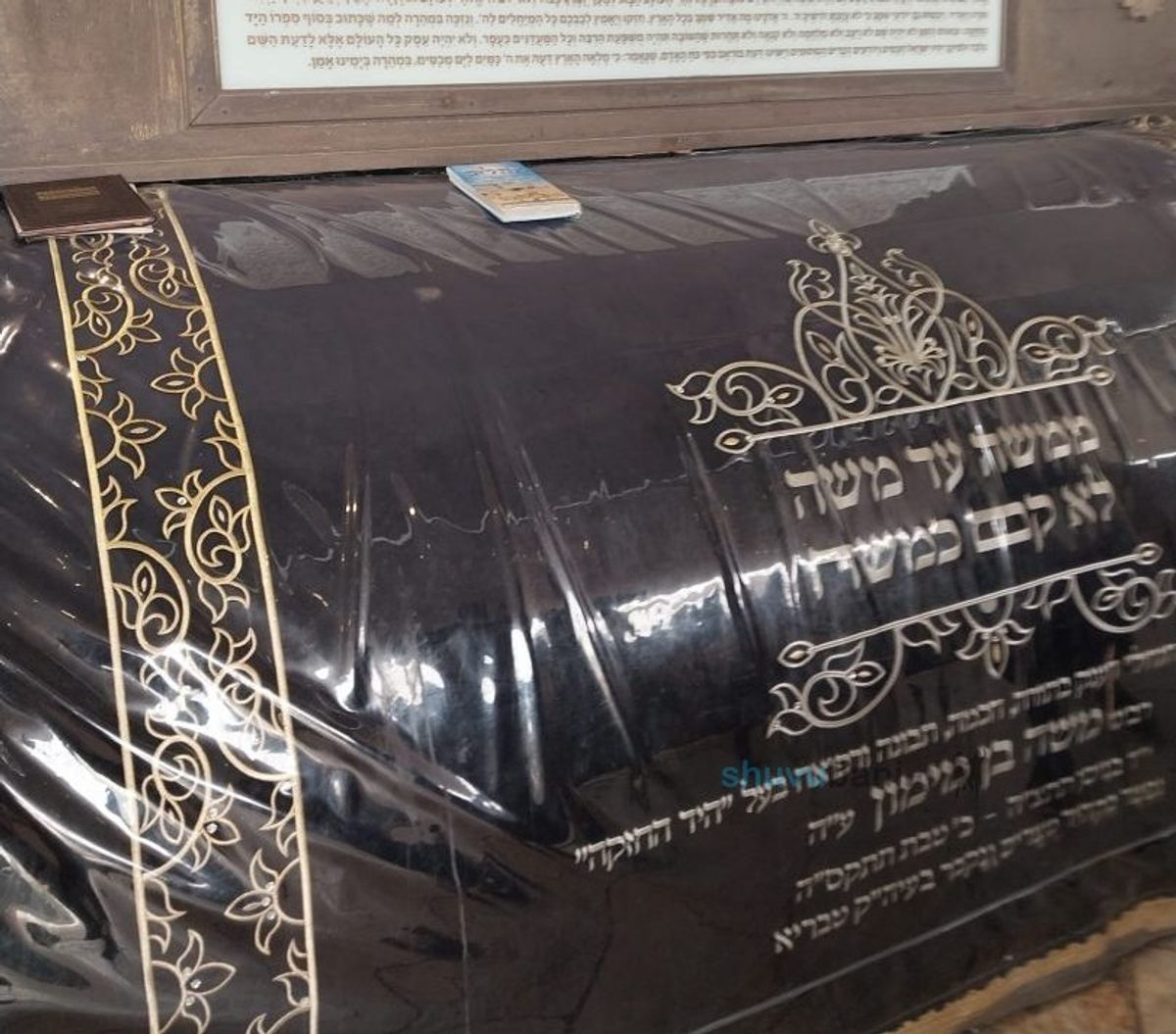
Today, the 20th of Teves, is the yahrzeit of the Rambam. Below are several excerpts from lessons about the greatness of the Rambam and words of strengthening on the preciousness of learning Rambam, from Rabbi Berland shlit"a:
The Rambam wrote his Commentary on the Mishnah while wandering from ship to ship on the “King’s Sea,” meaning the Mediterranean Sea—which the Rambam calls the “Salt Sea,” in contrast to sweet waters. As he writes at the end of the Commentary on the Mishnah (whoever wants can look at the end of Tractate Niddah, in Uktzin). He wrote the commentary at the age of twenty-three, when the entire Shas was already arranged in his mind, and he wrote it without any books—because he was wandering from ship to ship, from Fez in Morocco to Turkey, until he reached Eretz Yisrael. He was hungry, and [the Rambam] went down to Egypt.
The Rambam learned Shas without Rashi and without Tosafos; he had to understand everything on his own, without explanation. And by the age of thirty he completed the entire Commentary on the Mishnah. There he wrote that whoever finds an error in me—that I made a mistake—or whoever finds a mistake, this is beloved to me. Because a person must love those who rebuke him, for they bring him the World to Come; but those who merely honor him—what does he gain from that?
The Rambam wrote many works, and they were lost from him. He wrote a commentary on the Yerushalmi regarding the Mishnah (Chapter 5, Mishnah 1), always discussing the order of how the Kohanim in the Beis HaMikdash would pray: they would say “Barchu,” one blessing, recite the Ten Commandments, and say Krias Shema quickly in order to manage to pray before the offering of the Korban Tamid, and to bless the people after the offering of the Korban Tamid. There, in his commentary on the Mishnah, the Rambam wrote: “as I wrote in the Yerushalmi in Berachos.”
And the Rambam also revealed Kabbalah at the end of his life. Migdal Oz writes in Sefer HaMada that he found an old parchment—aged and smoke-darkened. I don’t understand how they used to write back then: there was no electricity; you needed a candle. Sometimes it would fall onto the candle and the writing would almost burn, or the ink and quill would fall near the flame and it would almost burn. There was once someone who came to light [a flame] and burned [something], and he did teshuvah for having lit it. And writing with a feather and ink is very difficult; sometimes it spills—any scribe knows that sometimes it spills. When I was in school it would spill and make a mess, and once the principal came and yelled.
And it is written there in an ancient, old, smoke-darkened script: “I, Moshe son of Maimon, testify: when I descended into the chamber of the Merkavah…” Because what the Rambam wrote—that this is Maaseh Merkavah and this is Maaseh Bereishis—stands opposed to Kabbalah. At the end of his life he retracted, but he did not manage to correct everything that was written against Kabbalah.
Two hundred years ago, when people would read the Rambam, they would tremble. Today people do not understand what the Rambam intended—things that make a person shake.
The Rambam wrote everything on ships—from Fez to Tunis and to Turkey—and he reached Eretz Yisrael and Egypt. And he had a tradition from his father about when prophecy would return to Israel (Rabbi Maimon the dayan son of Rabbi Yosef the sage son of Rabbi Yitzchak the dayan son of Rabbi Yosef the dayan son of Rabbi Ovadiahu the dayan son of Rabbi Shlomo son of Rabbi Ovadiahu the dayan). In the year 5572 (תקע"ב). And Rabbi Pinchas of Koretz said that truly, if we had merited, the Rambam would have lived another seven years and would have merited to receive the spirit of prophecy.
And there is a tradition about him that in truth everything the Rambam wrote—he would do Hisbodedus on an island in Egypt from the age of twenty until the age of thirty-six, and there he would receive his revelations. But he would never give up on a minyan. His uncle was wealthy, and he brought him ten “idle men” who spent the whole day fishing. When it was time for the minyan they would come, so that there would be Kaddish and Kedushah. In Kaddish he would receive his spiritual attainments, and so he was there for sixteen years, until at the age of thirty-six he went up with his child for a chalakah in Meron.
And when he reached Tzefas, he began to teach his revelations about Adam Kadmon. The Ridbaz, who was the Rav of the city, did not understand how he knew this—back then there was no “Zohar Mesuk MiDvash,” there were no commentaries on the Zohar; the Ramak had only begun to write a commentary. He sent the maggid, Rabbi Mordechai Alsheich, to go refute his words.
When Rabbi Mordechai Alsheich returned, the Ridbaz asked him: “So—did you refute his words?” He answered: “No. After all, you were sitting next to him.” He said: “I wasn’t there. You were sitting next to me—I was waiting for you to refute his words. I saw you weren’t speaking, so I didn’t speak.” Until they understood that Eliyahu HaNavi had come in the likeness of the Ridbaz.
The Gra said: Fortunate is the city that merited that Eliyahu HaNavi came in the likeness of the Rav of the city; and fortunate is the city’s maggid who saw Eliyahu HaNavi; and fortunate is the Rebbe—the Arizal was the Rebbe—whose shiur Eliyahu HaNavi came to hear.
Strengthening on the preciousness of learning Rambam:
A person needs to know the entire Rambam. The Rambam is written in such an easy language that even children at age three can understand it with ease. A person should take a child at age three and learn the entire Rambam from beginning to end. Within nine months one can finish the entire Rambam, because it is “only” straightforward halachos, in the simplest language in the world—and it summarizes the entire Shas.
The Rambam wrote the Commentary on the Mishnah while he was out at sea, tossed about inside ships that were standing on the water only by miracle. On every three ships, two would sink in the Great Sea; and in the sea (the Red Sea) [the Great Sea—in the ocean], out of every five ships, four would sink. And it took the Rambam ten years to compose these halachic chidushim; they were arranged and known to him by heart. And the Commentary on the Mishnah took another ten years.
And the first thing is to merit seichel. Rebbe Nachman says that a person received seichel so that he would learn Gemara with seichel. Instead of learning Gemara, he looks at iPhones; he looks at the internet—just “for the seichel,” to show that there is seichel in everything. Rebbe Nachman is pure seichel alone.
As it is written in the Rambam regarding Moshe Rabbeinu—that for Moshe Rabbeinu there remained only seichel. This is the Rambam’s language in Sanhedrin (Commentary on the Mishnah, the Thirteen Principles): that Moshe remained seichel alone; he did not have a body at all, and he did not have any likeness of a body, and he did not have anything—these were only imaginings, as if he had a body. Neither the Rambam nor Moshe Rabbeinu had any body; the Rambam says that only seichel remained.
Now, during Shovavim, one needs to learn every day the five chapters of Rambam. But it is impossible to understand any Rambam without Ketzos HaChoshen. Everything is full of apparent contradictions. You have to find where the Ketzos speaks about the Rambam you are learning—without that, you don’t understand.
So the Rambam writes, in a few words, in Hilchos Nachalos (2:14): even if a father says about someone who was never established as his son at all, “He is my firstborn son,” he is believed. Meaning: even about a person eight years younger than him, who was never connected to him, and people say to him, “What do you have to do with him? You have no connection at all; they never knew he was connected to him”—if he says, “This is my firstborn son,” that’s it: the entire inheritance passes to him—all the wealth, the million that I have among the relatives—everything.
A prayer written by Rabbi Berland shlit"a to say on the day of the Rambam’s yahrzeit:
To merit making a siyum every single year on the holy Rambam’s sefarim—he was one of the unique giants of the generations, and “from Moshe to Moshe, none arose like Moshe”
Please, Hashem, merit us every single year to make a siyum on the holy and awesome Rambam—“for from Moshe to Moshe, none arose like Moshe.” Please, Hashem, merit me to learn every single day—he was unique in all the generations, until the coming of Moshiach, from the destruction of the Second Beis HaMikdash.
And may we learn every single day three chapters of Rambam, and through this we will merit to make a siyum on the Rambam every single year on his hillula. And we will make a siyum every single year, all the days of our lives, for all one hundred and twenty years—and through this we will be included within Adam Kadmon of Adam Kadmon, in the Kesser of the World of Atzilus.
An additional prayer written by Rabbi Berland shlit"a to say at the Rambam’s grave in Tiberias:
Master of the World, Almighty, from Whom no plan is withheld: as I stand here beside the holy and awesome tziyun of the holy Rambam, my bones tremble from fear, with awesome awe and dread before You, Hashem our G-d, Who suspends the earth upon nothingness.
May I merit, in the merit of the Rambam, to be pure and holy before the King Who performs wonders. And may I merit from now on, in the merit of the holy Rambam, never again to look at any forbidden woman in the world at all, Heaven forbid; and not at any forbidden girl in the world at all, Heaven forbid. And may I never become angry, and never be strict and exacting, and never inform against anyone; and never be hurt by anyone. And even if they hurt me tens of thousands of times, I will never be hurt by anyone.
And may I merit to learn all the holy Rambam’s sefarim—especially the Yad HaChazakah, the fourteen books—together with Lechem Mishneh, Maggid Mishneh, Rabbeinu Manoach, Kesef Mishneh, Hagahos Maimoniyos, and Migdal Oz; the Gra; Rabbi Akiva Eiger; Ramban; Rashba; Ritva; the Hagahos HaRamak; the Rambam’s responsa; the responsa of Avraham the son of the Rambam; Or Sameach; and all the sefarim and commentaries written on the Rambam from time immemorial; and the Rambam’s Commentary on the Mishnah.
And may I know everything—straight and reversed—with breadth and with depth. And may I not, Heaven forbid, leave this world without knowing the Rambam perfectly—every word and every letter, together with all variant readings. And may I persist in learning Rambam day and night without pause and without weariness, with chavrusos and alone. And may nothing in the world be able to stop me from learning the holy and awesome Rambam, until I know all his halachos with complete clarity.
A prayer to merit learning every day 5 chapters of Rambam:
That all our descendants will persist in learning Shas and Rambam
Master of the World, Almighty: merit me to learn every single day eight pages of Gemara and five chapters of the holy and awesome Rambam. And through this, to be included within Adam Kadmon of Adam Kadmon—within Nukva d’Fardashka [Chotama d’Atik], in the right opening of Nukva d’Fardashka.
And through this, may we merit to be included in Ruach d’Chayyin and Chayyin d’Chayyin—the spirit of Techiyas HaMeisim—just as Asher merited, as it is said: “Hashem Echad” (1), “U’leAsher” (537) “amar” (241) “baruch” (228) “mibanim” (112) “Asher” (501) = 1750. For Moshe permitted Asher to release the cherem because his daughter revealed that Yosef was still alive and king in Egypt, and that he had two sons—Menashe and Ephraim.
And may we merit that all our sons and grandsons, until the end of all generations, from the age of seven will already merit to learn every single day eight pages of Gemara and five chapters of the holy and awesome Rambam. And below the age of seven: one chapter of Rambam every day; five chapters of Mishnayos every day; and two chapters of Tanach every day—beginning with Shmuel I, and Yehoshua at the end of the year.
And the daughters as well will learn from the age of five: two chapters of Tanach every day; one chapter of Rambam every day; and one complete book from the five books of Tehillim.
And through this they will merit to be included in the Adam of Adam Kadmon, in the soul of the holy and awesome Rabbi Shimon bar Yochai, who was in the cave for thirteen years and ate only carobs—without Kiddush and without the Four Species—because he attained them spiritually; everything according to sod.
And through this, may we merit to be included in the right opening of Nukva d’Fardashka, from where comes the spirit of Techiyas HaMeisim; and may we merit to revive all the dead in the world.
Subscribe to Our Newsletter
Receive Torah articles and inspiration directly in your inbox