
Thirty Years Since the Histalkus (passing away) of Rabbi Yisrael Dov Odesser
zt"l • The Story of His Coming Close by Rabbi Eliezer Berland shlit"a
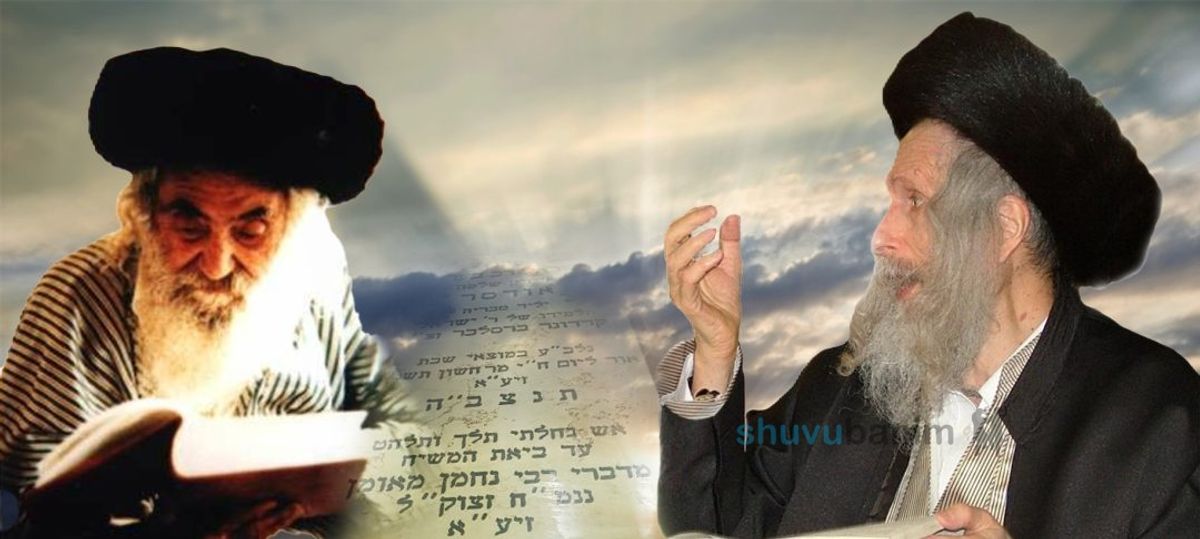
18th of MarCheshvan 5785 - 5755: Thirty years since the histalkus (passing away) of the Tzaddik Rabbi Yisrael Ber Odesser zt"l. Before you is an excerpt from a lesson given by Rabbi Eliezer Berland shlit"a, in which he tells the fascinating story of his coming close:
Rabbi Yisrael Ber Odesser would spend his whole day reciting Likutey Tefillot (collection of prayers). He arrived at the Al-Fandari neighborhood. There, he saw someone in the corner who also said only Likutey Tefillot; that man was already one hundred and fifteen years old, while Yisrael Ber was just a seventeen-year-old boy. He wondered about this boy—how was he even treated there? In the Yeshiva of Rabbi Meir Baal HaNes, that was the only yeshiva; there were no others. What was Breslov even? There were only Karliners and Slonimers. He didn't even know that Breslov existed in the world; he knew nothing of it. He only knew of Karlin and Slonim, which is what existed in Tiberias. There were no Gerer Chassidim yet, none of those things. They weren't even talking about it in 1914 (5674), which was already the start of World War I. There was no Ger here yet, nothing. There was no other Chassidus here at all, only Karlin and Slonim—that was it. And he knew only of Karlin and Slonim, and now he sits and recites Likutey Tefillot. He reaches Al-Fandari and asks, "What is happening with this boy?" A poor, miserable orphan boy, with a blind father, no chavrusos (study partners), and no one to care for him. There were eight other children at home, all sleeping in a tiny room the size of a kitchen, on the floor, because there was no space. It is impossible to describe the poverty that existed then. It is impossible to describe the level of poverty. The moment the English arrived, everyone became secular in a second; everyone fled their homes. They ran away to become lawyers and doctors, to establish hospitals. People literally starved to death—they literally died of hunger.
There were nine children lying on the floor in a room a third of this size, maybe a tenth of this size. There was no room to move a foot or a hand. It was already nine at night, and suddenly there was a knock at the door. Someone knocks at nine at night, and outside it is raining—it's the month of Tevet. In Tiberias, the rain falls even harder than in Safed because it is low-lying. You can't see a meter ahead, you can't see anything. Someone knocks, and Yisrael Ber opens the door. He said, "I suddenly saw a searchlight; I saw Eliyahu HaNavi (Elijah the Prophet)." All the time, he had been praying that he wanted Breslov; he prayed in the fields, doing Hisbodedus (secluded prayer). The building was surrounded by forests; there were no other buildings there. It was a lone building outside the city, where he would go out into the field. And there was no one to learn with him, no one to arrange chavrusos (study partners) for him. We stayed at his house, sleeping and eating everything for two years, and he stayed with us. You must remember him from when you were still a child, that he would sleep and eat at our home.
And he told me himself that it wasn't what people thought regarding the Petek (the famous note). He told me himself, "It wasn't from Heaven; I don't know who wrote it for me." But it happened on that day when he was already broken. He said it was the 17th of Tammuz (a fast day), and he was riding on a donkey; it was the longest day of the year. There is long and short, male and female, black and white. Sunrise was at 4:30 and sunset was at 7:00. He was traveling in the scorching sun from Safed on a donkey, and he felt he was about to faint. So he went into a room and closed himself in to eat because of pikuach nefesh (danger to life), and someone had followed him. That person wrote to him: "I know that you just ate on the 17th of Tammuz, therefore you are receiving a note from Heaven in the merit of your eating." If you want to receive a note from Heaven, eat on the 17th of Tammuz and you'll get one—that was the advice. He said—the person was making fun of him—he said to him, "I know you ate." And the sign that it was "real" was that you just ate now. So that person placed the note inside the book Likutey Halachos, Yoreh Deah. He had just taken the Likutey Halachos out of the cabinet when he saw the note. The person knew he was about to open the Likutey Halachos. So he told me himself that he knew it wasn't from Heaven. He sent it to Uman, and there everyone laughed at it. Rabbi Levi Yitzchak (Bender) told exactly how it arrived in Uman, and they didn't want to hurt his feelings... after all, he was just a boy, why hurt him? They told him, "Fine, we received it." They didn't say yes and they didn't say no.
In any case, when he opens the door, he had been praying for Breslov, because he had returned from the field with the book Hishtapchus HaNefesh (Outpouring of the Soul). He had found it in a genizah (repository for sacred texts), and that is how he began to come alive. He was already at the peak of despair, and someone grabbed the book from him—"What is this? Is this Breslov? Breslov!!? Don't you know? Eliyahu HaNavi was here, and all the Admorim and all the Rabbis and Roshei Yeshivas placed a cherem (excommunication/ban) on this book!" He replied, "Even if Eliyahu HaNavi comes now, I won't listen. You aren't Eliyahu HaNavi... what is this? This book is my entire life!" That person tore the book Hishtapchus HaNefesh; only two pages remained after he tore it, and with those, he went to the field. And now, for the first time, he heard that Breslov existed in the world. He understood that Breslov meant the Lamed-Vav (36) hidden Tzaddikim. And then he began, and he prayed for two months for Breslov—that Hashem should send him Breslov. Suddenly he sees someone (Rabbi Yisrael Karduner), and he says, "This is Eliyahu HaNavi, this isn't just Breslov, this is one of the Lamed-Vav Tzaddikim; he's going to fly into the air any moment." And then he (Karduner) performed Netilat Yadayim (ritual hand washing) like nothing else in this world, and a Hamotzi (blessing over bread) like nothing in this world, and a Birkat HaMazon (Grace After Meals) that lasted a whole hour with such roars. The blind father agreed to let him stay; he asked permission, as the father couldn't see anything. He sat there and boiled him a cup of tea. He said, "I only drink a cup of tea and eat a slice of bread." Rabbi Yisrael Karduner had performed a she'elat chalom (dream inquiry) to ask how much to eat each day, and they told him: two slices of bread and a cup of tea, twice a day. He (Yisrael Ber) wanted to make him an omelet or an egg, something, but he wouldn't have it under any circumstances. And it was a miracle that he found a magnificent building in... the brother of his wife—of his mother, of Yisrael Ber, the one who used to make the flour...
So all this is being discussed—"I saw Eliyahu HaNavi." He said that he (Karduner) sits for an hour reciting Birkat HaMazon. He goes outside, and a flood is coming down—what a torrential rain! You can't see a meter! You can't see a centimeter! But the doorframe was a bit wide, and they stood there, and Yisrael Ber says to Rabbi Yisrael Karduner: "I prayed for a Breslov Chassid, and Eliyahu HaNavi came to me! I'm afraid you're going to fly away from me now. Don't run away..." He said, "Fine, come." They went to look for a synagogue, but there was no synagogue; everything was closed and locked. In the torrential rain, the Arabs there could burn the synagogues, I know... and finally, he asks him, "Is there no synagogue open? Something they forgot to lock?" He says, "There is one on the shore of the sea (the Kinneret), they don't lock it there because it's already full of water and impossible to learn in, so let's go there." They went and saw it was all full of water; only one bench and one table remained. He opens Likutey Moharan to the Torah "Ki Merachamav Yenahagem" (For He who has compassion on them shall lead them) and lit a candle. During World War I, there were no candles and no food; children were dying of hunger. So they sat and learned until five in the morning, the entire Torah of "Ki Merachamav Yenahagem." Where the Rebbe says that the Tzaddik is the true compassionate one, and that the whole point is to believe in the True Tzaddik!
Subscribe to Our Newsletter
Receive Torah articles and inspiration directly in your inbox