
Tree, With What Shall I Bless You? • Tu B'Shevat Conference for the Avreichim
(married Torah students) of the Shuvu Banim Community
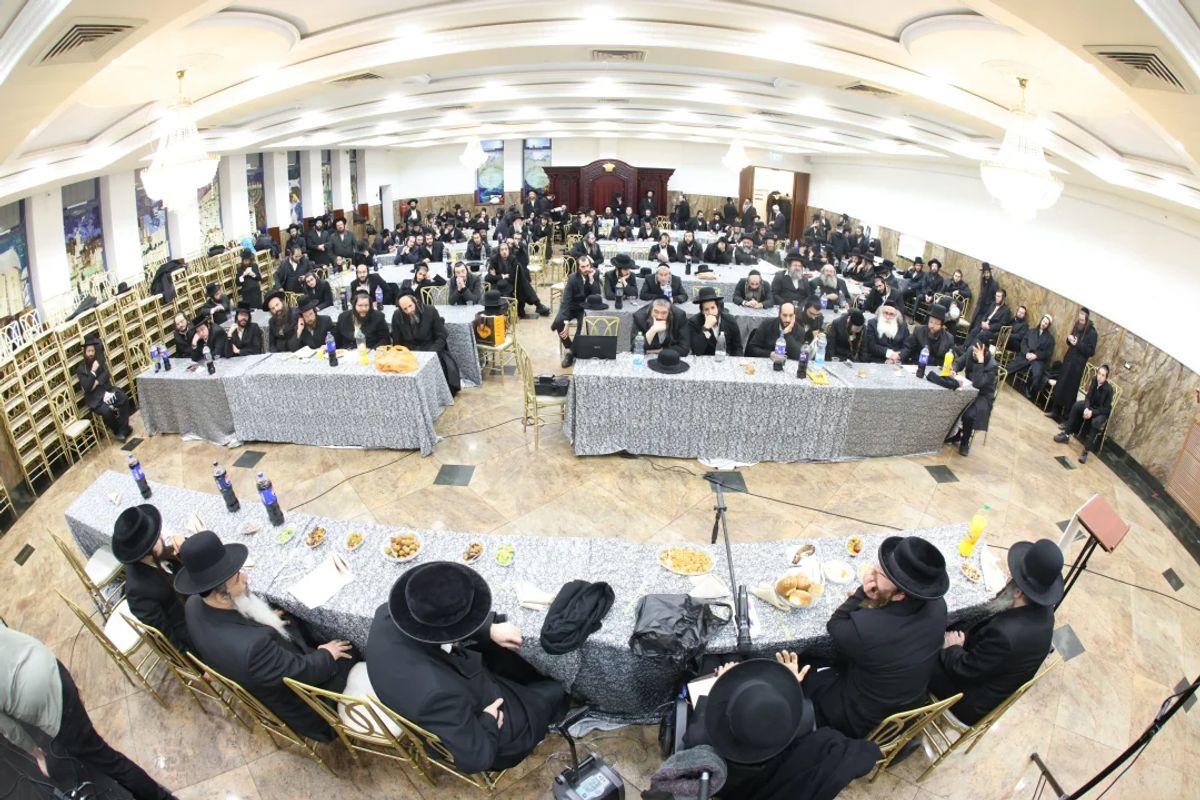
Truly, how magnificent was the sight when hundreds of members of our holy community gathered this week for an impressive and unique unity conference, hosted by the 'Union of Avreichim' (married Torah students) in honor of the upcoming New Year for Trees (Tu B'Shevat). This conference follows the previous event held on the eve of Hanukkah, which left a powerful impression on the hearts of the participants, who received many tools and much encouragement from the gathering.
Immediately following the previous conference, several chaburos (spiritual study groups) were established among Anash (our community), who meet once every week or two to strengthen one another through song and melody, regular study, and words of longing according to the path and guidance of our teacher, the Rav, Rabbi Eliezer Berland shlit"a (may he live long and good days). Now too, with the conclusion of the current conference, many of the community's avreichim (married Torah students) turned to the management of the Union, requesting to organize themselves into a chaburah (group) for the sake of Heaven.
The event, which was conducted with great taste and magnificent splendor, was hosted by the honorable Chassid Rabbi Nachman Edri shlit"a, director of the 'Chachma U'Daat' Yeshivas. With pleasant speech, he welcomed those present and spoke about the secret of the greatness of the days between the tenth of Tevet—the yahrtzeit (anniversary of passing) of Moharant (Rabbi Noson of Breslov) zt"l—and the fifteenth of Shevat, the day of his birth and the shining of his great light upon the world.
Afterward, Rabbi Edri brought the fourth story from the Sippurei Maasiyot (Stories of Rebbe Nachman)—'The Tale of the Cripple'—where Rebbe Nachman z"l tells: "There is a story of a wise man who, before his death, called his sons and family and commanded them to water trees. You also have permission to engage in other livelihoods (parnassah), but in this, you should make an effort—to water trees."
The honorable Chassid Rabbi Levi Yitzchak Bender zt"l (of blessed memory) explains in his teachings that Rebbe Nachman's intention in 'watering trees' is to instill vitality and encouragement into another person. Following this, he asks: first, if they can engage in other livelihoods, why is the main thing to water trees? Second, does engaging in other livelihoods not contradict the watering?
He answered that livelihood (parnassah) is when a person engages in Torah and prayer. But the main thing Rebbe Nachman z"l warns us about is to water trees: to study and then illuminate the words of Torah for a friend; to pray with enthusiasm and then share the sweet and delightful taste of prayer with a friend. And so it is with all service of Hashem (God)—in the work of joy, in performing acts of kindness, and so on. In this way, one engages in all livelihoods, and all livelihoods become the watering of trees.
Moharant (Rabbi Noson) writes in Chayei Moharan (Service of Hashem 543): "Many times he would speak much with us and warned us greatly to bring souls closer to Hashem Yitbarach (the Blessed Creator), to make an effort to speak much with people in order to awaken them and bring them back to Hashem Yitbarach. His will was even to speak with worldly people mundane conversations about worldly affairs, perhaps from this would grow and evolve words that would awaken them to Hashem Yitbarach. And even if it only achieves a slight movement, that some thought of teshuvah (repentance) or a temporary awakening enters them, that too is very good. Certainly, it is possible that over time, as he speaks with them again and again, he may merit to truly awaken them to Hashem Yitbarach and bring them closer to His service, than which there is nothing greater... and he, of blessed memory, spoke at length with us many times about this, and urged us to this very much with many types of expressions. And many times he would shame us with rebukes because we were lazy in this, and once he called us 'dry trees' because we do not give birth to souls that would be brought closer to Hashem Yitbarach through us."
Rebbe Nachman z"l would invest in 'Anshei Maaleh' (elevated individuals), because when you bring elevated people closer, you bring many people after them. Rebbe Nachman z"l placed a strong emphasis that a person should not serve Hashem by himself and alone, but should help and awaken his friends. And now, on the eve of the New Year for Trees, we must instill vitality and the dews of resurrection in our hearts, and unite with friends—which is why the 'Union' was established—to show a shining countenance and bring those who are near even closer.
Afterward, Rabbi Edri shlit"a welcomed one of the most well-known and famous historians, quoting the words of our teacher, the Rav shlit"a, who constantly says that history is a living book of mussar (ethics). The matter of the Holocaust is also very close to the Rav's heart, as he repeatedly recites the Torah's command: 'Remember what Amalek did to you... do not forget.'
Rabbi Edri said in the name of the Rav shlit"a that the Holocaust was a great 'eis ratzon' (time of Divine favor). Millions of Jews practiced mesirus nefesh (self-sacrifice) and died for Kiddush Hashem (sanctification of God's name), serving their Creator until the very last moment of their lives. Rebbe Nachman z"l explains in Likutey Moharan (Torah 57, Part II) that Hashem's providence in the Land of Israel—as the verse says, 'The eyes of Hashem your God are always upon it from the beginning of the year to the end of the year'—comes from His pride in the good deeds and fulfillment of mitzvot by the Jewish people. The Rav shlit"a explained that in the merit of the self-sacrifice of so many Jews during the Holocaust, the entire Jewish people merited to ascend to the Holy Land.
At this stage, a presentation was shown about acts of heroism and self-sacrifice from the Holocaust in Poland, Ukraine, Russia, and other countries of smoke-filled Europe. Those present watched with emotion a moving video showing a group of Jews united, including a 14-year-old boy, as they studied in a hiding place. This film was shot by the Nazis, may their names and memory be erased, who, after finishing the filming, shot all the Jews to death, may Hashem avenge their blood. O earth, do not cover their blood!
In the presentation, the editor linked these matters to our generation, a generation of luxury where food and lodging are not lacking, yet with every small difficulty that arises, our service of Hashem is shaken. We must learn and teach our future generations from the self-sacrifice of the Jews during the Holocaust.
People who experienced the terrible Holocaust testified that every act of self-sacrifice they merited to stand through with heroism empowered their spirit more and more with inexhaustible strength. It is told of a group of elevated individuals led by the Mashpia (spiritual mentor) Rabbi Gedalia Eisner zt"l, who climbed onto an immigrant ship in the middle of the war and docked at the shores of the Holy Land in the middle of the holy Shabbat. Since they did not know if they were permitted to disembark, they remained on the ship.
Everyone around them pleaded with them to disembark before the British came and blew up the ship, but they remained on the deck and held Seudah Shlishit (the third Shabbat meal) with spiritual elevation and songs of attachment and longing. For this is what Jews do in a time of self-sacrifice—they sing songs to Hashem Yitbarach and fulfill His will with joy and gladness, with exultation and song.
This is what we must impart to our generations after us, and this is what the chaburos (groups) impart to us. The holy Rebbe of Belz zy"a (may his merit protect us) said to the holy 'Imrei Emes' of Gur: 'Your Chassidim performed Kiddush Hashem.' They studied during the Holocaust with self-sacrifice and remained attached until their last drop of blood, and all this was in the merit of the unity and friendship in the chaburah, which provides strength even in times of weakness.
Those present watched additional moving videos about keeping Shabbat and performing mitzvot with self-sacrifice during the terrible war, and heard guidance on how to bequeath this to future generations in a Chassidic atmosphere of joy and song.
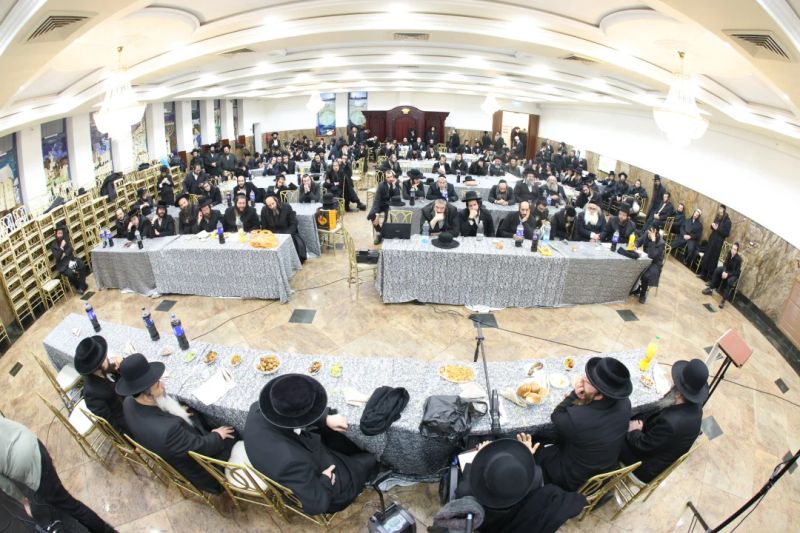
After the fascinating lecture, the gathered merited to hear the personal and strengthening story of Rabbi Yisrael Kepler, who with great talent spoke beautifully, accompanied by musical instruments and melody. Rabbi Kepler described his first journey to the grave of our holy Rebbe in Uman, the obstacles and difficulties, and the opening of the heart and connection to internal service.
He also strengthened those present regarding the greatness of the power of melody and song, and the special quality of Hisbodedus (secluded prayer) and speaking to Hashem—that all these are capable of bringing a person to very high and sublime peaks.
The conference was honored by the participation of the honorable Chassid Rabbi Moshe Tzanani shlit"a, who came with self-sacrifice to strengthen those present. He spoke about the importance of unity among the community members with a 'good eye' and a generous spirit. Rabbi Tzanani said that although with our teacher, the Rav shlit"a, we see that he serves Hashem with enthusiasm in every situation and at all times, and does not need a supportive environment or group members to strengthen his service, we, the simple folk, certainly need a chaburah (group) and support at all times.
People think that when they serve their Creator alone, they will reach higher places. But experience proves that one who served Hashem by himself did not sustain it for long. Conversely, one who is united with a chaburah and constantly receives encouragement and strength from friends, his resolutions and service endure for many days and years.
Rabbi Tzanani spoke at length about the great merit of praying with enthusiasm, as is accepted from Rebbe Nachman z"l—that one for whom prayer is difficult should imagine in his soul that he descended to the world in a reincarnation to rectify the prayer from 'Hodu' until 'Baruch She'amar,' and afterward imagine that he only needs to rectify from 'Baruch She'amar' until 'Ashrei,' and so on in this manner.
Afterward, he expanded on the necessity for a 'good eye' and the shining countenance that should prevail among the community's avreichim. For serving Hashem with a good eye is much more sublime and more accepted and desired Above.
Subsequently, the director of the institutions, Rabbi Natan Hananya, was honored to review the 'Union' system for the community's avreichim. He also expanded on future plans to organize conferences for the community's women, as well as establishing assistance for new mothers, and setting up a series of classes for the avreichim on the subject of child education and Shalom Bayit (domestic harmony).
Afterward, those present merited to watch a screening of a lesson from our teacher, the Rav, Rabbi Eliezer Berland shlit"a, who spoke at length in his holy words on the greatness of the tribe of Zebulun, who are mentioned by the Prophet in the Haftarah of Parshat Beshalach.
The Rav explained at length why Jael took a tent peg to kill Sisera despite the risk that he would wake up, and did not take a knife or sword.
It is because these are weapons of war, and it is the way of a man to go out to war; therefore, these are 'male implements.' Jael did not want the miracle to be performed through the prohibition of 'Lo Tilbash' (a woman shall not wear/use a man's things), and therefore she practiced self-sacrifice and killed Sisera with a peg and not with a sword.
Afterward, the Rav said that from the tribe of Zebulun we learn that one must serve Hashem 'without a heart'—meaning without worries and fears that perhaps I will not succeed or perhaps my service is not desired. On the contrary, they followed the Tzaddik, 'Deborah the Prophetess,' with a whole heart and with simple and innocent faith (emunah).
The Rav shlit"a awakened those present to the importance of diligence in the study of the holy Torah, which is the foundation and guarantee for all our service of Hashem. May it be His will that we merit to serve Hashem all our days with a willing heart and soul.
With the conclusion of the event, the organizers distributed 'the best of the land' to the participants—special kits with fruits in honor of Tu B'Shevat. The participants thanked with all their hearts the management of the institutions, who invest great efforts throughout the year and especially now with the holding of this special and strengthening event, led by Rabbi Natan Hananya, director of the institutions, and Rabbi Moshe Miller for the unique and amazing production with thought given to every single detail for the welfare of the community's avreichim. We also mention Rabbi Shimon Cohen, who contributed and assisted greatly in the design and strategy of this magnificent occasion.
The avreichim left the conference happy and moved, their faces shining with a precious light, filled with tools and wonderful advice for strengthening and standing against all the trials of the generation and the schemes of the Yetzer (evil inclination). Fortunate is he who merited!
Before you is a magnificent photo gallery:
Subscribe to Our Newsletter
Receive Torah articles and inspiration directly in your inbox