
When a Person Does Something for the Sake of Heaven
It Shines—Even Esav! • The Daily Lesson from the holy Tzaddik Rabbi Eliezer Berland shlit"a
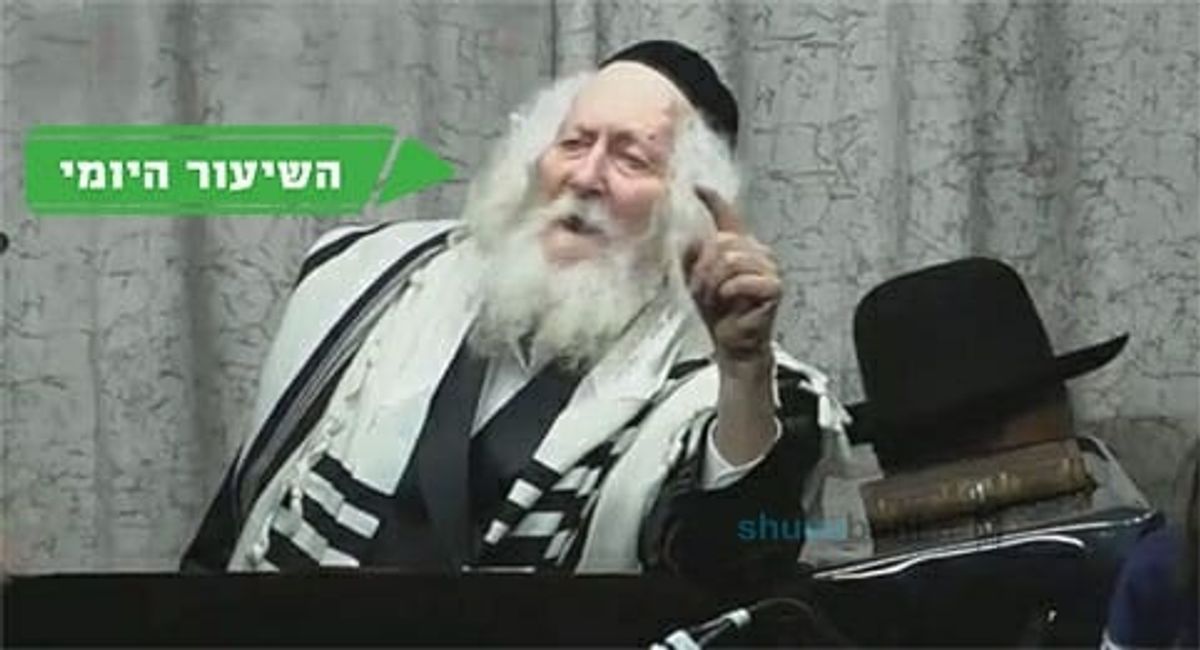
Here is the complete daily lesson as delivered by The Rav, Rabbi Eliezer Berland shlit"a, on Sunday night, the eve of 11 Kislev—after the Ma’ariv prayer:
It is written, “And he kissed him” (Bereishis 33:4). He gave him real kisses—kisses with all his strength. He fell on his neck and cried. The poor fellow—he cried and cried and cried. He cried and kissed; he cried and kissed. On the word “And he kissed him” there are seven dots—seven dots, corresponding to seven prophetesses: Sarah, Rivkah, Rachel, Leah, Esther, Avigayil, and Chanah.
Chanah was a prophetess, and she prophesied about Chanukah. Even though it was seven hundred years before Chanukah—there was the entire First Beis HaMikdash, and two hundred years of the Second Beis HaMikdash, and the Babylonian exile—still, seven hundred years earlier she already prophesied that in the mazal of Keshet (Sagittarius), no trace would remain of all the “bows” of the Romans; and the Greeks—may their name be erased.
And Yehudis cut off the head of Nikanor—because 13 Adar is “the day of Nikanor.” Nikanor came with a thousand elephants and a hundred thousand soldiers. Everyone was lost—finished. A thousand elephants is like a thousand tanks. An arrow can’t pierce an elephant. Elazar tried to pierce an elephant, and then the elephant crushed him—he thought it was the king’s elephant. Who can fight elephants? There’s no such thing. Today there are cannons; once there were only arrows—so what can you do? Elephants—so everyone is lost.
So Yehudis said, “I’m going to marry him.” She brought him a jug of milk, a jug of cheese. She said, “I came to marry you, but among us Jews, before the chuppah we go to the mikveh. We must go to the mikveh—must. What can we do? If there’s no mikveh, we go to a spring. So tell them they shouldn’t check me, because I’m going to the spring—so they won’t check me.”
Suddenly they see her leaving the king’s tent—the general’s tent—the king’s. “Where are you going?” “To the spring.” In the basket was already the king’s head—the head of Nikanor—already wrapped nicely. She came, they hung it on the wall, and when the Greeks saw the head of the king’s commander, they all fled. That’s why women are obligated in the Chanukah candle. That is the reason: because women made the miracle—the miracle of Chanukah was done by women. Just like on Purim—Ta’anis Esther, Megillas Rus, Megillas Esther.
The kingship of the House of David came from Rus, because Rus went to gather stalks. She didn’t give up. She said, “I’m not giving up.” She was told, “Go back home—you’ll find rest, each woman in her husband’s house. You’ll marry, you’ll build families, you’ll establish generations.” And she said, “I don’t want a family and I don’t want generations—you are my family, and that’s it.” “Where you go, I will go; where you die, I will die; your God is my God; your people are my people; your God is my God” (Rus 1:16).
Because everything depends on the woman. The woman aligns everything; she navigates the husband; she refines him.
Like Rachel said to Rabbi Akiva: “Go learn!” Tosafos asks: how could she take such a criminal—he was an underworld type, literally a man of the lowest world. He said, “If only I had a Torah scholar, I would bite him like a donkey”—I’d break the bones of all the Torah scholars; I wouldn’t leave a single bone whole.
If you want to take someone who’s basically okay and rehabilitate him… there are women who take someone disabled, someone limited, and they want to rehabilitate him. They want to do kindness. But such a wicked, vicious underworld criminal—a man of the lowest world—who said, “If only I had a Torah scholar, I would bite him like a donkey”?!
But Rachel had two degrees in psychology—she did two degrees and finished university, two degrees in psychology. She said: he is the smartest of them all. Even though he says such nonsense—because he doesn’t understand—he’s not to blame.
It’s like when you bring a technician into the house to fix the refrigerator, to fix the air conditioner—he’s not allowed to touch anything. If he touched something, you need to immerse it. A table—fine, you can still immerse it, it’s wood. But a couch…? A couch is all fabric, all wool—so the couch is ruined. They scream at him: “What did you touch? You climbed on the couch to fix the air conditioner—you don’t know you’re forbidden to climb on the couch? You’re an am ha’aretz, you’re forbidden to touch the couch!”
And he starts crying: “I didn’t know! What do you want from my life?”
Rabbi Akiva received screams like that. He was also a technician and also an electrician and also fixed air conditioners and also fixed refrigerators, and every time they screamed at him: “How did you come in without supervision—so you won’t touch anything? What did you touch? Tell us!” “I don’t remember what I touched…” So now they need to immerse the whole house! If he doesn’t remember what he touched—he reached the kitchen, to the refrigerator, passed through three rooms—now they need to immerse all the furniture. Maybe he leaned on a chair—so the chair became impure. Because whatever an am ha’aretz touches becomes impure.
That’s how it was—such contempt for the amei ha’aretz. And Rabbi Akiva didn’t know how to read—he was a complete non-Jew. She simply took a non-Jew! Simply a non-Jew! If I had seen this I would have gone crazy—I would have made a scandal there! It’s a miracle I wasn’t there—I would have made such a scandal. What are you taking—a shepherd? He says here, “If only I had a Torah scholar, I would bite him like a donkey.” Whatever you touch becomes impure. How can you take such an impure person, such a person?
But Rachel said: he is the smartest of them all. He has the greatest potential—I see it. Because only the woman sees; the man sees nothing. The man is blind—he sees nothing. Only the mother sees.
The mother knows that you must separate Yishmael from Yitzchak. You can say, “Fine, she’s narrow-eyed, she’s jealous”… but look—Rivkah: this is her son, her sweet son, her darling, the sweetest he could be—already born with hair—he’s “made.” Yitzchak truly loves him. He says: you can’t abandon a child. I don’t understand Rivkah—go to a psychologist, go to counseling, there are clinicians, there are advisors—go to advisors. You don’t abandon a child; there’s no such thing as abandoning a child.
If he does… he was in the house with his sinful wives, who offered incense to idolatry, and that’s how Yitzchak became blind from their smoke—they lived by him. He didn’t have money for an apartment—where would he have money? He was a yeshivah bochur, with long peyos down to his waist—he was a yeshivah bochur, he had no money. He lived with the two women by his mother, and they offered incense to idolatry—and she was already a psychologist and she didn’t even protest. She didn’t even protest, and he was offering incense there. And she offers incense—and his wife offers incense. And there was smoke in the whole house, and Yitzchak became blind just from the smoke.
Rivkah was the greatest psychologist. You don’t need to teach Rivkah to be a psychologist—if we try to teach her, woe to us. She was the greatest psychologist in the world.
And it doesn’t say the day she passed away. “And Devorah, Rivkah’s nurse, died” (Bereishis 35:8)—we just read it in the parashah—she was (- buried at -) “Alon Bachus” (ibid.). Rashi says: they don’t write when she died, because everyone cursed her: “What kind of son do you have…? A robber, a murderer—he murdered Nimrod. What did Nimrod do to him?”
If he had done it (- killing Nimrod -) for the sake of Heaven—just a drop for the sake of Heaven—he would have done teshuvah. Because when a person does something for the sake of Heaven, it shines—even Esav! But he…
That’s why it is written regarding Machalas that his sins were forgiven, and Rashi says he took another wicked woman. Why [does Rashi write] “another wicked woman”—aren’t his sins forgiven? But he didn’t intend that his sins be forgiven; he intended to kill his father. “Let the days of mourning for my father draw near” (Bereishis 27:41). He couldn’t kill—Yitzchak at the age of 180… at 180 he extended his life, and Esav went out of his mind from it. How long is he living, how long is this father living? This father keeps living and living and living—I’m sick of it, I want to be rid of him already, enough! I want to sit shivah for him—why isn’t he dying? Why is he doing this to me? Why is he doing this to me? He says he loves me—so let him die if he loves me! Why is he doing this to me…?
Already 180—Esav almost went completely insane; he didn’t know what to do. He went to Yishmael: “Yishmael, maybe you’ll kill him?” Suddenly Yishmael passed away—right when he came to propose it, he brought him a knife, he brought him a sword, a dagger. At that moment that he came to him, he [Esav] took Machalas—right before the chuppah, boom! He collapses—during the chuppah he collapsed. It was from all the debts. A person takes a million shekel of debts to marry off a child—so he collapses. That’s what happened to Yishmael: he took a million shekel of debts, or a million pounds for sure—built them a beautiful villa. And in the end he collapsed, poor fellow. Right before the chuppah he fainted, had a stroke, and they brought ambulances, Ichud Hatzalah, they brought Dudu Greenwald—already it was impossible to revive… They did CPR, but nothing helped! No matter how much they tried to revive him, it didn’t help—he was, in the end, a poor fellow.
So we know that he killed at the age of 137, because on the day Yishmael passed away, Yishmael was 63, and he was 137. According to this, from all the calculations it comes out that fourteen years are missing. So he [Yaakov] went to take a shidduch, and instead of the shidduch he went to the yeshivah. Again everything is upside down. I don’t know where he learned this from. You’re going to make a shidduch—they brought you a kallah. You have two kallos, Rachel and Leah—and you go to learn in yeshivah…? Decide what you want—shidduch or yeshivah! No—he goes to yeshivah. Again confusion.
He doesn’t know… Lavan is waiting for him—Lavan waited for him fourteen years, because they said, “Any minute he’s arriving.” So they immediately wrote letters—immediately letters to Lavan: “Yaakov is arriving, prepare the brides, prepare the chuppah.” And he doesn’t arrive—fourteen years he waits for him, Lavan waits for him. He runs to him, wants to kill him, wants to poison him: “I waited for you fourteen years—where were you?” “I was in yeshivah.”
So why didn’t Esav come to catch him? Esav now—Esav is looking to kill Yaakov—so he already knows he’s by Lavan. But by Lavan they would slaughter [firstborns for idolatry]. Let’s say I’m a firstborn—if they slaughtered me, I remember. That was three thousand seven hundred years ago: three thousand three hundred years to the Exodus from Egypt, plus another two hundred and ten that they were in exile—that’s three thousand five hundred, plus another hundred years—because Yitzchak was forty when he married—so another hundred years makes three thousand seven hundred.
I remember they slaughtered me—I was a firstborn, they slaughtered me. I screamed such screams, I made such an outcry—none of the screaming helped me. They slaughtered me, made me into terafim, salted me, put me in myrrh oil, fragrant oil—an apothecary’s work, expertly blended, holy… And they would speak with me and I would answer; they would make candles for me, burn incense for me, and I would speak, speak, speak.
In the end Rachel stole me—Rachel stole the terafim. Because Rachel was a thief from the day she was born—this we know, that Rachel was a thief. Her son is a thief—goblet; and Yosef speaks lashon hara—a family of thieves.
So Yaakov says to Leah: “Tell me—are you Leah or Rachel? Decide!” He asks her, and she says to him, “I am Rachel.” In the morning he asks her—“And in the morning, behold, she was Leah” (Bereishis 29:25). In the morning they see it’s Leah—it’s not Rachel. How can you lie? Fine—Rachel is a liar, a trickster. But you’re a good girl, an innocent girl—how can you lie to me?! I asked you: are you Rachel or Leah? If I had known you were Leah, I would have told you: go home, goodbye, it was a mistake—your father is a swindler. You would cry five minutes and we’d be done. How much can a person cry? Maybe that night she wouldn’t sleep, and after that she would calm down. She would wait for her shidduch with sweet Esav—what’s so bad about Esav? The most wonderful person in the world!
So she said to him: there is no Rav without students—you are my Rav; you taught me to lie. You also lied—you said you were Esav, so I said I was Rachel! But he did what his mother told him. He didn’t want to lie. It is written he went against his will, crying, and angels came to support him so he wouldn’t collapse—so he wouldn’t fall.
What comparison is this? Leah says to him: “I’m like you.” Why…? He didn’t lie—his mother forced him, that’s all. His mother—he’s not guilty of anything. Rather, she said to him: “You said you are Esav, right…? And I belong to Esav, so I am your shidduch, because you are Esav. You said, ‘I am Esav your firstborn,’ and from her will come Melech HaMoshiach, and the complete Geulah will come speedily in our days, amen!”
To watch the replay—the lesson at minute 37:18
https://www.youtube.com/watch?v=LPB-PNqWI1g
Subscribe to Our Newsletter
Receive Torah articles and inspiration directly in your inbox