
Where Is the Burial Place of Mordechai the Jew and Queen Esther?
Where is the burial place of Mordechai and Esther, in Persia or in the Land of Israel? >>> The various traditions regarding their graves >>> The perspective of our teacher, Rav Eliezer Berland shlit"a, on the subject
Jewish pilgrims and travelers have identified the burial place of Mordechai and Esther in the city of Hamadan in Persia (modern-day Iran), and even in several places in the Land of Israel; in the Upper Galilee in the forest near the village of Bar'am, where a marker for their grave still exists today. Additionally, their burial site is mentioned in Samaria, in Awarta, in Safed, and in Tiberias, though in these places there is no longer any trace of their graves today.
The pilgrims who identify their burial place in Hamadan, Persia
In the city of Hamadan in the country of Persia (modern-day Iran), there is an ancient and magnificent structure containing two markers for Mordechai and Esther. This place has been sanctified for prayer for about 850 years. The first traveler to mention the location of the marker is R' Benjamin of Tudela (The Travels of Benjamin) in the year 4939, and Rabbi Yaakov, the emissary of our teacher Rabbi Yechiel of Paris. After them, this place remained known throughout all the years until this very day. In the last month, our teacher, Rav Berland shlit"a, said that the burial place of Mordechai and Esther is in Persia, near Tehran.
In the year 5595, the 'Chibat Yerushalayim' writes: "And behold, several kosher men, whom I know and recognize, told me that they were in the country of Persia, and there in a city called Hamadan, where there are Jews, there is a house built with a dome, and inside the house are two markers for the graves of Mordechai and Esther. And every Purim they read the Megillah there, and people come from a far land to pray there."
It should be noted that these three travelers identify their burial place both in Hamadan and in the Land of Israel, in Bar'am (Benjamin's travels even note that some say their grave is in Samaria).
For those who hold that they were buried in the Land of Israel, where is it mentioned that they were brought there?
B. In the year 4975, R' Menachem bar Peretz the Hevronite, who served as a prayer leader in Hebron for about 8 years, relates: "And from there I went to the land of Bar'am, and I saw one rock, and inside the rock is the grave of Queen Esther, who commanded in her lifetime to her son Cyrus to bring her there."
C. 'Gelilot Eretz Yisrael' from the year 5384 writes: "Mordechai and Esther were buried in Bar'am, they brought them from the land of Elam" (and he also brought this in the name of 'Seder HaDorot').
The pilgrims who identify their burial place in Bar'am, Israel
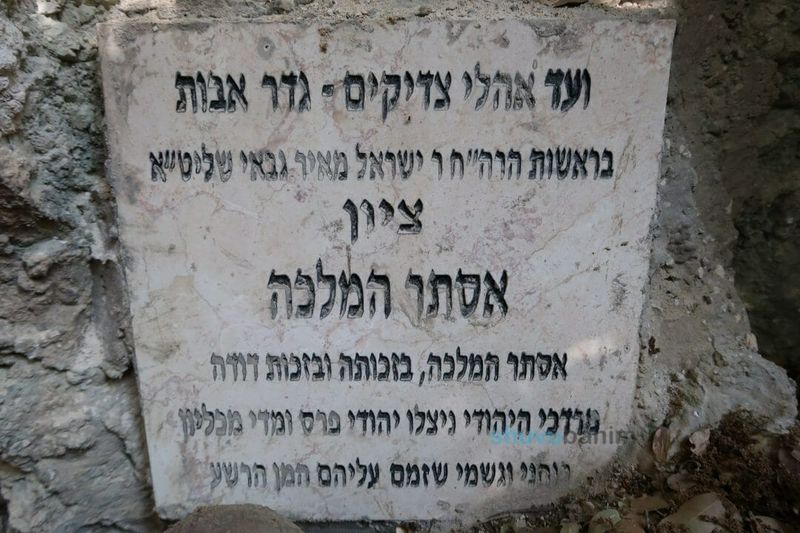
Deep in the forest near the village of Bar'am, there is a large, ruined megalithic structure. In this place, the earliest travelers who recorded their journeys for future generations have identified the burial place of Mordechai and Esther for about 850 years. It should be noted that in most traveler lists, only the grave of Queen Esther is mentioned in Bar'am. The tombstone in Bar'am at their burial site was erected by Anash, students of our teacher, Rav Berland shlit"a, and with his encouragement.
Their burial place in Bar'am is mentioned as early as the year 4905 (Kivrei Avot). And after that - in the years: 4939 (Travels of Benjamin). 4970 (Our teacher Rabbi Yonatan of Lunel and his group). 4975 (R' Menachem bar Peretz the Hevronite, as mentioned above). 4995 (Rabbi Yaakov, emissary of our teacher Rabbi Yechiel of Paris). 5000 (Student of the Ramban). 5060 (Seder Kivrei Avoteinu, manuscript Ilan II). 5200 (Moscow manuscript). 5203 (Rabbi Yitzchak ben Alfra). 5282 (Rabbi Moshe Basola).
In the year 5297, 'Yichus HaAvot' writes: "The village of Bar'am... and there is the burial of Queen Esther, peace be upon her. And it is about a parasang and a half from Safed. And every Shushan Purim, a minyan goes to her grave from Safed and they read the Megillah there, and they eat, drink, and rejoice there."
Likewise, their marker in Bar'am is mentioned in the years: 5321 (Yichus HaTzaddikim). 5384 (Gelilot Eretz Yisrael mentioned above). 5386 (Igeret Mesaperet Yichusata DeTzaddikaya DeAr'a DeYisrael). 5460 (Seder HaDorot in the name of Gelilot Eretz Yisrael mentioned above). 5494 (Rabbi Moshe Chaim Capsuto). 5504 (Zichron BiYerushalayim). 5569 (Yadei Moshe). 5595 (Chibat Yerushalayim). 5709 (Eden Tzion).
The pilgrims who identify their burial place in Awarta, Safed, and Tiberias, Israel
Awarta: Rabbi Yitzchak bar Musa. Safed: Rabbi Yosef Demontanya. Tiberias: Admor Moharnat (Yemei Moharnat, Part II, 151. He only mentions Queen Esther as an 'it is said').
Stories from the journeys of Anash to the grave of Mordechai and Esther in Bar'am
On the 12th of Av, 5760, a young man from Anash entered to our teacher, Rav Berland shlit"a, and told him that a group of young men from Anash had purchased a tombstone to place on the burial site of Mordechai and Esther in the village of Bar'am. The Rav was very happy to hear this and gave his blessing for the matter.
In the year 5771, a group from Anash traveled to the graves of tzaddikim, and when they arrived at the grave of Mordechai and Esther in Bar'am, the cell phone of one of the Anash rang, and on the line was our teacher, Rav Berland shlit"a. The man told the Rav where they were. When our teacher heard this, he was happy and asked them to pray for him there and to recite the Tikkun HaKlali for him. Naturally, the prayer there was already different - with enthusiasm and vitality.
Subscribe to Our Newsletter
Receive Torah articles and inspiration directly in your inbox