
Who Ate All the Fish, and Who Doesn't Stop Praying Until the Gate Above Closes?
Rav Soferin with Chilling Stories
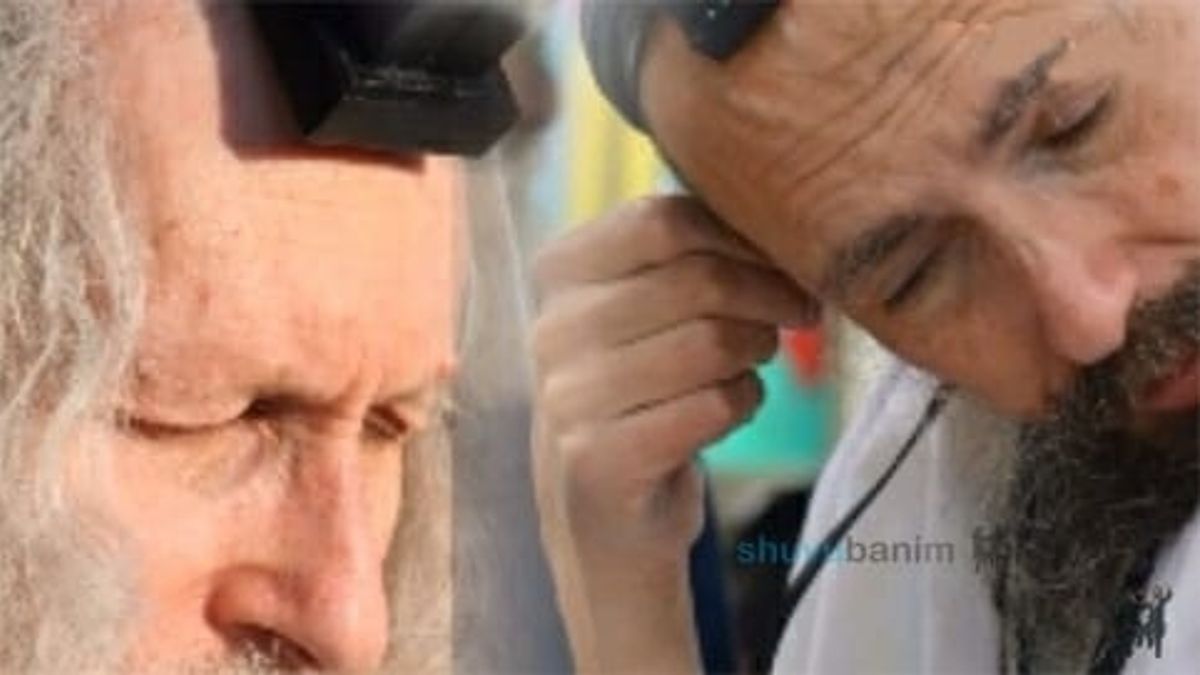
HaRav HaTzaddik Rabbi Mordechai Sofrin shlit"a, in a special lesson from the Likutey Halachot of Moharnat for the holiday of Chanukah, explains how, even though the tzaddik appears similar to a regular person, he is still distinct and elevated beyond all measure and estimation. Rav Sofrin seasons the words of Moharnat with stories of tzaddikim of our generation, our teacher Rav Eliezer Berland and Rav Dov Kook shlit"a.
The tzaddik reveals a little and conceals a lot
"Both Hashem and the tzaddik reveal a handbreadth and conceal a handbreadth, so that one knows that the more one draws near, the further away one still is. For, even though He revealed a handbreadth to me and I drew a little closer to Hashem, I must know that the majority is still hidden from me. And this is true both regarding Hashem and regarding the tzaddik, because it seems to us that we know the tzaddik; we walk around next to him, we see him, and we think that we know him a little."
"But, in truth, this is only a tiny bit of what he reveals. His inner essence is very hidden and concealed. For the tzaddik is also sealed, wondrous, and very hidden from us—a tzaddik is something completely different; he is not a regular person, he is not the same person we know. How does Rebbe Nachman say at the end of Likutey Moharan in Torah 116: 'Even a kosher person who is close to the tzaddik, in comparison to the rest of the world—if we compare the tzaddik and the kosher people to the rest of the world, they truly appear similar in their movements to other human beings; they eat the same things, they are the same, and there is no difference between them in terms of physicality, to all appearances of fleshly eyes.'"
"And nevertheless, in the ultimate truth, we believe that they are separated and completely distinct—they are something completely different. A kosher person is a completely different matter, and all the more so the true tzaddikim. The tzaddik is something completely different; when you see him, you see that he is a little different from human beings. He does not need to sleep like me. He eats, but he eats differently than I do; one can see this."
Rav Berland confuses the wealthy at the fundraising dinner
"I just heard a story. They held a dinner for Rav Berland to raise money for the yeshiva. They gathered all the wealthy people, I think in New York; each one bought a ticket to the dinner for $15,000, and during the dinner, each one donated more—half a million, three hundred thousand dollars, whatever each one wanted to donate. That is how they do it in the world; they bring the tzaddik and he speaks words of Torah. There is the most magnificent feast there, they bring the tray with all the food, and he eats a tiny bit, and afterwards, they distribute the leftovers to everyone."
"There is a segulah to eat from the leftovers that the tzaddik leaves behind. So, the Rav gave them a drashah, and told them that the most terrible and disgusting thing in the world is money—that one should not speak to someone who has money. Rav Berland spoke to them about how anyone who has money is repulsive and stinks. They wanted him to finish speaking already, so they brought him a tray of fish for all the guests so that he would eat a little and they would distribute it to everyone."
"The Rav began to eat the fish, and he ate, and ate, and ate—he ate all the fish. Yossi Druck, who was there, tells this on the line. Who can eat so much fish? It is impossible; it is fish for a hundred people, a portion for a hundred people—all so that they would not make him into a 'Rebbe.' Because, in Breslov, we do not have a 'Rebbe'; Rebbe Nachman is our Rebbe. But people make a person into an Admor, they make him into a tzaddik so that he will eat and leave leftovers. Rav Berland laughs at them—'There are no leftovers, I am not leaving any leftovers, I am eating everything.'"
"With the tzaddik, one sees things different from other human beings, a different behavior. He can earn several millions at this dinner, and he only ruins it for everyone, only destroys what they are doing. This is just a small thing, some kind of curiosity, but in his behavior and in his life, how he is separated, how he can pray for hours upon hours, how he sings and can dance for hours—deveikut (cleaving) to Hashem, the Amidah prayer for six hours, 12 hours. Who can stand in the Amidah prayer for hours?"
He does not stop praying until the gate above is closed
"Someone told me that he saw Rav Kook standing for several hours in prayer. He asked Rav Kook's son-in-law, 'What is he doing for six hours in prayer?'"
"He answered: 'I also asked him that, and Rav Kook told me that he prays as long as the gate is open; when they close the gate, then he stops. Rav Kook enters some gate, he is traveling, I don't know what he is doing there, until they close the gate for him. Then he knows that the time has come to stop the prayer.'"
"Yes, these are different people. I cannot pray for six hours; I have nothing to do for six hours in prayer. I don't see any gate, I don't see anything. One sees that the tzaddik is something else. But just as the Torah and the tzaddik are sealed and hidden from us very, very much, so too are they very, very close and near to us. But the tzaddik is here, we walk around next to him, and he speaks to us and teaches us, and illuminates us. And conversely, just as they are revealed and very near to us, so too are they far, hidden, and very exalted from us. Both are true; he is very close to us because he is here, but he is also very hidden and not grasped at all. And so it goes, back and forth, because both are true—he is both close and far."
"This is the concept explained in the aforementioned Torah, 'Peace to the far and to the near.' The verse in Isaiah says: 'Creating the fruit of the lips, peace, peace to the far and to the near, says Hashem, and I will heal him.' The literal meaning of the verse is peace to the far and peace to the near, but Rebbe Nachman says, 'Peace'—who can attain peace? Someone who understands that he is both far and near. This is one person who is the near and the far (the tzaddik); it is one person."
"Our teacher Rav Berland told us that one of the things that impressed him when he was a child—I don't know in which grade it was, in elementary school I think, perhaps at the beginning of high school—the year began and a new teacher arrived in the class. The first thing he said to them: 'There is not one child here in the class who has not once had deveikut in prayer.' That is how he opened the year—and then everyone looked at themselves and saw that it was true."
Subscribe to Our Newsletter
Receive Torah articles and inspiration directly in your inbox