Why is the Path to Uman Blocked? Rabbi Moshe Binenstock
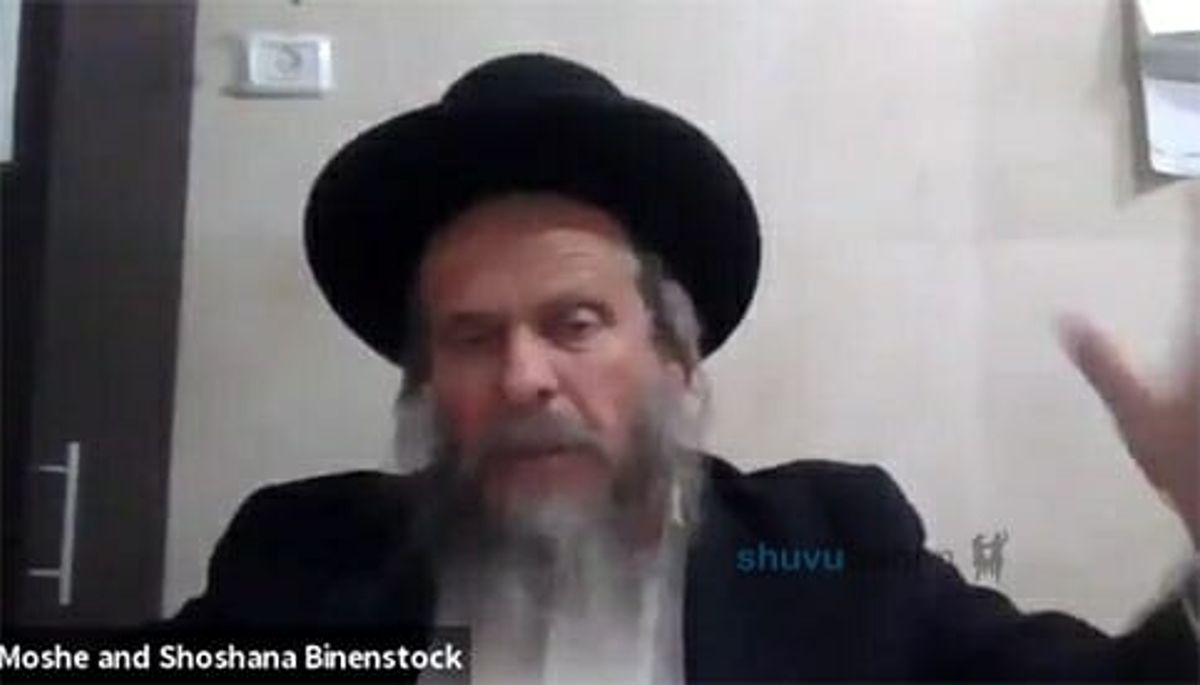
Rabbi Moshe Binenstock shlit"a, one of the great Breslov mashpi'im (spiritual mentors) who served the great Breslov rabbis of the previous generation for decades—most notably Rav Levi Yitzchak Bender zt"l—shares a stirring talk on the reasons for the closure of the path to Uman.
These are his words:
The Rebbe said the world will marvel at the love between my people! Why did the Rebbe drive us away? Why does the Rebbe not let us come to him? What happened, is he fed up with us?! Is something wrong with us? It is not because of this or that official; while one must make an effort (hishtadlut), that is not the problem. We need to hold a day of prayer where all the leaders of Breslov Chassidut gather, but they cannot sit together. This relates to this group, and that relates to that hashkafah (ideology), and it doesn't fit. If he sits with these people, what will they say about him in Monsey, in America? Heaven forbid, he spoke Hebrew!
But, most of the people who travel to Uman do not know Yiddish, so should they be erased? Do they not exist?! So the Rebbe is doing his own selection.
I still remember the love that existed at the kibbutz in Jerusalem 50 years ago. Where is it? Today, in the Kloiz, 7,000 people are unable to dance together because there is no love. Instead of confusing people's minds by going to protests and dancing with leftists in places where there are women not dressed with modesty, what will surely have an impact is for the leaders to speak with one another and not be ashamed to unite and cry out a great and bitter cry.
There is no coincidence here! It is not enough that a few managed to enter and say, 'I have saved my own soul,' but what about all of Anash (the community)? We must see what has happened here.
"Who knows if we are not guilty regarding our brother—just as the brothers said about Joseph, for we did not see the distress of his soul."
The full conversation transcribed from audio:
"Today, Breslov is in the headlines, something that has never happened before. The Rebbe said to issue a proclamation; today everyone is issuing proclamations about us. News editions all over the world are talking about Breslov Chassidut today—in the USA, in Europe, in Paris, in Turkey, and in Kiev, it goes without saying. Something is happening that has not occurred in the last 30 years."
"Baruch Hashem, we were pampered from Heaven; Breslov experienced a flourishing that has no equal in all the Chassidic courts. In the past, Breslov chassidim could be counted on one's fingers. Breslov has become a huge, sprawling Chassidut that spreads everywhere. And the highlight, from which all this burning fire is received, is located there in the impure Ukraine, opposite the 'Peor' house (a place of idol worship). There lies the grave of the tzaddik, in the aspect of Moses; there he made his dwelling place—that is the place."
"Reb Noson writes that it is said only about Moses our Teacher in Tractate Avot, 'The place that was designated for him from the six days of Creation.' We see in his passing that the Rebbe said: 'Move me this way, move the bed, move the chair.' Reb Noson says: 'I saw that everything was directed toward the upper worlds.'"
"The entire passing of the Rebbe is amazing. A person travels specifically to be buried in Uman. We have not heard of such a thing in history. It is one thing for a person to travel to be buried in the Land of Israel, but a person travels to be buried in an impure place. Reb Levi Yitzchak would always say that Uman and Medzhybizh were impure places that the tzaddikim chose specifically to be buried in. And the Rebbe revealed to us that we would come to Uman."
"There was no such thing in history. Our Rebbe took two kosher witnesses, Reb Naftali and Reb Aharon the Rav of Breslov, and gave an absolute promise: 'Anyone who comes to my grave, says the ten chapters of Psalms, I will grab him by his peyot and pull him out of the lowest depths.' Not only after death; this is already happening in life."
"Those who come to our Rebbe come to cry out to draw closer to Hashem, to do teshuvah (repentance), to perform a tikkun (rectification) of the covenant. The Rebbe promised and said that what he can do on the eve of Rosh Hashanah, he cannot do throughout the entire year."
"We wait for this all year, and now suddenly, due to our many sins, the gates of Zion are locked. And who is interfering? And who ruined it for us? Our own poor Jews! We believe that everything is from Heaven. 'Who knows if we are not guilty regarding our brother—just as the brothers said about Joseph, for we did not see the distress of his soul.'"
"Who knows if this is not because of a lack of love for one's fellow, where instead of seeing the merit of our friends, we seek to see their faults. Who knows, perhaps the Rebbe said: 'You don't get along, so don't come to me.' Who knows? We are not prophets. But, certainly, this is one of the foundations the Rebbe said: 'The world is worthy of marveling at the love that exists between us.'"
"The Rebbe says in Sefer HaMiddot: 'Strengthen your friend in fear of Heaven, and he will love you.' Reb Levi Yitzchak would say in the name of Reb Avraham ben Reb Nachman that the vessel to receive the light of the Rebbe is received only if there is love between our people. The Rebbe said: 'If you hold yourselves together in love, you will draw me upon yourselves.'"
"So he thinks this way and I think a little differently; he has his Rebbe and I have my Rebbe. His Rebbe said it is forbidden to go to elections, and there are great Torah leaders here who said it is permitted to go, and likewise regarding wigs (sheitel). Therefore, must you hate me and distance yourself from me? Let us talk about what we can talk about with each other; let us talk words of love and encouragement; let us talk about the Rebbe's advice. That is the Geulah (Redemption)."
"Our Rebbe writes in Torah 27, 'Then I will turn to the peoples a clear language, that they may all call upon the name of Hashem.' And the Rebbe says that this will be the Geulah; this must be our language, nothing else. The speech of Anash must be only in the service of Hashem. When this vessel exists, the Rebbe is inside. Then we have power; then we have strength."
"After all, the whole concept of the 'kibbutz' that the secular people took—they took it from the Breslov chassidim. The merit of the kibbutz is to be together. Reb Noson in Likutey Halachot brings what is written in Genesis regarding Jacob's words to his sons: 'Gather yourselves together, that I may tell you...' Reb Levi Yitzchak would explain this beautifully. Our Sages teach that Jacob wanted to reveal the End (of days) and did not. Reb Noson asks: Why does Jacob start by saying 'Gather yourselves' (He'asfu), and then says 'Assemble yourselves and hear' (Hikavtzu)?"
"'He'asfu' is like a gathering of neighbors without chemistry between them. Jacob saw that this was only a gathering, but everyone is looking at the fault of the other—the End I will not reveal, the Shechinah (Divine Presence) departed, but I will reveal what will bring the End."
"The prescription for Geulah is: 'Hikavtzu'—stick together, be one piece, stop seeing the faults of the other. This is what you receive from the Rebbe: to see the good, not to live from the faults of the other."
"Once, Breslov chassidim cried out: 'I am weary of my life' (katzti b'chaiyai), today they cry out: 'I am weary of his life' (katzti b'chaiyav)..."
Subscribe to Our Newsletter
Receive Torah articles and inspiration directly in your inbox