
With Emunah You Turn the Desert into a Hilton
The Daily Strengthening from the Gaon and Tzaddik, Rabbi Eliezer Berland shlit"a
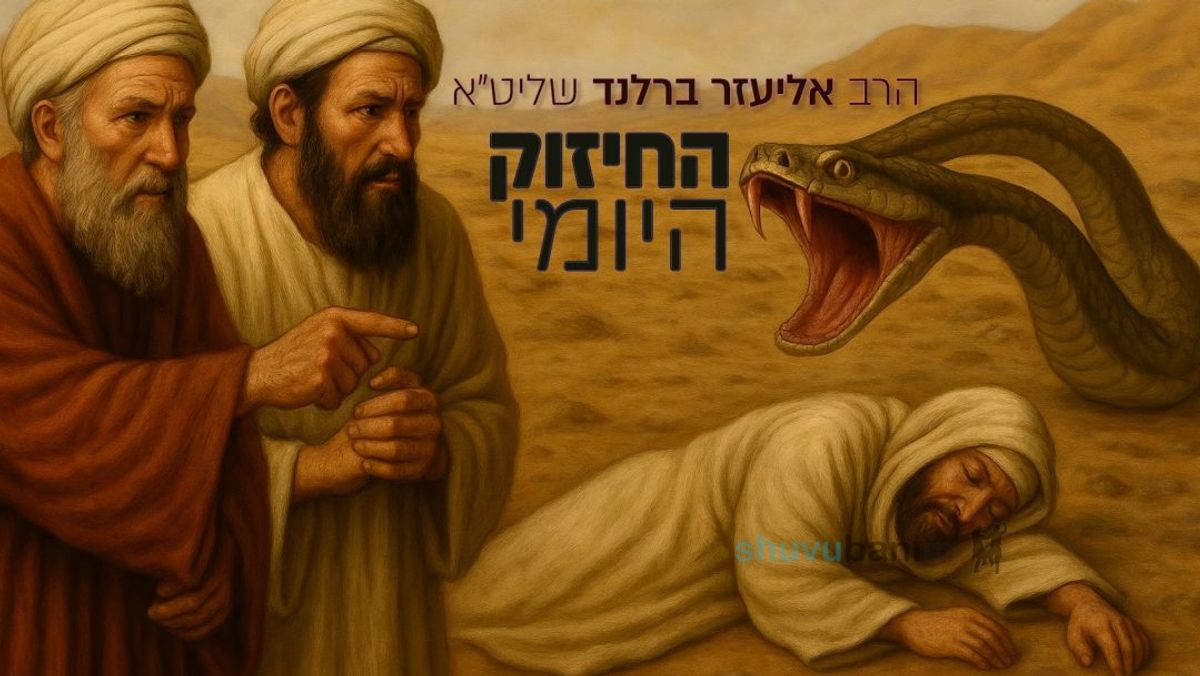
In our world, where every mitzvah (commandment) is recorded above in precious light, and every small act of chesed (kindness) opens gates of blessing, two tzaddikim (righteous men) walk in the desert, and on their way, a story is revealed that shakes the heart and awakens the soul. This is not just a story about generosity or emunah (faith), but a living lesson on Hashgacha Pratis (Divine Providence), on the hidden ways of Hashem, and on the mighty power of one simple choice – to practice mesirus nefesh (self-sacrifice) for the truth or to follow nature!
The Daily Strengthening from our Master and Teacher, the Gaon and Tzaddik, Rabbi Eliezer Berland shlit"a - Monday, 27 Sivan 5785
It is written in the Zohar ¹(Behar, page 110) that Rabbi Chiyya saw two wayfarers (people) walking from afar; he saw that they were standing at a distance of a kilometer. He had a kind of telescope with which one sees exactly what is happening, seeing ahead two people walking in the desert. When a person walks in the desert, he doesn't know when he will exit the desert; today there are already roads in the desert, but back then there was no Waze, and those who walked in the desert would get lost and not reach home.
Rabbi Chiyya cried; Rabbi Chiyya shed tears, saying, "I want to merit the mitzvah (of feeding the needy) myself; why didn't I merit it?" - If a person asks "What will we eat?" he stops the flow of abundance!! Now he (the one performing the act of kindness) will see double abundance, "'And I will command My blessing for you in the sixth year'" (Zohar Behar 110b). Rabbi Chiyya and Rabbi Yose were walking on the way, they encountered that mountain, and they found two men who were walking. They saw through the telescope, through which they could see until the end of the world. They saw that he was taking out a cloth (with food to give to a poor person).
https://vimeo.com/1095481232?share=copy
Not like Nachum Ish Gamzu who told the poor man, "Wait" (Taanis 21a), giving him Torah Lesson 6 in Likutey Moharan [anachronistic reference by the Rav to connect concepts], but rather he made sure first that he should drink and eat. He gave (one of the two to the third hungry person they met) all of his food. After he ate, he gave him more food; he gave everything he had left. And the friend says to him (to his companion), "We are in the desert, it’s impossible (to give all the food). Give him (only) a sip, give him a bite; another person will come (besides us) and give him a bite too, and that way, slowly, he will be revived."
The poor man says, "I haven't eaten for two days." (The first man) gave him all the food and gave him drink, saying, "I walk only with Hashem—there is no difference if you are in the Plaza or the Hilton, there is no difference if you are in the heart of the desert or on HaYarkon Street. If it is decreed that you must receive a hamburger for lunch, or fattened geese, then you will receive fattened geese. There is no difference if you are in the Hilton on HaYarkon Street or if you are in the heart of the desert; with Hashem, it is all the same. It’s not the Hilton that matters, nor the Plaza."
The Gemara brings ²in Kesuvos (67b) that someone came to Rava and said to him, "I eat a chicken every day for lunch!"
"What, have you gone mad? A whole chicken? People eat 100 grams, 50 grams, but you want a whole chicken? That’s impossible!"
He said to him, "No, I eat a chicken every lunch." Within five minutes, Rava's sister arrived—whom he hadn't seen for 13 years—and brought him a chicken in honor of the meeting. He said to him, "Here, the chicken is ready."
The same Gemara continues and brings that another person asked to eat chicken and then he passed away; everyone is according to his emunah (faith). If you have emunah that Hashem will send to you in any place in the world, even in the heart of the desert, it doesn't matter. There is no difference if I stay in the Plaza, the Hilton, on the Yarkon beach, or if I stay on King George Street in Jerusalem—Hashem will always send me the finest lunch.
And now (at the time of delivering the lesson), the holiday of Shavuos will be here soon; there will be such abundance as hasn't been since the creation of the world.
So he says to him (the companion who opposed giving the food), "Know that for me it is a 'principle' (not to give charity) that I am not giving you anything." There are people with "principles." "From me, he won't get anything." He stands on his principle: "I am telling you (the hungry man), you won't get anything from me."
Rabbi Chiyya sees this and is going crazy. He says (to Rabbi Yose), "No, let's give him food already."
Rabbi Yose answers, "No, no, no, I want to see the miracles." He says, "Why didn't we merit [to give]? Apparently, because there is a death sentence upon him. Is there a death sentence upon him?" Suddenly he sees that he walks with him for half an hour in the sun, fifty degrees [Celsius], and he falls unconscious. He hasn't eaten for several hours; he gave away all the food and he falls unconscious. Rabbi Chiyya says (to Rabbi Yose), "Let's give him food." Rabbi Yose says, "Under no circumstances; hold on."
And then a giant snake came upon him (the hungry man who lay unconscious). Rabbi Chiyya says, "This is the end." Rabbi Yose was a true Breslover; he said to Rabbi Chiyya, "Now you will see the miracle." Within a second, they saw a second snake come and bite the first one, swallowing it.
With Hashem's help, everyone should live until 120 years.
—————————————
Rabbi Chiyya and Rabbi Yose were walking on the way, they encountered that mountain, and they found two men who were walking. Meanwhile, they saw one man who was coming, and he said to them: "I beg of you, give me some bread for food, for these two days I have been lost in the desert and have eaten nothing." One of those two men slipped away [from his companion], took out the food he had brought for the journey, gave it to him, and fed and gave him drink. His companion said to him: "What will you do for food, for I am eating my own?" He said to him: "And am I walking based on yours?" That poor man sat with him until he ate everything he had, and that bread which remained he gave to him for the journey, and he went on his way.
Rabbi Chiyya said, "The Holy One, Blessed be He, did not want this thing to be done through us." Rabbi Yose said, "Perhaps a judgment was decreed upon that man, and the Holy One, Blessed be He, wanted to prepare this [merit] before him in order to save him." While they were walking, that man became exhausted on the way. His companion said to him: "Did I not tell you not to give bread to the other?" Rabbi Chiyya said to Rabbi Yose, "Behold, we have food with us, let us give him to eat." Rabbi Yose said, "Do you wish to take the merit away from him? Let us go and see, for surely in the form of this man's face, the pattern of death is taking hold, and the Holy One, Blessed be He, wanted to prepare his merit in order to save him."
Meanwhile, that man sat and slept under a tree, and his companion distanced himself from him and sat on another path. Rabbi Yose said to Rabbi Chiyya, "Now let us sit and see, for surely the Holy One, Blessed be He, wants to perform a miracle for him." They stood and waited. Meanwhile, they saw a form of flames standing before him. Rabbi Chiyya said, "Woe to that man, for now he will die." Rabbi Yose said, "Happy is that man, for the Holy One, Blessed be He, will perform a miracle for him." Meanwhile, a snake descended from a tree and wanted to kill him. That form [of flames] rose against it and killed it. The form turned its head and went on its way.
Rabbi Yose said, "Did I not tell you that the Holy One, Blessed be He, wants to perform a miracle for him, and you should not take his merit from him?" Meanwhile, that man woke up, rose, and went on his way. Rabbi Chiyya and Rabbi Yose caught up to him and gave him to eat. After he ate, they showed him the miracle that the Holy One, Blessed be He, had performed for him.
Rabbi Yose opened and said, (Psalms 37) "Trust in Hashem and do good; dwell in the land and nourish yourself with emunah (faith)." Happy is the portion of the man who does good from his own, for he awakens good with Knesses Yisrael (the Assembly of Israel), and with what? With tzedakah (charity). For when tzedakah is awakened, it is good, then it awakens toward Knesses Yisrael, and about this it is written (Proverbs 10), "And tzedakah saves from death." What is the reason? Because tzedakah is the Tree of Life, and it awakens over that Tree of Death, and takes those who are held by it and saves them from death. Who caused that Tree of Life to be awakened for this? You must say, it is that tzedakah that he does; as it were, he made it Above, as it is said (Psalms 106), "He who does tzedakah (charity) [is like one who makes] tzedakah at all times." And behold, it has been explained.
- "A certain man came before Rabbi Nechemia. He said to him: 'On what do you dine?' He said to him: 'On fat meat and old wine.' [Rabbi Nechemia said:] 'Do you wish to join me with lentils?' He joined him with lentils and died. He [Rabbi Nechemia] said: 'Woe to this man whom Nechemia killed.' On the contrary, it should have been said: 'Woe to Nechemia who killed this man!' Rather, he [the man] should not have pampered himself so much. A certain man came before Rava. He said to him: 'On what do you dine?' He said to him: 'On fattened chicken and old wine.' He said to him: 'Are you not concerned about the burden on the community [who provides the charity]?' He said to him: 'Am I eating from theirs? I am eating from the Merciful One's [Hashem's]! As we have learned (Psalms 145:15): "The eyes of all look expectantly to You, and You give them their food in its time (be'ito)." It does not say "in their time (be'itam)," but "in its time (be'ito)," which teaches that for each and every individual, the Holy One, Blessed be He, gives his parnassah (livelihood) in its time.' Meanwhile, Rava's sister arrived, whom he had not seen for thirteen years, and she brought him a fattened chicken and old wine." (Kesuvos 67b)
Subscribe to Our Newsletter
Receive Torah articles and inspiration directly in your inbox