
Words of the Gaon and Tzaddik Rabbi Eliezer Berland shlit"a Transcribed along
with the Recorded Class
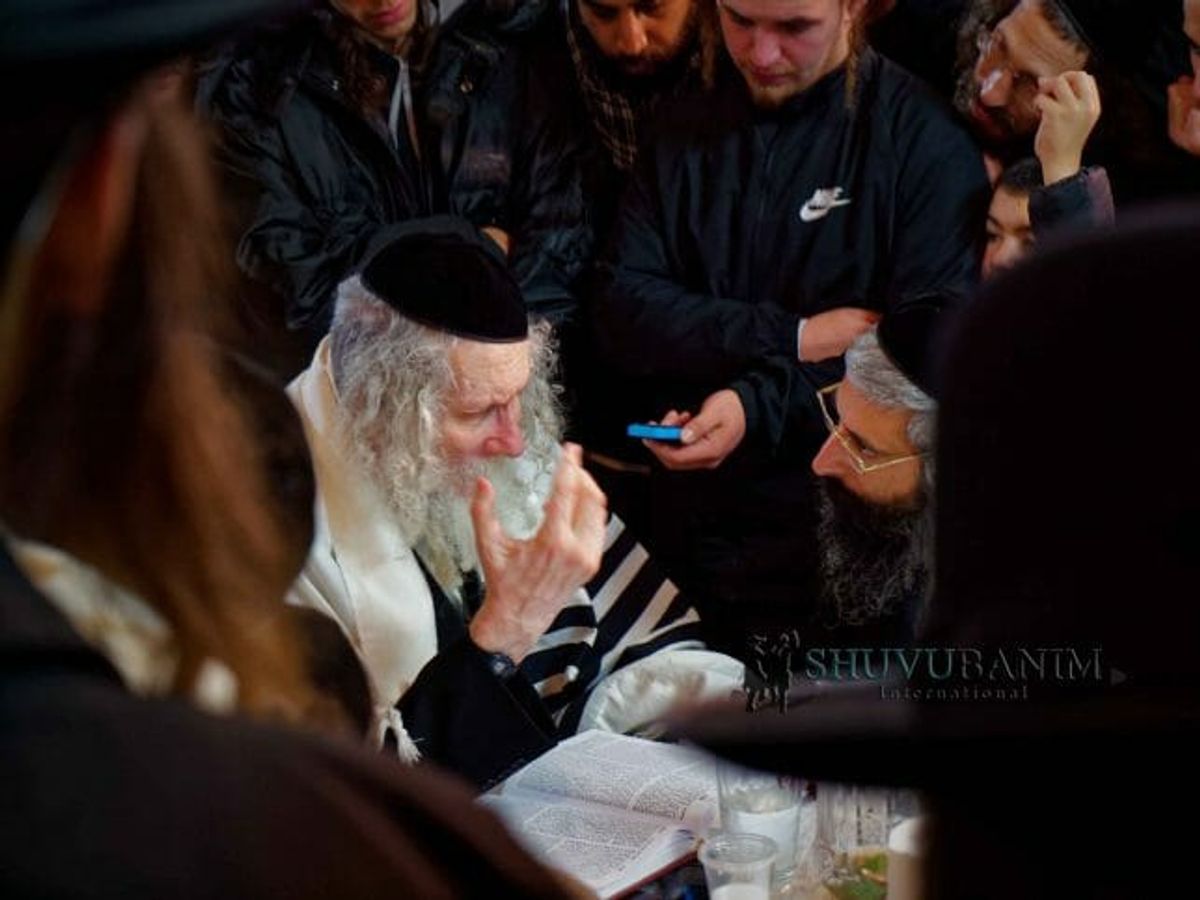
(My wife is away from home) What, she left the house? Did she go to her parents? (She went to an apartment by herself.) So I will speak with her; I will bring her back. Buy her pizza—pizza or ice cream. Who has fifty shekels? You buy a wife ice cream, and she returns. Truly, go to her home, knock on the door, and say, "I brought you ice cream," and she... Are you a 'Reb Areleh' Chassid? (No, Breslov, Breslov.) A little close to the Reb Arelechs. So, with Hashem's help... A wife needs ice cream and pizza and falafel every day. Once you buy her falafel... A wife—you need to sit with her for two hours every day. Du darfst zitsen mit ihr tzvei sha'ah yeder tag (You must sit with her two hours every day), two hours calmly. Speak words of Torah with her, speak a little about current matters, that soon it will be Hoshana Rabbah. (Ahh, she doesn't want to speak with me, even in words of Torah.) But what, did you insult her once? Did you tell her, "You have no brains," "You are stupid," or something? (--- emotional and sensitive.) Don't you have lessons in Tomer Devorah? So why didn't it succeed? (She got angry one time.) She doesn't... she... (--- even on the phone, she already ran away over a year ago, but she spoke on the phone.) With someone? With someone else? With whom? (Now she... if I pick up the phone, she hangs up.) She doesn't answer. So, you learned Tomer Devorah—that should have been the best connection. I also learned Tomer Devorah with my wife. You, too, should learn... everyone... --- today --- (Can the Rav speak with her on the phone so she will return?) Go knock on her home. Do you know where her apartment is? On which street in Jerusalem? Yes. (I know, yes, but she won't want me; she closes the ---) So what? You didn't wash dishes for her? You didn't mop the floor? A wife wants the dishes washed for her once a week. To wash dishes—even Ezekiel washes dishes once a week. (She doesn't let me into the house.) So we need a third party here. A third person needs to enter. We have someone, Meir Malka—Meir Malka and his wife Shulamit, they do Shalom Bayis (marital reconciliation). They go and speak with the wife. To speak like this: "What, what does she want? To wash dishes? I will wash dishes. She wants me to mop the floor? I will mop the floor." What is the wife asking for already? Chocolate? Bring her chocolate. A wife doesn't have many demands; she only wants the husband to help her a tiny bit. How many children do you have? Five children? (Ten children.) Ten?! Wow, how do they --- (---) No, that is ten compartments of Gehinnom. How old is the oldest? Thirteen? Fifteen? (The oldest is already married.) Already married? So he can help a tiny bit. So maybe the oldest child will enter the story. (Can the Rav speak with her on the phone?) I... no problem. So give me the number. She will answer me now. Now it is five-thirty; after the prayer, I will speak with her. After the prayer, I will ask her what she wants exactly. What are you saying? That you didn't say an insulting word to her? You didn't say some word like "stupid," "you have no brains," or something? (She has many imaginations; she built houses upon houses.) What does she want? That you should be a Rosh Yeshiva? That you should be an Admor? That you should be a Rebbe? What... what does she see, that you aren't advancing? What is her desire? You... you can take ten students and teach them like you learned Tomer Devorah. So take ten students, teach them Tomer Devorah, Mesillas Yesharim. Maybe she wants you to give a class, to be more active. (Need to tell her that it's all imaginations.) I will speak with her. I will tell her that whatever she wants, she will receive. If she wants you to be a Rebbe, to be a Maggid Shiur (lecturer), be a Maggid Shiur. Give a class on Tractate Berachos, give a class on Tractate Kesuvos. What is the problem with Kesuvos? "A virgin marries on the fourth day [Wednesday]." Why Wednesday? And why not Sunday? Why not Monday? People didn't eat a festive meal for three days, but rather on Wednesday, so that he would have Sunday, Monday, Tuesday to prepa--- for the seudah (meal). Remember Kesuvos? These are simple things. And the Seven Blessings are taught... You can also learn Gemara with the wife. Learning Gemara is more interesting than Tomer Devorah. We (4.00)
We learn Gemara with the wife, the story, the laws of Kesuvos. The first seven pages speak about the Seven Blessings, how they are done, making a quorum of ten. Boaz gave to her... Why Wednesday? Why not Sunday? Because the courts sit on Thursday and on Monday. So why specifically Wednesday? Because it is written regarding one who reads the Mishnah "A virgin [marries] on the fourth day," all his sins are forgiven. --- King David, when he reached the Mishnah "A virgin marries on the fourth day," Hashem said, "And your iniquity shall be taken away, and your sin purged" (Isaiah 6:7). So one can learn the Gemara as well; today one can learn everything—Gemara, Zohar. There is a Zohar about Elijah the Prophet and Deborah the Prophetess, where Elijah the Prophet says: Why did Deborah bring [the people] back in teshuvah (repentance), but I do not bring them back in teshuvah? I bring down fire from heaven, yet they worship idols! They scream "Hashem is God, Hashem is God" --- screamed "Hashem is God" and then go to worship idols. Deborah, in truth, the entire nation stopped [sinning], did teshuvah, and immediately went to fight against Sisera. --- It is possible to win; if one does teshuvah truly, then it is possible to defeat Sisera as well—everyone can be defeated. So the Zohar says in [Parashat Vayakhel] 190 that regarding Elijah it is written, "And he sat down under a broom tree (rotem)" (1 Kings 19:4), and regarding Deborah, "[And she sat] under the palm tree (tomer)" (Judges 4:5). Tomer and Rotem are the same letters. Elijah asks why Deborah brought them back in teshuvah and I did not, even though he fasted forty days and forty nights. But they didn't do teshuvah. He did teshuvah, but not the others. So he asks why Deborah merited this. Deborah was only a woman; why did she merit it? Because she walked in simplicity (temimus). She used to make wicks. Deborah's wicks never went out. Di lichten fun Devorah kein mal nisht gevoren farloshen (The lights of Deborah never became extinguished), never became extinguished. How did it burn? If it had gone out, it would have been impossible to learn Torah. There is no electricity. Everyone receives a candle, sits from eight in the evening until eight in the morning. If the candle goes out, he goes home to sleep; he has nothing to do. Not everyone can learn by the light of the moon, and if there is no moon, then it is impossible to learn. So Deborah would pray that her candle would never go out, that what she lights should burn for the entire 24 hours. --- Deborah. And then they went out to war. And it is written in the Zohar on 19b --- that the Song of Deborah is higher than the Song of Moses, "Then [Moses] sang," because then there was nothing. "Was there a shield or spear seen?" (Judges 5:8). There was neither shield nor spear. With Moses, they went with Clouds of Glory. Even during the Splitting of the Sea, there were Clouds of Glory. They threw catapult stones at them, and the Clouds of Glory threw them back at them. What they shot at the Jews returned upon them. But with Deborah, there was nothing. There were no Clouds of Glory and there was nothing, and they went to war. Zebulun—it is written, "Of Zebulun, such as went forth to battle, expert in war, with all instruments of war, fifty thousand; and to keep rank without a double heart" (1 Chronicles 12:34). Zebulun goes without a heart, without a head. Joshua, it is written, was without a head. Joshua without a head, and Zebulun without a heart. A person needs to be born without a heart and follow the Tzaddik. Whatever the Tzaddik tells him, whatever the Tzaddik tells him, he must go and do. So, sit with the wife, explain to her what Zebulun is, what Deborah the Prophetess is. There was Deborah, there was Queen Esther, there was Yael. Yael knew that the soul of Rebbe Akiva was here. She knew it. She didn't just stab him. Here, "she smashed his head" (Judges 5:26). She erased his whole head, erased his --- of Rebbe Akiva. Because everyone has a soul of a Tzaddik, even the greatest wicked person. Sisera had Rebbe Akiva. In Og, King of Bashan, was Shimon ben Nethanel. Five students of Rabban Yochanan ben Zakkai—one was Shimon ben Nethanel, who says "a good neighbor" (Avot ---). So Shimon ben Nethanel was in the ankle, in the ankle. So Moses jumped ten cubits and had an axe of ten cubits, and like that, he struck the ankle --- so in the ankle was the soul of Shimon ben Nethanel. So every wicked person has some spark, but one must bring him back in teshuvah. If Sisera had merited, he would have done teshuvah. "They fought from heaven; the stars in their courses fought [against Sisera]" (Judges 5:20). Twice Haman. "From heaven the stars fought from their courses" (Min shamayim nilchamu hakochavim mimesilotam)—this is [acronym] N-H-M. "The stars in their courses fought"—this is H-Haman. Exactly H-M-N. So Sisera was twice Haman. And Deborah defeated him. In the beginning, it is written, "The bows of the mighty are broken" (1 Samuel 2:4). Now --- we read now in the Haftarah. So this will remain with us until the end of generations. For "The bows of the mighty are broken" refers to the wicked Greeks. "And they that stumbled are girded with strength" (ibid)—these are the Hasmoneans, the Kohanim, regarding whom [it says], "Smite through the loins of them that rise against him" (Deuteronomy ---). Now in [Parashat] V'Zot HaBerachah, "Smite through the loins of them that rise against him" refers to the Hasmoneans. They were twelve. We know about five; they were twelve. There are a few more brothers. So twelve brothers defeated all the tens of thousands. Hundreds of thousands came. Twelve brothers—everyone abandoned them. They saw tens of thousands; everyone remained alone, only the brothers with a few others. And immediately they screamed, "Please Hashem, save now! Please Hashem, grant success now!" Everyone died. And elephants came and trampled them. The elephants turned them over, trampled them. The elephants threw them, trampled them. They came—the elephants are like tanks. So it turned against them. So now, Hannah saw all this. So, "They that were full have hired themselves out for bread" (1 Samuel 2:5)—these are the seventy sons of Haman, who, the Targum says, went to Mordechai to ask for forgiveness. The Targum in Megillat Esther (what the Rav requested to be said was brought in the leaflet 'Kevavas Shamram' at the time --- the sons of Haman clapping their hands, etc.). It says, "And Mordechai went out [from the presence of the king] in royal apparel of blue and white" (Esther 8:15). White (Chur), because he had the soul of Chur, the soul of Miriam --- miracles. So all the sons of Haman came to ask for forgiveness, together with Zeresh. "Why were we such wicked people? Why did we want to hang you? Forgive us. We had a wicked father, a stupid father; he seduced us. We ---." They did teshuvah, for they came to ask for forgiveness. So all this, one needs to learn. Sit with the wife, make it a little interesting for her, a little suspense, a little... so it will be a little interesting. The study... bring the Midrashim. And on all this, there are Midrashim. On everything. On all this, there are a billion Midrashim, a million Midrashim on everything. And each time there is Esther, sometimes there is Deborah, sometimes there is Yael. And in everything, there are righteous women who existed. Soon is Shovavim [weeks]; in Exodus, the righteous women—everyone got divorced. All the men today are looking to get divorced. So the women didn't want to get divorced. So they raised children. The men didn't want to. And therefore it is written that the mirrors were more beloved than anything, for these were not mirrors; they were tears. Every woman knew that in another nine months, they would throw the child into the Nile. So she would only cry all day. She had no pleasure, nothing, only weeping. The Laver (Kiyor) is the tears of the mothers. The Laver—all that they cried over the course of eighty-three years. For eighty-three years was the decree of "Every son that is born you shall cast into the river" (Exodus 1:22). Even after Moses was born, the decree continued. And they didn't say... they are lively (chayot). It is written that she drew vitality (chayut) from Atik. One needs to draw vitality from Atika Kadisha. The whole concept is that a person draws vitality from Atik, from the Ancient One. "And they kept alive"—Rashi says, "And they kept the children alive" (ibid 1:17)—from the Nukva d'Pardashka. Nukva d'Pardashka is the nose, the nostrils, from which came, from the right side, the spirit of the Resurrection of the Dead, and here is the spirit of Moshiach. So from the start, there should be Resurrection of the Dead, for no child was born with a blemish. Every child... it never happened that a child was born with a blemish, so they wouldn't say that they caused the blemish. So, and these children—they received the Giving of the Torah. They prayed that they would receive the Torah. So the children that Miriam and Yocheved delivered, they received the Holy Torah. So now, at the Giving of the Torah, we see Hashem face to face. This moment, we are at the Giving of the Torah. So now, on Yom Kippur, we received the Second Tablets. We are --- after Yom Kippur is Hod. The night after Yom Kippur is Hod. Chesed within Hod. Yesterday was Chesed within Netzach. Today is Chesed within Tiferet. Today is the 13th; tonight is the 14th—it will be Chesed within Gevurah. And on Sukkot, it is Chesed within Chesed. For this is internal Chesed within Chesed with encompassing Chesed within Chesed. Encompassing (makif) is the Sukkah. Tomorrow night we already enter into the Sukkah, we say Shehecheyanu, Sukkah of Peace. So one needs to sit with the wife, tell her stories. I tell them every day for two hours (12.10)
(But she hangs up the phone.) So I will speak with her. If not, I will send someone to her. Can't the oldest son speak with her? She won't listen? (He already tried to speak.) No, it didn't work. So I will try. Come in the afternoon; I will ring her. Now it is already 6 in the morning; she is surely up already. When does she get up to pray? When does she pray in the morning? Seven? Is she meticulous about the Shacharit prayer? (I think so.) So she is surely up. So now we will start. (Need to tell her that such actions can lose all merit.) No, the children will be secular. What? If she does this, the children will be secular. If the mother runs away... So I will explain everything to her. I, immediately after the prayer at eight... the prayer finishes at eight, another two hours. So immediately at eight, we will call her. Immediately. Come at eight. Yes, come at eight so we can see exactly what can be done at eight exactly –
(13.23) (What is the difference between Rotem and Tomer?) Between Tomer and Rotem. I have a lawyer named Rotem. What can I do? One named Rom... I told her "Rotem"? What suddenly "Rotem"? Why not "Tomer"? I argued with her; it didn't help. --- Rotem is the coals that never go out. The coals of Rotem never go out. The Rotem shows a lot... says that --- the Hidden Light is that --- after twelve months --- they came... It is written in Rabbah bar Bar Chanah... what Torah is this? --- Here, Itamar. Itamar Rotem is Nachman the Levite. He knows the whole Torah --- learned in the womb. He remembers everything the angel taught him. Here, open for me here. Where is the Rotem? Where is it? (Part II, Torah 5). Part II, 5 (Tanina). 5, 5. End of 5. End of 5. Here, here. So Rav Ashi said: This is not Rabbah bar Bar Chanah; this is Rav Huna bar Natan. --- We hung meat on the grass until we brought the wood, so the meat already became raw meat --- atama hatama became raw --- we came there after a month, we saw that they were still burning. These are coals of broom (retamim). So this is the Rotem. This is the Rotem that Elijah had. Just as the Tzaddik is always burning for Hashem. Yes --- what are coals? A person needs the coal within him to always burn. It is written --- Jerusalem --- only love for Hashem Yitbarach. So why does he have a seminal emission (keri)? If he has a seminal emission, he is lost; he will not exit Gehinnom. A person, even if he has an emission by accident, he will not exit Gehinnom forever. He has no chance; he has no teshuvah for the matter. Because he creates... he creates billions of demons. Every drop is four hundred million cells, sperm cells. If a person emits... emits a million drops, so that is a million times four hundred million. That is a thousand billion million. That is six... twelve billion... four hundred thousand billion. Every time it exits, that it spills from a person, it is four hundred... four hundred thousand billion demons and spirits that he creates. So how will he do teshuvah? How can he eradicate this? Every time a drop of seed exits a person, it is completely lost. So it is better that he was not created. It is better to go commit suicide. If a drop of seed went out from him, he needs to go commit suicide, to go up to the roof and jump. --- Four hundred thousand billion. I begged you not to travel to Las Vegas. I warned you. You didn't listen to my voice. Now let's hear what is happening there. Come, call... call Las Vegas. Bring the phone. Fifty-six. Ask... he was a hundred meters from there. The greatest singer, whose name is Benny Elbaz, and he did the "Lion's Roar." He invented the "Lion's Roar." He gave such a roar... if I give such a roar, it is of a lion. So he was there, a hundred meters away. Everyone hid under the cars. He says there was shooting; they heard some six hundred shots. Six hundred wounded, fifty-six killed. I said to the one who accompanied me, Ben Yoav... Ben Yoav, I told him that there are four hundred wounded in one press [of the trigger]. And it is automatic. In twenty seconds times thirty, that is six hundred. He gives a press, so you have six hundred killed in a second. In twenty seconds... every second is thirty bullets. I said to the one who accompanied me, Ben Yoav, "What are you doing here? The holiday is entering." --- Thirty seconds, six hundred killed. What will you do? --- Also in Hebron, I told them, until you catch the... six... Sarah is standing here --- and there is one press, he eliminates 600. But I sounded the alarm not to travel to Las Vegas. I warned you, Nachman, you don't listen to my voice. I warned you not to travel there. People travel to events to have fun. What is fun? Six hundred wounded is not a joke at all. So now let's travel to Las Vegas. Let's travel to Las Vegas. Let's ask exactly what is happening there. Now here it is 6; there the time is 8 in the evening. 8 in the evening there. So why didn't you write that here? Listen to what happened. Here --- 052-424... that is the number for Las Vegas --- 2278. Now we are speaking with the global singer, and he was there --- how many --- were... Here, he isn't answering. Not answering --- after the prayer. So it will be 10 o'clock in the United States --- So that's it, Yosef ben Iris. So where is he, this young man? Where is he? Bring him now. We haven't said the blessings yet...
(19.15) Blessed are You, Hashem our God, King of the Universe, Who gave the rooster understanding to distinguish between day and between night....
(20.28) So I am arriving within fifteen minutes. I am arriving now. I am arriving; let them arrange a bed for me there, everything, pillows. I am arriving. But what is important is now to speak with the father. The father is in Las Vegas now, right? So --- we can do a conference call. Let's see, we'll do a conference call. Maybe he will answer. Now it is eight there; maybe he will answer us. Hope he is alive. It is all because of you. I warned you. I told you that it would be a disaster. You travel, return from the --- Is Dad answering? No. Now, another twenty minutes is sunrise (HaNetz). Another twenty minutes is sunrise. So after sunrise we --- Oy vey, oy vey. We need now... we need twenty thousand shekels. Twenty thousand shekels Pidyon (redemption money). And give them the ointment. The ointment. Give them the ointment --- ointment --- We are traveling now. Will you come with me to Las Vegas? (What?) Will you come with me to Las Vegas? (If the Rav takes me, I will come.) At any hour. And twenty drops every hour from six in the morning. Is the father on the line? So I am coming now to sleep. I am coming now to sleep. At this moment I am coming. Try to get Dad on the line. You are traveling with me. You are traveling with me. You... I don't know if it is worthwhile for you to come there, to see the dead. No --- Natan also, it's not worthwhile regarding the --- We will take... his son became Bar Mitzvah --- surrounded by fire for three days until today. After Maariv. Is the father answering? Good, ring in another two hours. Now we are starting the prayer. Pray, and we will call you in another two hours, at eight. Okay? Good. Another two hours. So we, after the prayer, are traveling --- 052... dial 714-2514. Here, call waiting --- Everyone is sleeping. Now it is six; no one has gotten up from sleep yet. Let's start Odeh...
I will thank the God who searches the heart, with song together the morning stars...
(The Rav said that whoever is connected to the Tzaddik, the Tzaddik will save him from flaws of the Covenant.) The Tzaddik erases for him all the demons that he created. From today, I am erasing for you all the demons. Amen. Not a single demon will remain. Amen. And do not travel to Las Vegas. Do not travel. Closed. --- (Naftali Bezanson: I traveled with Shloime tonight to Hebron.) Didn't you see what happened? How many killed there were? No, you didn't see. You, tonight, will also travel. (Fifty-eight.) Yes. (It went up to fifty-eight.) Fifty-eight, it went up. Oy vey. It is all... you are guilty. Tonight you are traveling to Hebron immediately after the prayer --- and after that continue. (Naftali Bezanson: We only left at two.) No, leave at twelve or at one (---) So leave at two. From two until five --- until four-thirty, arrive at five. At two, leave from here, say the Tikkun HaKlali, and return at four-thirty, three-thirty.
Thanks to “Shvivie Ohr” 0583-283-181
Subscribe to Our Newsletter
Receive Torah articles and inspiration directly in your inbox