
All the Secrets of Redemption that Operate During the Holidays
The Righteous Rabbi Eliezer Berland shlit"a
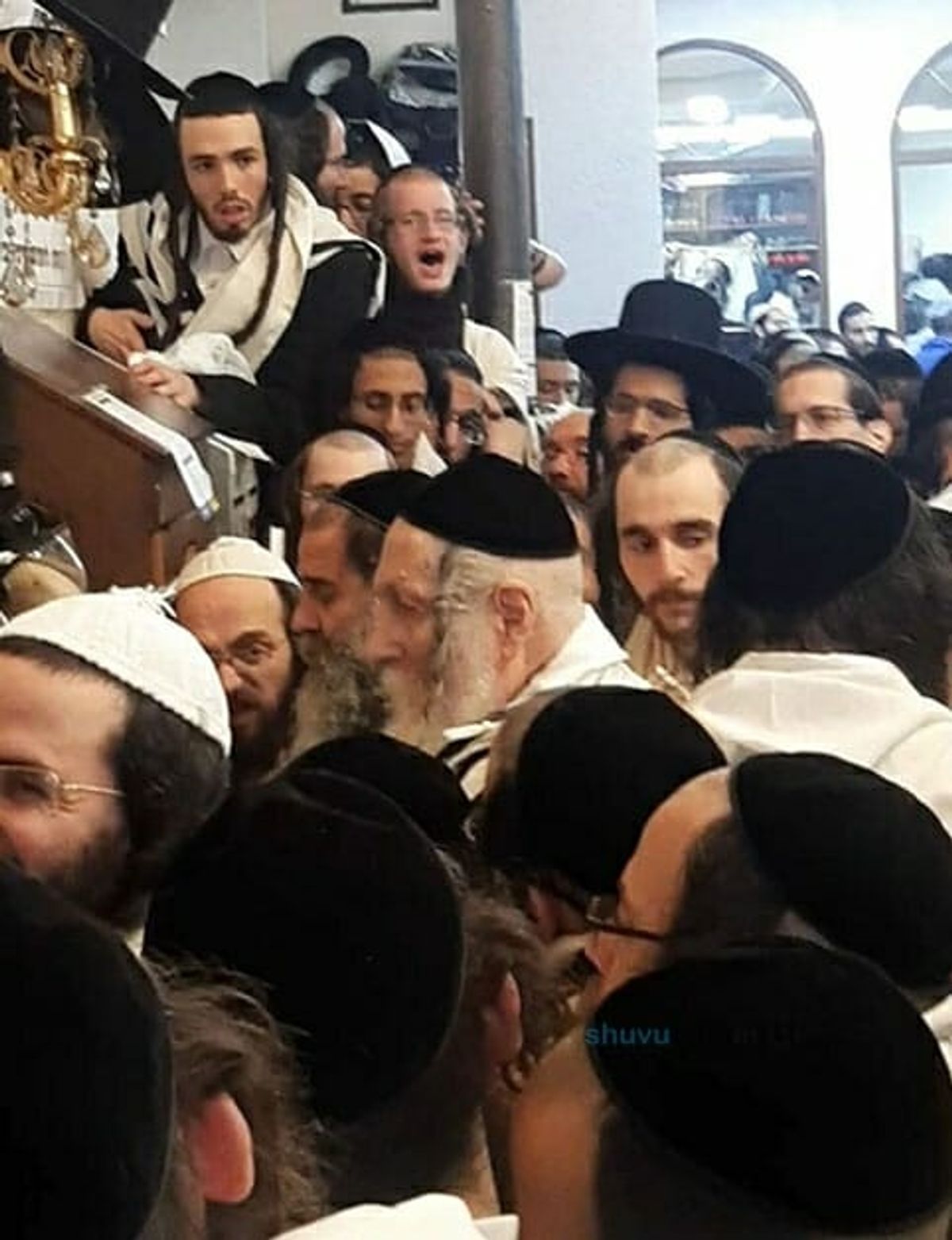
Why must we travel to Uman?
Why do we bring pure and innocent children to Uman?
And furthermore, the bitul Torah (loss of Torah study) of two days going and two days returning—could they not have studied during this time?
All of this is explained in Shaar HaKavanot on Yom Kippur, Drush 5, regarding why one must specifically travel to Uman. The Chatam Sofer said, "For now I would have lain still and been quiet; I would have slept, then it would have been restful for me" (Job 3:13). The Rambam says, "I slept then for 8 hours..." Everyone is a tzaddik, everyone is beloved, everyone does not sleep, everyone studies Torah day and night, so why must one specifically travel all the way to Uman? In Shaar HaKavanot, the Arizal says that there are two types of tzaddikim: there are tzaddikim of the aspect of Leah, and there are tzaddikim of the aspect of Rachel. These are two types of tzaddikim as far apart as heaven and earth.
In truth, everyone is beloved, everyone is clear, everyone is holy, everyone is pure, but the Arizal says there are tzaddikim who are of the aspect of Leah, and about them it is said that complete tzaddikim are written and sealed immediately for a good life, already on the first night.
The tzaddikim of the aspect of Leah attained everything through weeping
The Rambam says that in every generation there is one tzaddik; there are not many tzaddikim of the aspect of Leah, and the entire secret of Leah was hidden from Yaakov until after Rachel passed away. The secret of Leah, of the tzaddikim who are of the aspect of Leah, is that the eyes of Leah are soft, meaning they only weep and pray: "Pour out your heart like water before Hashem." They do not attain any spiritual achievement without prayer. The Rebbe asks, why is the tractate called "And my tears have been my food" (Psalms 102)—because the tzaddikim mingle their study with tears by the rivers of Babylon. How did they manage to compile the Babylonian Talmud? Upon rivers of tears! These tzaddikim, who are of the aspect of Leah, do not approach anything, any side, or any movement before they shed rivers of tears. "By the rivers of Babylon, there we sat, we also wept" (ibid. 137). The Babylonian Talmud was written by the Tannaim and Amoraim who poured out rivers of tears, and therefore, the smallest among you can revive the dead.
The Arizal explains in Shaar HaKavanot that not every tzaddik reaches the aspect of Leah; it is true that everyone is a tzaddik, everyone is beloved, and everyone is holy and pure. And Rabbeinu says, "Your righteousness is like the mighty mountains" (from the piyyut for Motzaei Shabbat), that Mount Tabor is to break pride in four aspects, four parasangs. The first level in breaking pride is to believe in the tzaddikim first of all—Breslov is not, Heaven forbid, to deny any tzaddik; Breslov is to believe in all the tzaddikim. But there is one tzaddik who is of the aspect of Leah, which is something entirely different, and whoever reaches this tzaddik, says the holy Arizal, is immediately sealed for a good life, already on the first night.
Everyone who is with this unique tzaddik on Rosh Hashanah is written and sealed immediately
Regarding this, the Gemara says (Rosh Hashanah 16b) that complete tzaddikim are written and sealed immediately, along with all those who accompany them. Everyone who reaches such a tzaddik, who is of the aspect of Leah, of the aspect of "Leah's eyes were soft," whose every achievement was through rivers of tears—all of Likutey Moharan is rivers of tears, it is "Pour out your heart like water before Hashem." A person usually cannot cry if he does not have some trouble; he cannot shed tears over the suffering of the Shechinah, over the suffering of Hashem. As it is brought in the name of one of the great tzaddikim, that after he finished Tikkun Chatzot, he said, "Now we must say another Tikkun Chatzot." What is Tikkun Chatzot? Do we cry like this?! So he said another Tikkun Chatzot until the morning; he said Tikkun Chatzot three times. This is called weeping over the pain of the destruction, over the pain of the Shechinah.
This tzaddik, who truly feels the pain of the Shechinah, the destruction, and the exile of the Jewish people, the troubles of the Jewish people, is the tzaddik who is of the aspect of Leah. The Rebbe says, "I feel all the troubles of Israel even before they are decreed." The Rebbe already told of the decree of the kidnapping of the children 24 years earlier; the decree was issued in 5587, and the Rebbe spoke in 5562. He said, "I delayed it for 20-something years." The Rebbe says, "I feel the troubles even at their root; even before they begin to awaken, I already feel that there is going to be a decree upon the Jewish people." And a million Jews were kidnapped, and half a million jumped into the Volga and committed suicide, and everything that the Righteous Among the Nations find is always from the descendants of those children.
The tzaddik, even though he is sealed immediately, continues to worry for the sake of all of Israel
The holy Arizal explains in Shaar HaKavanot that these complete tzaddikim who are written already on Rosh Hashanah immediately for a good life, they and those who accompany them receive the seal—the seal is in the Yesod of Leah. So why do we not say on Rosh Hashanah, 'May you be written and sealed immediately'? He says that even though they are written for a good life, what kind of good life can there be if there is suddenly an exile? If there is suddenly a decree? If Jews suddenly go into captivity? It is true that the tzaddik will remain alive, but he will go with everyone; he will not hide in some basement, in some bunker, or in some cave until all of Israel is written. So it is true that he will enter into a good life, but we must now worry for all of Israel as well. After we prayed on Rosh Hashanah and we all merited, already on the first night, to be written and sealed immediately for a good life, the Yesod of Leah, now we must pray for all of Israel.
And this is the intermediate ones who are sealed on Yom Kippur, and the seal of Yom Kippur is not yet enough because we must now make the third seal, which will be on Hoshana Rabbah, the final seal. Then even the wicked are sealed for a good life, because if there were a decree upon the wicked, then permission would be given to the destroyer not to distinguish between the tzaddik and the wicked. Because until all the wicked are also sealed for a good life, they are also given to live another year, and the intermediate ones are included with the wicked, so the tzaddikim would also be included in the decree.
After building the stature of Leah, we must sweeten the judgments by building Rachel
The holy Arizal explains that immediately on the night of Yom Kippur, Rachel ascends, because we must reach Rachel. The unification of Rachel will only be in the Keter during Musaf; all the unifications now are only in Leah. On the first night, the tikkun in Leah already occurred; the tzaddikim who are of the aspect of Leah already had the entire tikkun done in all the worlds on the first night. But there is also the stature of Rachel; Leah is the complete tzaddikim, and the rest of all of Israel are called Rachel. Therefore, on the first night, we built the Keter of Rachel; on the second day, we built the Chochmah of Rachel; on the third day, we built the Binah, and then Gedaliah was killed, because the judgments of the Keter and Chochmah are sweetened by the blowing of the shofar. Since there is no shofar blowing on the 3rd of Tishrei, there was nothing to sweeten the judgments upon Gedaliah ben Achikam.
Because Gedaliah ben Achikam was the greatest of the generation, and he was of the aspect of Leah; he was the greatest tzaddik in the generation, and him they left alive with all of Israel. But since terrible judgments awaken on that day, and he did not succeed in sweetening the judgments of the collective—the judgments of himself he did sweeten, but the judgments of the collective he did not succeed in sweetening. So even though he himself was of the aspect of Leah, and he already passed, he did not succeed in sweetening, and the Arizal says that this is why Gedaliah ben Achikam was killed, because then it was the Sefirah of Binah.
On the 4th of Tishrei it is Da'at, on the 5th it is Chesed, on the 6th it is Gevurah, on the 7th it is Tiferet, on the 8th it is Netzach, and on Erev Yom Kippur we must rectify 3 Sefirot: Hod, Yesod, and Malchut. Rachel begins to ascend—after we built the stature of Rachel, we must rectify 11 Sefirot in 9 days. Leah was rectified immediately on the first day; Leah received the tikkun, and all the tzaddikim of the aspect of Leah and those who accompany them were sealed immediately for a good life. But now we must bring into a good life all the tzaddikim who are of the aspect of Rachel.
Until Yom Kippur, all the ascents are only of Rachel
On Erev Yom Kippur, it remains to complete Hod, Yesod, and Malchut, and then Rachel begins to ascend. In Kol Nidre, she ascends to the head of the Tevunah, which is the lower female of Abba. In the Maariv prayer, we raise her through our prayers to the aspect of the Malchut of Binah. Because first she ascends to the head of the Tevunah, after that in Maariv when we say 'Barechu', and after that in the Amidah, she ascends to the Malchut of Binah Ila'ah, which is the upper female of Abba. In the Shacharit of Yom Kippur, Rachel ascends to the Chagat of Binah; in the repetition of the Amidah, she ascends to the Da'at of Binah. The ascents are only in Rachel; they are not at all in Zeir Anpin.
The Arizal asks: Why do men even need to fast, since now only Rachel is being raised?
If so, the women should fast and not the men! And he answers: simply so as not to distinguish between men and women, so the men also fast. But in truth, the prayers of the women are those that raise everything; the Nukva alone is the one that ascends. And even though we are already in Musaf, Zeir Anpin is still below his place; he has no ascent at all. All the ascents are only in Rachel, and all the unifications are only in Leah. The ascent of Zeir Anpin begins in the Mincha prayer, when Zeir Anpin and Leah ascend to the head of the Tevunah, and then they ascend to the chest of Binah Ila'ah, and in the Ne'ilah prayer, they ascend to the head of Binah.
Whereas Rachel ascended slowly, first to the Da'at of Binah, because Zeir Anpin always ascends according to the measure of his stature, and now Zeir Anpin, Leah, and Rachel are already equal, because they ascended to the Keter of Binah. And in the repetition of Ne'ilah, all three ascend to Imma Ila'ah, and then we shout, "Hashem is the G-d, Hashem is the G-d," because now everyone is at the same height; everyone is included in the beard of Arich Anpin. Therefore, we had to say 'Elokim' is 'Havayah'. What is the meaning of 'Hashem is the G-d'? Because Hashem, Hashem, the G-d is Atika Kadisha, because they ascended to Atika. That even Rachel and Leah, who are called 'Elokim', ascended and are included in Atika, and therefore everyone is called 'Elokim'.
The tikkunim of Sukkot - no sin is counted
On Sukkot, on the 18th of Tishrei, we reach the Sefirah of Netzach, because on the 11th we rectified the Chesed in Hod, the inner lights. The inner lights go from bottom to top. On the 12th, we rectify Chesed in Netzach; on the 13th, Chesed in Tiferet; on the 14th, Erev Sukkot, Chesed in Gevurah. And when we reached Sukkot, it is Chesed in Chesed. Now the Sukkah is surrounding lights, and therefore there is no accounting of sins; the sins are not counted in these days because only kindnesses are drawn down. Inner kindnesses go from bottom to top, from the Chesed in Hod to the Chesed in Chesed, which is on the first day of Sukkot, and this day is the highest, because then there is also Chesed of Chesed of inner lights, and Chesed of Chesed of surrounding lights is the Sukkah, the surrounding lights.
And from then on, we begin to descend. On the 15th, it is Chesed in Chesed; on the 16th, Chesed in Gevurah; on the 17th, we are in Chesed in Tiferet; on the 18th, we are in Chesed in Netzach, the Sefirah of Rabbeinu. On the 19th, Chesed in Hod; on the 20th, all five kindnesses are included in Yesod, and on the 21st, on Hoshana Rabbah, all the kindnesses are included in Malchut, and then a unification occurs on Simchat Torah, the complete tikkun. Because in the Keter, a unification of Zeir Anpin and Rachel occurs, and if we perform it with perfection, this unification can bring about the building of the Holy Temple; this is the unification of Simchat Torah.
The secret of the tzaddik who builds the two Holy Temples
The grandson of the Sma was a tremendous kabbalist, and he incorporated all of Kabbalah into the Psalms. In chapter 11, he explains the entire secret of the building of the Holy Temple. He says that the tzaddik of the generation, who is of the aspect of Leah, always has the power to build the two Holy Temples: one Holy Temple of precious stones and pearls, and the second Holy Temple of fire. The Zohar says in Pinchas, on page 220, that this is the secret of the verse, "The place, O Hashem, which You have made for Your dwelling, the Sanctuary, O Lord, which Your hands have established" (Exodus 15:17). "The place, O Hashem, which You have made for Your dwelling" is the Holy Temple of stone; "The Sanctuary, O Lord, which Your hands have established" is the Holy Temple of fire.
Rabbeinu says, "I can do everything that Mashiach will be able to do, only that the generation is not ready to receive." Until the generation believes that the Rebbe is the tzaddik of the generation, until a person knows the difference between this tzaddik and that tzaddik—all the songs are holy, but there is a Holy of Holies. All the tzaddikim are only of the aspect of Rachel; the greatest tzaddikim can only be of the aspect of Rachel. But the aspect of Leah, only one tzaddik can be, and this tzaddik is the only one who is written and sealed immediately for a good life.
These are the questions that a gentile asked Rabbi Eliezer the Great (there), "What is the meaning of 'The glory of this latter house shall be greater than the former'?" So he fixed his eyes upon him and made him a pile of bones, and immediately he began to weep. After all, the gentile asked a good question, and Rashbi himself asked, "What is the meaning of the latter house?" It is written, "The glory of this latter house shall be greater than the former" (Haggai 2:9). Haggai says, "This house which you see, they made it out of plywood; go up to the mountain, bring olive wood and cedar wood," and everyone began to weep. It is written in Ezra that the sounds of weeping rose above the sounds of joy. What is the Holy Temple? After all, only 70 years earlier the previous Holy Temple was built. Whoever was 20 at the first Holy Temple is today 90 years old; whoever was 10 is today 80 years old.
Those who rejoiced and danced tried to overcome the sound of weeping and did not succeed, because all of the Jewish people who had still seen the First Temple, which was entirely gold—King Solomon built it—whereas here they took some plywood and made a Holy Temple—in every generation there are those who can see the Holy Temple.
And this is what the Sabe d'Bei Atuna asked Yehoshua ben Chananiah, if he was the tzaddik of the generation who could build the Holy Temple. "Can you build a house in the air? Can you bring down a Holy Temple of fire?" So he showed them a Holy Temple of fire! Yehoshua ben Chananiah was the tzaddik of the generation who defeated all the Sabe d'Bei Atuna and brought them to the king. They were the greatest heretics in the generation, and he succeeded in killing them all, just as the Rebbe drew the three heretics close and brought them to teshuvah. Yehoshua ben Chananiah, who was the tzaddik of the generation, took the greatest heretics who were in the world, the 60 Sabe d'Bei Atuna, and brought them to the king of Rome until he killed them completely.
He showed the Sabe d'Bei Atuna, 'If you want to be Jews, now convert; I am showing you a Holy Temple of fire.' The tzaddik of the generation can see in every generation a Holy Temple of fire; he can bring the Geulah to the Jewish people in every generation.
On Simchat Torah, we reach the unification of Yaakov and Rachel, Zeir Anpin and Rachel, and then the Holy Temple will be built speedily in our days, in the blink of an eye.
Amen
Subscribe to Our Newsletter
Receive Torah articles and inspiration directly in your inbox