Customs and Spiritual Practices from Our Holy Rebbe, Rebbe Nachman of Breslov
and His Disciple Rabbi Nosson of Breslov for the Days of Purim
A compilation from the books of Breslov Chassidut on the greatness of the days of Purim. Customs practiced by Rebbe Nachman of Breslov and his student, Reb Noson of Breslov, which they also established for their students. Stories and insights from the great Breslov Chassidim throughout the generations. Regarding prayers on Purim and their timing, the reading of the Megillah, hitbodedut on Purim night, and the dancing and joy.
Greatness of the Day of Purim
Purim in its entirety is: "Pei, Vav, Reish, Yud, Mem" with the letters and the kollel totaling the number "Nun, Chet, Mem, Nun"—the name of our holy and awesome Rebbe, Rebbe Nachman of Breslov. (Kochavei Or, Chochmah U'Binah by Rabbi Avraham ben Rabbi Nachman Chazan)
Now, the entire beginning will be from Purim, which is the aspect of wiping out Amalek, as is understood from the words of [Rebbe Nachman of Breslov] z"l (Likutey Torah, Siman 74). The essence is through the power of the 'arousal from below' of the heads of the unique ones of the generations, who are Admor [Rebbe Nachman of Breslov] z"l and Rabbi Shimon bar Yochai z"l, who receives from him as mentioned above. This is especially true through the essence of the tikkunim (rectifications) that were established on the day of their passing (as understood from his holy words), as the two days of their passing are set to fall on the day that Purim falls (as brought in a manuscript from Rav Rabbi Nachman of Tulchin z"l). In both, there is the magnification of the hillula (the day of Lag B'Omer is the hillula of Rabbi Shimon bar Yochai z"l) and the time of our rejoicing (the day of the passing of Admor Rebbe Nachman of Breslov is the fourth day of the festival of Sukkot, the time of our rejoicing—just like Purim, which is a day of joy). Similarly, the past Purim also falls on the day that Lag B'Omer falls, as the ancients gave the sign 'Pei-Lamed-Gimel' (Shulchan Aruch, Orach Chaim, Siman 428). It is explained in the writings (Pri Etz Chaim, Sha'ar 19) that the days of Chanukah correspond to Hod (Splendor) and the days of Purim correspond to Netzach (Victory). Likewise, Lag B'Omer is always on the 18th of Iyar, and the second day of Chol HaMoed Sukkot is also on the 18th of Tishrei. When the 25th day of the counting (of the Omer) falls on Shabbat, it is the center point for the days of the counting, including the three Sabbaths before it and the three Sabbaths after it, for all the sefirot, including the sefirah of Hod. (Kochavei Or)
Now, the beginning of the Geulah (Redemption) and the tikkun of all the worlds is from Purim, as is understood from the hints in the holy words of our Rebbe [Rebbe Nachman of Breslov] z"l (in Likutey Moharan, Part II, Siman 74), when he said the Torah on the verse: 'From Egypt' and 'None shall appear before Me empty-handed' (Lo Yera'u Panai Reikam), which are the initial letters of 'Purim'. He said then that initially, all beginnings were from Pesach, which is the Exodus from Egypt, and now... etc. He stopped in the middle and did not finish his words, and from his words, I understood that now, the beginning is from Purim. (Ibid, 25). (Siach Sarfey Kodesh I, 27)
Once on Purim, they told Moharnat z"l that Nachman, son of Marat Chaya, daughter of our Rebbe, was staying at the house of Rabbi Mordechai, the wealthy Rabbi Mordechai Rotenzait z"l: 'Nachman is staying at Mordechai's house.' He replied and said: 'So the matter is practiced, that on Purim, "Nachman"—who is the soul of the tzaddik—stays with Mordechai the Tzaddik, and on Pesach, the tzaddik stays with Pesach, and so on every holiday.' (Ibid, 175)
Rescue Me
Reb Noson of Breslov (Moharnat) related: Once on Erev Purim, I cried out to Hashem, 'Rescue me from the klipah (shell) of Haman-Amalek,' and it seemed to me as if Haman-Amalek was standing over me to strike me with an iron rod... (Avnei Barzel)
Ta'anit Esther
Once, before the Mincha prayer of Ta'anit Esther, when Reb Nachman of Tulchin entered the synagogue, he was very happy because he was rejoicing in the joy of the approaching Purim. When Moharnat saw him, he said: 'The entire congregation is now going to say "For we are in great distress" (in the Aneinu prayer during Mincha), and Purim has not yet arrived; what is this joy doing?' (Siach Sarfey Kodesh)
Psalm 22
On Purim, Breslov Chassidim were accustomed to saying Psalm 22 in Tehillim—'For the leader, upon Ayyeles HaShachar.'
Reading the Megillah
The arousal and enthusiasm that existed among Anash (our people), the Breslov Chassidim, on Purim, especially during the reading of the Megillah, was greater than the arousal that existed during the saying of Kol Nidre. They literally felt and saw tangibly that Yom Kippurim is truly a day 'like Purim' (Ke-Purim), as per the words of the Tikkuney Zohar.
Hitbodedut on Purim Night
Anash, the Breslov Chassidim, were accustomed on the nights of Purim at midnight—which is a most auspicious time—to go to the fields and forests and increase in hitbodedut and prayers to merit the light of this great and awesome day.
Reb Pinchas Kiblitser z"l once said and explained what is stated in the Megillah, 'And the King loved Esther more than all the women,' based on what is explained in the words of our Rebbe, Rebbe Nachman of Breslov, in Torah 49, Part I, and in Torah 1, Part II, that a woman who fears Hashem is the aspect of prayer. He explained that the most important and accepted prayer is the prayer of hitbodedut, which is a hidden prayer. This is 'And the King loved'—that is, the King of the World—'Esther'—that is, the aspect of prayer that is in concealment, which is hitbodedut—'more than all the women'—more than all other prayers—'and she found grace and kindness before him more than all the virgins.' After he said this to his students, the Breslov Chassidim, on Purim night, they ran to the field and stayed there for the entire night out of great enthusiasm and arousal. (Siach Sarfey Kodesh)
Vasikin Prayer
Anash, the Breslov Chassidim, were accustomed to pray on Purim at sunrise (Vasikin), in accordance with the insistence of the Baal Shem Tov that one should pray at sunrise on five days of the year, and one of them is the day of Purim.
Service of Yom Kippur
Moharnat said: 'The order of service in the worship of Hashem on the day of Purim is much harder for me than the order of service on Yom Kippur,' because on Yom Kippur, one is in the synagogue all day and occupies oneself only with prayers and supplications. This is not the case on Purim, where one must increase in intoxication, joy, eating, etc., and in this way serve Hashem—it is much harder. (Siach Sarfey Kodesh III, 139)
Dancing and Joy
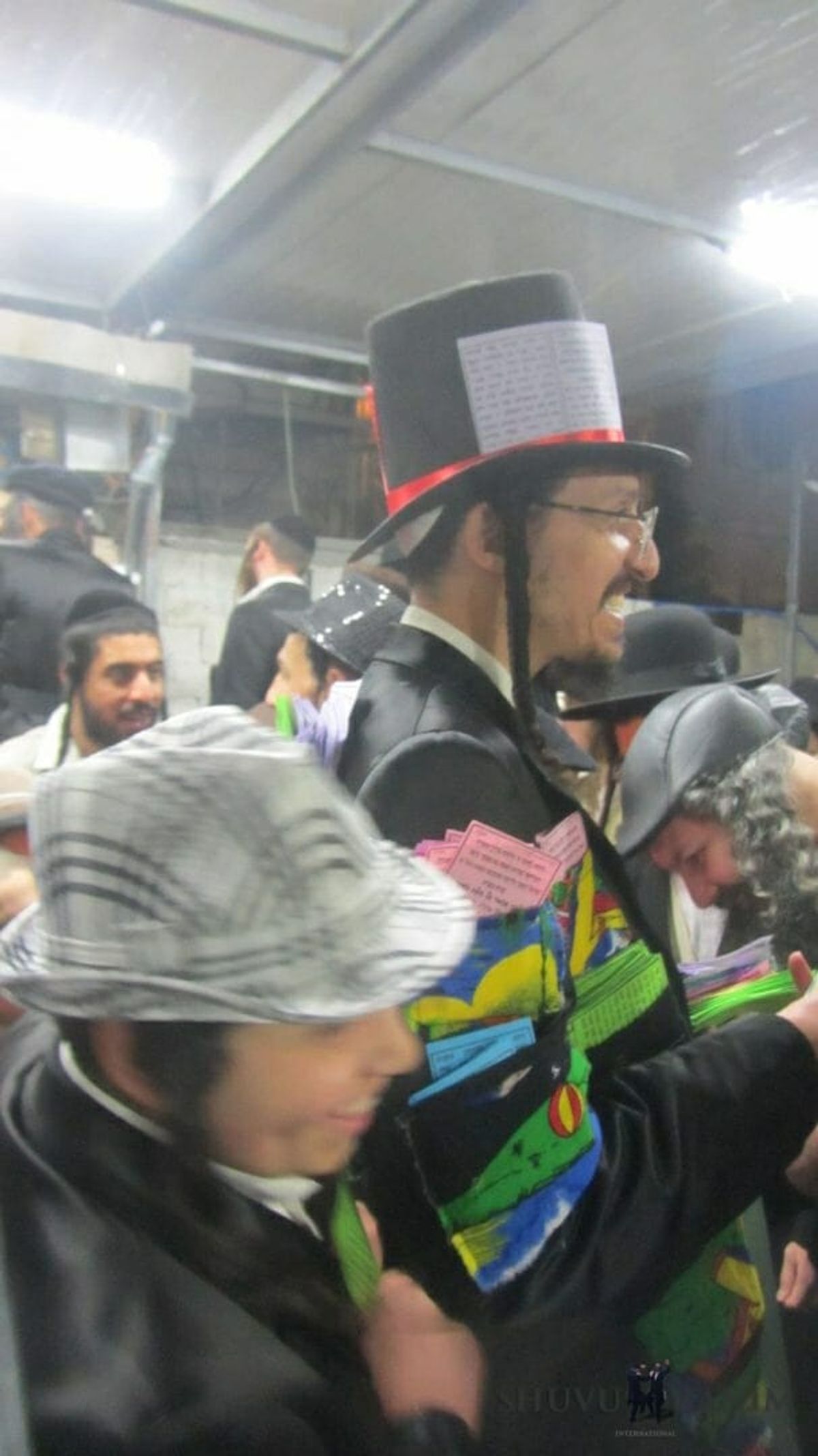
It is a mitzvah of the day to increase greatly in dancing and melodies to rejoice in the joy of the miracle and the light of this day. Through these dances, one sweetens and nullifies all decrees and judgments.
Rabbi Yitzchak Aizik Yosef z"l, father of Rabbi Pinchas Yehoshua z"l of Tulchin, was among the first close followers of Moharnat. He was of very high stature. Once, on Purim, during the drinking, he boasted before Moharnat that he was no longer afraid of the yetzer hara (evil inclination). The day after Purim, he went in again to Moharnat z"l, and Moharnat asked him if he remembered what he had boasted about yesterday during the drinking. He replied to him: 'Even today, I say the same.' I heard from Rabbi Pinchas Yehoshua z"l that Moharnat once said to him: 'Your father was a tzaddik.'
Before his (Reb Yitzchak Aizik's) drawing close to Breslov, once on the night of Yom Kippur, Moharnat z"l was walking past the study hall and saw through the window Rabbi Yitzchak Aizik Yosef, the scribe mentioned above, standing and finishing Tehillim in a loud voice and with immense enthusiasm. It was also known that he was now finishing Tehillim for the second time, equal to the number of 'Kofer' (ransom), and at the time of finishing the second time, he was still in the same immense arousal and enthusiasm as at the beginning of the first time. Thus, Moharnat z"l saw that this precious soul was worthy for our people to draw close to him. He began to work with him to draw him close, but it was not so manifest until Purim of that year, when he was slightly 'besamim' (intoxicated), he came himself to Moharnat z"l, stood at his doorway, and shouted: 'The Rebbe, the Rebbe, his greatness!' Before Purim, he had to be in Tulchin, and because he was poor, as is the way of scribes, he walked on foot. Upon his return to Breslov, a great test befell him, and he stood in the test. (Siach Sarfey Kodesh)
Shushan Purim
Our holy Rebbe, Rebbe Nachman of Breslov, said to Moharnat: 'Is Shushan Purim not also Purim? It is a mitzvah to be in joy on Shushan Purim as well, and you can rectify on the day of Shushan Purim even the joy that was needed on the day of Purim...' (Hagahot HaMa'atik in Chayei Moharan)
Subscribe to Our Newsletter
Receive Torah articles and inspiration directly in your inbox