Mishloach Manos with Dried Wheat and Ginger • Special and Fascinating
The Mishloach Manos of the Amoraim in the Era of the Gemara
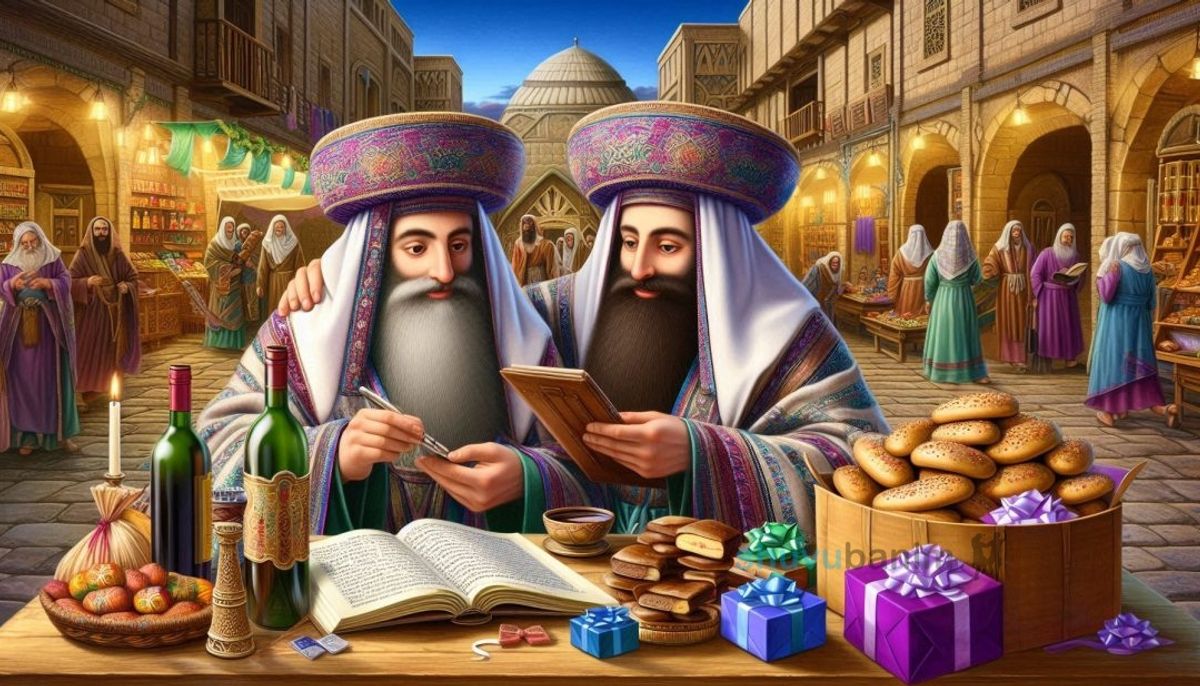
On the holiday of Purim, we all run from here to there to fulfill one of the mitzvos (commandments) of the day—sending Mishloach Manos (gift portions) to one another. During the era of the Amoraim (Sages of the Talmud), they also sent Mishloach Manos, but for some reason, the Amoraim chose unique gifts that did not include chocolates or liqueurs... Before you is a special description from the Gaon and Tzaddik Rabbi Eliezer Berland shlit"a (may he live long and good days) based on Tractate Megillah, with insights you have never heard before regarding the secrets contained in the Mishloach Manos of the Amoraim:
The Gemara in Megillah 7b says: "Rabba sent to Mari bar Mar." There was a great tzaddik named Mari bar Mar; he (Rabba) sent via the hand of Abaye "a basket full of dates and a cup full of flour of parched corn (dried wheat)." This is the secret of the wheat. Esther was a reincarnation of Ruth. When she became a giyores (convert), she merited what no other person in the world merited. Specifically, converts merit what no other person merits. [She merited] to bring Mashiach ben David, and therefore she revealed the secret of the wheat. This is the secret of "a cup full of flour of parched corn"—a full cup of flour from dried wheat from the oven, which possesses such sweetness, the peak of sweetness that can be imagined. "Abaye said to him," Abaye said to Rabba: "You have sent such sweet things." For on Purim, the sweetness of the "river that flows out of Eden" is revealed. On Purim, everyone ascends to Gan Eden (the Garden of Eden), and everything one eats and drinks on Purim is the "preserved wine," the "Shor HaBar" (Wild Ox), and the "Leviathan"—[Ziz Sh-dai] these are all birds from Gan Eden, the Leviathan from Gan Eden, and the Shor HaBar from Gan Eden. Abaye said to Rabba: What is happening here?!
On Purim, it is revealed—as the "Kedushas Yom Tov" says—the secret of "Baruch Mordechai" (Blessed is Mordechai). The secret is: Who am I really? And this is revealed specifically on Purim, and this is the "Baruch Mordechai." For "Cursed is Haman" is transformed into "Baruch Mordechai," because specifically one who knows he is Haman, one who discovers that he is Haman, said the Kedushas Yom Tov, he can merit "Baruch Mordechai!" A person must know that he is Haman; [if he] knows he is Haman, he can become "Baruch Mordechai!"
This is what Abaye said to Rabba: "What will the Master (Mari) say about you?" Because Rabba wanted to humble himself; Rabba only saw that he was essentially Haman. That he was essentially Haman himself, and through this, he would become "Baruch Mordechai." "If a peasant becomes king, he does not remove the basket from his neck" [Rashi explains: The basket he was accustomed to carry while still a villager to feed his cattle, he does not remove from his head even now. So too you, you have become a king and a leader in Pumbedita, yet you send him only items that are common to everyone]. The basket remains for a lifetime. For "HaSal" (the basket) has the Gematria (numerical value) of Haman. The Gemara reveals to us that "HaSal" is 95, which is the Gematria of Haman; this is the secret of Memuchan.
For the Gemara says (Megillah 12b): Memuchan is Haman, but the Tosafos in the name of the Midrash says: Memuchan is Daniel. For Daniel has the Gematria of Haman, and Daniel is also 95 = "HaSal" (the basket).
But [Abaye] did not understand the hint that Rabba wanted to convey [about himself]—that he is Haman. He hinted at this through the Gematria of "HaSal," showing that the basket stands above his neck. The moment I know that I myself am Haman, then it is possible to be "Baruch Mordechai." And this is the work of a lifetime—the basket does not move from his neck. "HaSal" is the Gematria of Haman. He knew he was essentially Haman, and therefore he merited two students like Abaye and Rava—where Abaye pointed to the heavens and Rava pointed to the ceiling (as told in Tractate Berachos 48b, see there).
(The Gemara continues to tell of Mari bar Mar when he returned the Mishloach Manos to Rabba:) "He then sent back to him a basket full of ginger." He sent him ginger (Zingbeila). The root of ginger is the secret of the "river that flows out of Eden"; this is the secret of Gan Eden. Therefore, in the word "Zingbeila" (זנגבילא), there are the letters "Gan" (Garden). He revealed to him the secret of the river that flows out of Eden. "And a river went out of Eden to water the garden." From where does the river emerge? From the Tree of Life. For on Purim, the Tree of Life is revealed; every Purim, the Tree of Life is revealed.
For Purim is the secret of Techiyas HaMeisim (the Resurrection of the Dead)—that one can reach the secret of the Resurrection of the Dead. And this is what the Gemara tells later, that Rabba arose and slaughtered Rabbi Zeira. Rabba, with his own hands, grabbed Rabbi Zeira and slaughtered him, because Rabba knew the secret of Purim, Rabba knew the secret of Purim... On Purim, everyone rises to life, even a slaughtered person, even a dead person! And this the Gemara reveals to us in Megillah page 7: the secret that on Purim it is possible to revive a person, for the secret of Purim is the secret of the Resurrection of the Dead, the secret of the Geulah (complete Redemption) that we shall merit speedily in our days, Amen!
Subscribe to Our Newsletter
Receive Torah articles and inspiration directly in your inbox