Sukkot and Simchat Torah in Parshat V'Zot HaBerachah: The Secret of Joy, Truth, and the Greatness of the Torah
"And You Shall Rejoice in Your Festival": The Mitzvah of Joy on Sukkot
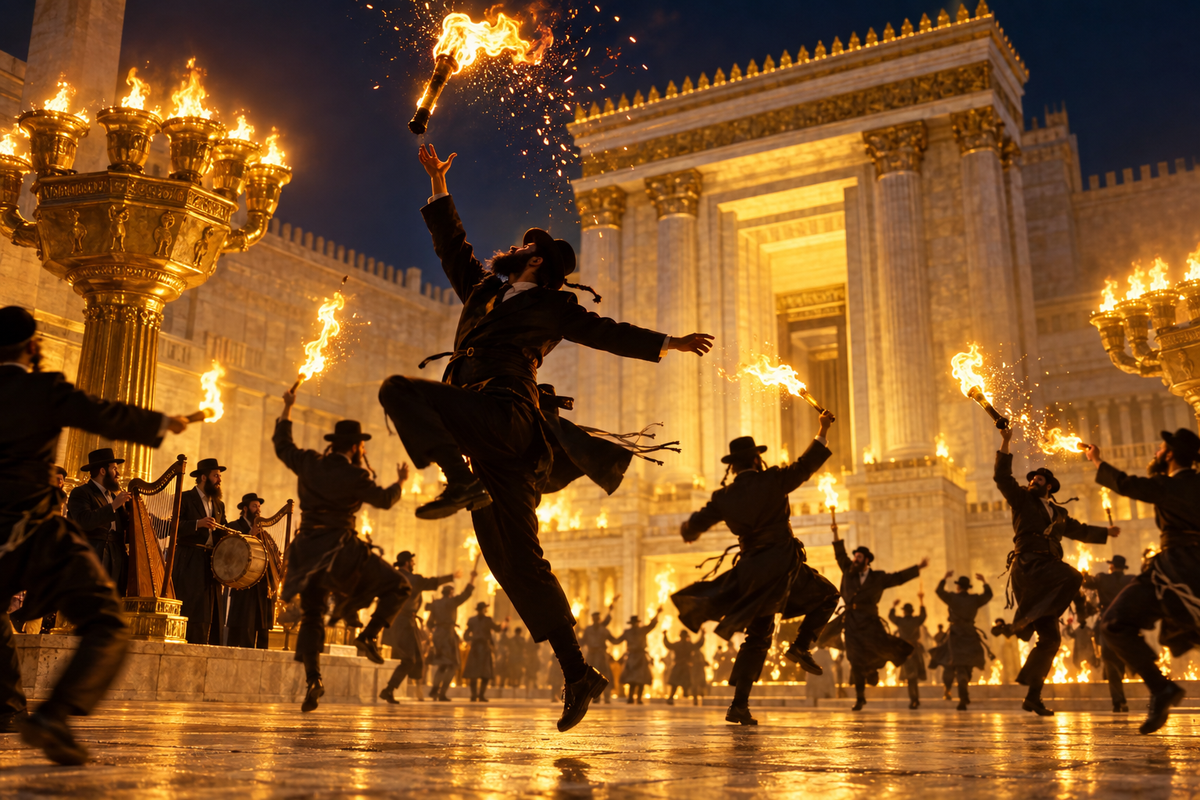
Even though it is a mitzvah to rejoice on all the festivals, on the holiday of Sukkot, joy is a mitzvah in and of itself. During Sukkot, there was extraordinary joy in the Holy Temple. The Sages established the holiday of Sukkot for double and multiplied joy. We must dance and rejoice without interruption throughout the entire holiday—and certainly learn Torah in between, because if one does not learn, it is impossible to dance.
As Rebbe Nachman brings down (Likutei Moharan 31):
"Through melody, a person is recognized as to whether he has accepted upon himself the yoke of Torah. The sign for this is: 'They shall carry it on the shoulder' (Numbers 7:9). The Sages expounded (Arachin 11a): 'Carry' (yisau) refers exclusively to song, as it is stated, 'Raise up (se'u) a song and sound the timbrel.' This verse was stated regarding the burden of the sons of Kehat, who carried the Holy Ark on their shoulders, which represents the aspect of the yoke of Torah."
Whoever carries the yoke of Torah can play music, sing, and dance. In the Holy Temple, there was immense joy, as it is stated, "And you shall rejoice," because the Torah itself says:
"And you shall rejoice before Hashem your God for seven days."
This is a Torah commandment (d'Oraita). It is not written regarding Pesach, nor Shavuot; rather, it is stated only regarding the holiday of Sukkot. It is a Torah-mandated joy to rejoice for seven days without pause. The Torah commanded us to rejoice and dance continuously, day and night, for seven days.
The Dancing of the Tzaddikim and the Sweetening of Judgments
And how did they express this joy? They would bring all the musical instruments, playing the harp, lyres, and cymbals—each and every person with the musical instrument they knew how to play. But the intense, stormy dancing, the dancing with juggling and acrobatics—that was performed only by the great tzaddikim.
The moment the dancing began, only the great tzaddikim, the holy ones of the Most High, danced, leaped, and whirled, just like King David who leaped and whirled. Only men of pious deeds who engaged heavily in Torah and mitzvot, and who faithfully attended to the needs of the public, not sleeping day or night with true self-sacrifice—only they would dance, clap, and strike their hands in the Holy Temple.
Therefore, everyone must dance and rejoice during these holy days, knowing that dancing and joy are a very great tikkun (rectification). A person does not know what terrible judgments await him in the coming year. Rebbe Nachman says (Torah 206) that when a person commits sins and causes spiritual blemishes, at first they deal with him in a good way. Hashem begins to call out to him with a hint, then with a direct call, until eventually, if he ignores it, He strikes him and afflicts him.
You committed sins? Do teshuvah (repentance)! And if you do not do teshuvah, perhaps through suffering you will grasp something, you will begin to do teshuvah, you will start to cry over your blemishes and be shaken up a little. If not, then the wife will become sick, Heaven forbid; if not the wife, then the children, Heaven forbid. Rebbe Nachman promised that he would rectify everything, but the question is, how will he rectify it? With what suffering will he rectify it?
Building the New Year Through Joy
We are Jews; nothing is atoned for free. Among the Christians, one doesn't have to do anything except go to the priest and confess once a year, and he says you are forgiven, and then they continue in their ways. But among Jews, there are no such things! For a sin, one pays! For every transgression, one pays! And if a person does not do teshuvah and does not awaken, then they begin to strike him and afflict him, as it is written, "There is no suffering without iniquity."
We have 22 days from Rosh Hashanah until Simchat Torah. From Rosh Hashanah until Yom Kippur, we sweetened the severities, we sweetened our evil inclination so that it would not rule over us, and now, from Yom Kippur until Simchat Torah, we are given 12 days for the sweetening of judgments and the forgiveness of sins. Now we are building the new year. Until now, we were only sealed; it was just the sealings. The sealing on Rosh Hashanah for completely righteous people, the sealing on Yom Kippur for intermediate people—now you must start building!
The building takes place on Sukkot through joy, dancing, singing, praying with intention, and guarding one's eyes. And according to how a person dances and sings during these days, that is how he builds the new year. Through the dancing, the songs, and the circle dances (mecholot), sins are forgiven. What is a "machol" (circle dance)? It means that all sins are forgiven (nimchalim, from the same root as machol). Through the circle dances, no sin and no judgment remains.
The Arizal says that whoever rejoices and dances also on the night after Simchat Torah until the morning will merit that all his sins will be nullified. The dancing and the joy create the new year. Through the dancing, we draw down the health of the new year, the intellect (mochin), and the heart of the new year. With Hashem's help, may we merit, through the joy, the songs, and the dancing, the forgiveness of sins, the sweetening of judgments, and the complete Geulah (Redemption), speedily in our days, Amen.
In the Light of the King's Face: The Truth That There is None Besides Him
There is only one truth. True, everyone has their own level on the ladder of truth, but there is only one truth. There are not many truths. There is a path to reach the truth. There is a first stage on the path to truth, a second stage on the path to truth—there are stages, but there is only one truth. What is the truth? That there is none besides Him. Of everything else, nothing will remain. Because what is truth? It is something eternal. After 80 years, what is left of a person? What remains of him is the truth. That is why it is called the World of Truth.
Here, it is the world of falsehood (alma d'shikra). But we must not become bitter and fall into depression because of this. That is not why we came here. That is not what Hashem wants from us. He does not want us to be broken and sad, saying, "Everything here is a lie, and we pass away anyway." That is not the point. A person needs to connect to the part that remains forever—to something that will endure.
A person might say, "So what? Because of this I have to suffer now? Because of what will be in the World to Come? Let me live now!" This is what a person might say. If it were truly so, that he is actually living now, fine. But the whole point is that even now you are not truly living; there isn't a single minute of real life. When a person seeks falsehood rather than truth, when he seeks his own ego and self-importance—the exact opposite of "there is none besides Him" (Hashem)—thinking, "I am, and there is nothing else besides me," just "me, me, me," and "I am like this, and I am like that," then oh, what suffering he endures! He has no life at all. Why does he have no life? Because he is far from the truth.
The Shattering of the Vessels and Faith in the Good
Hashem established the world upon truth. This is the blueprint of creation, and this is how man was created—these are the rules of creation. You were created according to these rules, and if you act contrary to them, it is like a person who turns on a machine he just brought home without looking at the manufacturer's instructions, pressing all the wrong buttons. Obviously, the machine will break, malfunction, and go awry, leading to very severe consequences.
In other words, there will be a "shattering of the vessels" (a Kabbalistic concept where the spiritual vessels break because they cannot contain the immense Divine light). This is what is called the shattering of the vessels. If you are currently unable to receive the light, if you are not a proper vessel to contain it, then this light will burn you, Heaven forbid. Even when the most terrible things in the world happen, a person cannot deny the truth; he cannot deny God.
A few years ago in Auschwitz, they found an earthenware jug containing a letter written by a man right before his death there during the Holocaust, addressed to Hashem. What was written in the letter? "I know, Hashem, You took my wife from me, You took my children from me, and I was left all alone, yet I continued to trust in You, to remain strong in You. And now they are taking me to my death; I, too, am now going to die. I know what You thought, Hashem. You thought I wouldn't love You, You thought I would betray You, You thought I would deny You. But You did not succeed. I love You." He wrote this and buried it in the ground, and it was discovered just a few years ago. This means that this is how he went to his death—with such a revelation of immense love for Hashem.
Where is Hashem? In the Chalal Panui (the Vacated Space, a Kabbalistic concept where God seemingly withdrew His presence to make room for creation). He is seemingly absent. But man contains a Divine spark; God is found within a person's heart. How can one say there is no God when He is right there inside the heart? So, even when the most terrible things in the world happen, a person cannot deny God, because if he denies God, at that very moment he is in Gehenna (Hell). Why? Because he is denying the truth. What truth? That there is none besides Him, and that everything is for the best. If Hashem did something and we say otherwise, it means we are denying His goodness. Because everything Hashem does for us is only good. If Hashem said, "It is not good for man to be alone," and you think you can exist without a wife, it means you do not understand the deep Divine wisdom that it is impossible for a person to be truly good while alone.
The Secret of Moshe's Burial: Humility vs. Arrogance
We find in Targum Yonasan (the Aramaic translation and commentary on the Torah) on the verse:
"And He buried him in the valley in the land of Moab, opposite Beis Peor" (Devarim 34:6):
"Blessed is the Name of the Master of the Universe who taught us His proper ways... He taught us to bury the dead from Moshe, for He revealed Himself to him through His Word, and with Him were companies of ministering angels, Michael and Gabriel, who spread out a golden bed studded with gems... and by His Word He created four things, and He buried him in the valley opposite Beis Peor, so that whenever Peor rises up to remind Israel of their sins, it looks at the burial place of Moshe and is subdued."
In other words, his burial opposite Beis Peor is intended to nullify the heavenly accusation stemming from the sin of Peor. This is explicitly stated in the Talmud (Sotah 14a): "Why was Moshe buried near Beis Peor? In order to atone for the incident of Peor." Tosafos writes there (s.v. Mipnei): "The Midrash Aggadah states that every single year, at the time when Israel sinned with the daughters of Moab, the idol of Beis Peor rises upward to accuse and recall the sin. But when it sees the grave of Moshe, it sinks back down, for Moshe Rabbeinu sank it into the ground up to its nose, and every time it rises, it sinks back to the place where Moshe Rabbeinu sank it."
This seems to be hinted at in the verse (Bamidbar 31:2):
"Avenge the vengeance of the Children of Israel against the Midianites; afterward you shall be gathered to your people."
This means that Hashem hinted to Moshe that even "afterward you shall be gathered to your people," even then you will continue to avenge the vengeance of the Children of Israel against the Midianites, because as soon as the idol sees Moshe's grave, it sinks back down. We find that the sin of Peor is an accusation that awakens periodically and must be nullified, and this was Moshe's role in being buried opposite Beis Peor: to destroy and nullify this accusation against Israel. However, we still need to understand why this specific sin is constantly relevant.
The Humility That Nullifies Arrogance
However, we find what the Meor Einayim writes (Parashas Terumah): Behold, it is said regarding Moshe Rabbeinu, peace be upon him:
"And no man knows his burial place" (Devarim 34:6).
This is based on the teaching that the extension of Moshe exists in every generation. Therefore, the aspect of Moshe is hidden within every Jew. "And no man knows his burial place"—meaning, they did not know where Moshe was buried and hidden, because in truth, he is hidden and buried within the Daas (spiritual awareness/intellect) of each and every Jew. This is the meaning of "And He buried him in the valley": the aspect of Moshe, which is Daas, is hidden within one who is lowly in his own eyes like a valley and does not act with arrogance, for one who is arrogant is considered as if he worships idols. And this is the meaning of "opposite Beis Peor": the Daas is hidden within one who is lowly in his own eyes, and this stands in direct opposition and contrast to Beis Peor.
We thus learn that the sin of Peor represents arrogance, whose nullification comes through humility—namely, Moshe Rabbeinu, peace be upon him, the most humble of all men. This is the secret of his burial opposite Beis Peor: to instill submission and humility into all the souls of Israel until the end of all generations.
The Partnership of Zevulun and Yissachar: Supporting the Torah
"Rejoice, Zevulun, in your going out, and Yissachar in your tents..." (Devarim 33:18)
Yissachar and Zevulun are the youngest of Leah's sons, and therefore they are mentioned in Moshe's blessing after the blessing to their older brothers. However, the question arises: why does Moshe bless the younger Zevulun before blessing Yissachar, who is older than him? This question is even more fitting regarding the blessing of Yaakov, who generally addresses his sons in the order of their birth, yet still precedes Zevulun's blessing to that of Yissachar, his older brother.
Rashi addresses this question in his commentary, stating: Zevulun and Yissachar formed a partnership. Zevulun dwells by the seashore, goes out to trade in ships, earns a profit, and provides for Yissachar, while the sons of Yissachar sit and engage in Torah study. Therefore, Moshe preceded Zevulun to Yissachar in his blessing, because Yissachar's Torah study was made possible through Zevulun (in the merit of Zevulun).
Regarding this matter, Rabbi Yitzchak Caro notes in his book Toldos Yitzchak: Yaakov Avinu and Moshe Rabbeinu precede the blessing of the younger Zevulun to the older Yissachar in order to teach us that the reward of Zevulun—who toils outside, by the seashore, to enable his brother Yissachar to study Torah in his tent without worries of parnassah (livelihood)—is incredibly great. From here we learn that one who supports the hands of those who study Torah receives a reward greater than the reward of those who actually toil in Torah.
A Story for the Parashah: The Value of Every Hour of Study
"Moshe commanded us the Torah, an inheritance"
The brilliant tzaddik, Rabbi Yisrael Meir of Radin, known as the Chafetz Chaim, was renowned throughout his life for his extraordinary diligence, practically fulfilling the verse:
"And you shall meditate on it day and night" (Yehoshua 1:8).
From a young age, he lived in Radin and earned his parnassah (livelihood) from a small grocery store. Every hour he was not busy in his shop, he engaged in Torah study with immense dedication. Over time, he founded a large yeshiva in his city, which became famous throughout the Jewish communities of Europe.
Once, the Chafetz Chaim entered the study hall of his yeshiva and saw a large group of young men neglecting their studies and engaging in idle chatter. The Chafetz Chaim approached them and said: Since you are idling away from Torah study, I will tell you a story I heard from Rabbi Yisrael of Salant (the father of the Mussar movement in Lithuania). There was once a man who lost his mind and began dismantling a few meters of railway tracks. People scolded him, angrily shouting: Why are you tampering with this railway line? You are endangering the train passengers who are scheduled to pass through here today!
The man feigned innocence and replied to the complainers with a tone of astonishment: You all know that the railway line here stretches for thousands of kilometers, and I only damaged a few mere meters of it! Less than a fraction of a percent of its length—what harm could that possibly cause...?!
The moral of this story, the Chafetz Chaim cried out with emotion, is a Jew who holds himself back from Torah study, even for just a brief hour, with the foolish claim that his fathers and forefathers studied Torah diligently, and that there are many other good people in the world who uphold Torah study properly—so what harm could it possibly cause if I do not learn? This person is compared to that senseless man who inflicts a minuscule amount of damage to the massive railway, yet by doing so, he endangers all the passengers traveling on the line...
The Wondrous Burial of the Tzaddikim in Nikolsburg
"And no man knows his burial place to this day"
Shortly before the passing of the tzaddik Rabbi Shmuel Shmelke (who was one of the premier disciples of the Maggid, Rabbi Dov Ber), he commanded that his grave be dug next to the resting place of the brilliant Rabbi Menachem Mendel, author of the Tzemach Tzedek, who served as the halachic authority in Nikolsburg and had passed away many years prior. However, when the members of the Chevra Kadisha (burial society) began digging their rabbi's grave, one of the local elders suddenly appeared and passionately claimed that decades ago, he heard from his father that the Tzemach Tzedek had commanded right before his passing that no one should be buried next to him!
The members of the Chevra Kadisha were deeply perplexed upon hearing the elder's words, as he was known in the community as a wholesome and honest man who would never utter a lie. His father, too, was known throughout his life as an outstandingly pious man who would not deviate from the truth by a hairsbreadth. Since they could not delay the funeral of their great rabbi for long, the members of the Chevra Kadisha opened the old ledgers, which recorded the names and burial locations of the deceased from over a century ago.
After leafing through the pages, they miraculously arrived at a yellowed, worn page detailing the death and burial of the Tzemach Tzedek. Alongside these details, it was written: "The brilliant Rabbi Menachem Mendel zt\"l commanded, prior to his passing, that no one should be buried next to him until such-and-such day in such-and-such year."
How great was the amazement of the people present, who realized that the date specified in the will of the rabbi who passed away one hundred and twenty years earlier matched exactly with the date on which their rabbi, Rabbi Shmuel Shmelke, passed away (the 2nd of Iyar, 5538). Immediately, the community leaders held a massive funeral for their rabbi and buried him adjacent to the grave of the Tzemach Tzedek. For many days, they spoke of the great wonder that the two rabbis who served in their city, separated by one hundred and twenty years, had intended the exact same thing in their final wills...
Subscribe to Our Newsletter
Receive Torah articles and inspiration directly in your inbox