
Sukkos: The Secret of the Esrog, the Aravah, and the Dance that Will Bring the Geulah
Lesson No. 2096 | * Friday, 3rd day of Chol HaMoed Pesach 5753 - at the Yeshiva
This article explains the secret of the Four Species, and why specifically the simple aravah (willow) and the tasteless lulav (palm branch) symbolize the highest spiritual attainment. Through the secret of building the Sukkah, singing, and dancing, it is explained how humility and accepting humiliations with love are the key to bringing spiritual light down into the world of action and bringing the Geulah (Redemption).
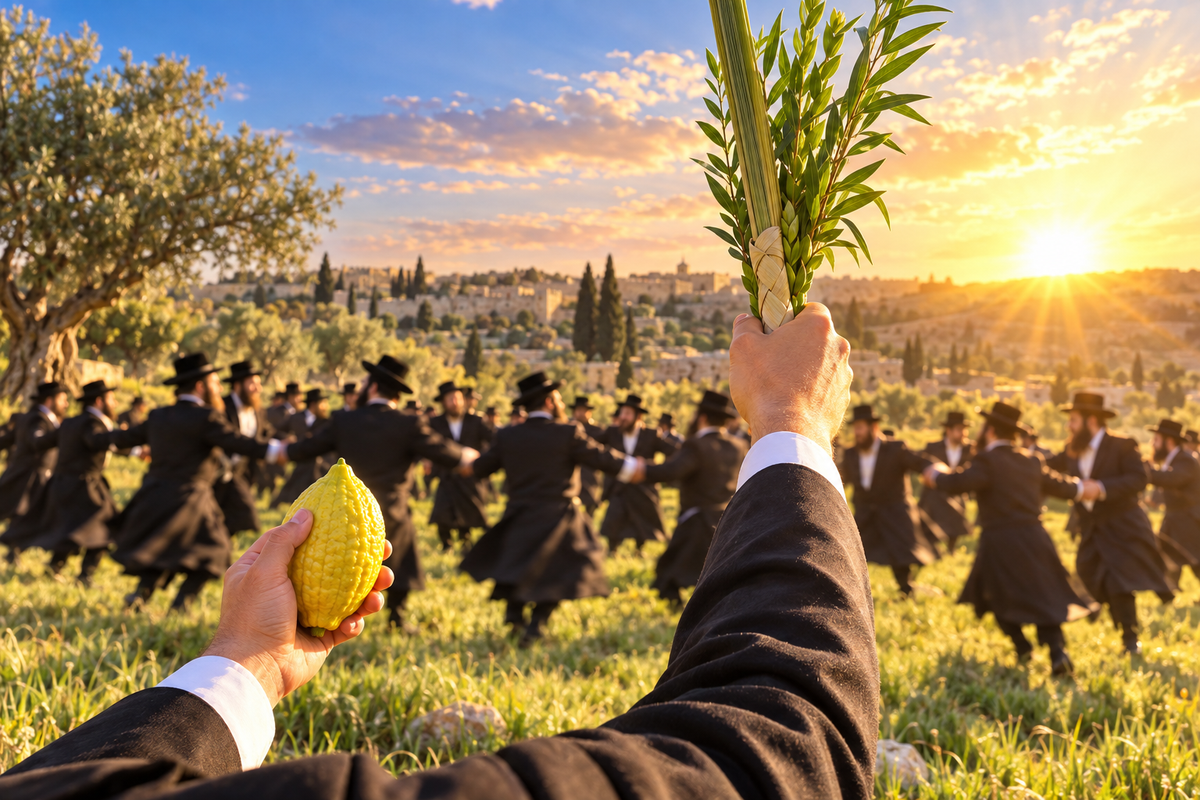
According to the holy Zohar (24b) and Likutey Halachos (Orach Chaim Part 3, Laws of Shabbos), the aravos (willows) are called 'Netzach' (Eternity/Victory) and 'Hod' (Splendor/Submission), and they are the ones that channel abundance to the Sefirah of 'Yesod' (Foundation). The question arises: How is it possible that the esrog (citron), which is so beautiful and majestic, is located specifically in the lowest Sefirah of all—the Sefirah of Malchus (Kingship)? The holy Arizal explains that according to the order of the letters of Hashem's ineffable Name, the aravos correspond to the first letter 'Hei', while the esrog is the final letter 'Hei'. That perfect esrog, which has absolutely no blemish even on its tip, is found specifically in the lowest place of all.
Reb Noson brings down in the Laws of the Synagogue that the lulav symbolizes the true tzaddik. The lulav has no fragrance and not even any taste. Why don't we take the date fruit itself, but rather specifically the fronds of the date palm, the simple and closed branch? Reb Noson explains: "Regarding the true tzaddik, one must know that there is absolutely no grasping his fruits. What is a tzaddik? Who is a tzaddik? What are the actions of the tzaddik? There is no grasping this at all." A person could live a million years and still have no comprehension of the inner essence of the tzaddik. We are only given the simple branch to hold onto, and if a person merits, he has a grasp of the simple actions of the tzaddik—his eating, his sleeping, his mundane conversations. But as for his fruits, they are completely beyond our comprehension.
Consequently, the esrog, which is so beautiful and majestic, has no connection to this level of comprehension of the lulav. Therefore, at the time of the blessings, we turn it upside down. In contrast, the aravos of the brook symbolize the baalei teshuvah (returnees to the faith). The Kotzker Rebbe said that today, everyone is called a baal teshuvah (repentant). A person should not feel inferior; "The moment he has the title of a baal teshuvah, he can already—with lowliness, with humility, with dancing and singing—reach all the spiritual levels and bring the complete Geulah (Redemption), the building of the Holy Temple, and the resurrection of the dead in the blink of an eye."
Renewing the Mind: The Power of the Baalei Teshuvah
Mashiach can come today. We believe with complete faith that if we were to sing and dance correctly, Mashiach could come today. The problem begins when people calculate the end times and predict in which year he will arrive—this is exactly what pushes Mashiach away. This is what happened in the year 5570 (1810) with Rabbi Levi Yitzchok of Berditchev, and this is why Reb Noson declared in the year 5600 (1840) that Mashiach would not come, in order to prevent the kind of devastation that occurred during the time of Shabbetai Zvi and the Frankists, when many fell away and converted to Christianity or Islam.
Rebbe Nachman says: "I too have spiritual attainment and I could have brought Mashiach, but I set everything aside and devoted myself to you." To bring people back in teshuvah (repentance) is a greater thing than bringing Mashiach. When a person has blemished his mind a million times and caused destructive fires in the upper worlds, he must now renew his mind a million times. This is a new creation, an entirely new type of spiritual work in which he must discover hidden paths and concealed ways.
Melting the Heart of Stone Through Song and Dance
Dancing and singing are above everything. The Zohar (Vayikra 19b) says that Devorah and Chanah merited to sing a song that no tzaddik in the world ever merited to sing:
"Even Moshe and Aharon among His priests, and Shmuel among those who call His name, did not merit the song that Chanah merited, as she said: 'There is none holy as Hashem, for there is none beside You.' Because through song, one sees that there is nothing else; when a person sings and plays music, he wants to reach the song of Chanah."
The Zohar continues and explains the verse, "When a leader (nasi) sins"—why specifically a leader? The more a person receives a position of authority and elevated status, the more his heart is liable to turn into a heart of stone. A person who has a yeshiva and students can develop a coarse heart. The leaders of the tribes had to bring the onyx stones to atone for their hearts of stone. The only way to melt this heart of stone is solely through singing and dancing.
Hammering a Nail in the Sukkah: Bringing the Light Down to the World of Action
The holy Arizal explains that there is no true concept of men and women, but rather Chasadim (loving-kindness) and Gevuros (severity/discipline). The Vilna Gaon explains the verse, "Light is sown for the tzaddik, and joy for the upright of heart": The man needs to bring down the light, to bring the Shechinah (Divine Presence) home after learning for long hours. The melody and the song replace all of a person's blood, making him calm and illuminating him.
The woman, on the other hand, is "joy for the upright of heart." She is the uprightness, the Sefirah of Gevurah (Discipline), the measuring line that straightens the home and sets a person in his proper place. She tells him: "You fasted on Yom Kippur, very nice. You truly elevated yourself and entered between the Cherubim. But now you are in the world of action—now go hammer a nail in the Sukkah!"
"Now even the Kohen Gadol (High Priest) needs to take a nail, to hammer a nail in the Sukkah, and then it will be an everlasting edifice." When a person hammers a single nail into the Sukkah with awe and love, he is raising up the fallen Sukkah of David, and with this Sukkah, it is possible to bring the Geulah (Redemption) at any moment.
Accepting Humiliation with Love
The Midrash describes how, approaching the Giving of the Torah, all the mountains began to uproot themselves from their places and dance like rams. They all wanted the Torah to be given upon them. Hashem told them to return to their places, because He had chosen Mount Sinai—the lowliest, the shortest, and the most despised of them all.
However, two mountains, Tavor and Carmel, insisted. They crossed countries and airways, flying and continuing to advance toward Sinai. When they reached the Land of Israel, Hashem stopped them and told them to land. Even though they were not chosen for the Giving of the Torah, for their very desire and devotion, they received an immense reward. Mount Tavor waited and merited the Song of Devorah, and Mount Carmel merited Eliyahu the Prophet and the revelation of "Hashem, He is God."
From here we learn a tremendous foundational principle: "Any person, the moment he accepts humiliation with love, his entire true desire is only to reveal Godliness in the world." He does not care if someone else reveals more Godliness than he does. He is not broken by humiliations and does not say, "Leave me alone, I'm going to sleep." He fights until the very last second to reveal that Hashem is God.
Humility vs. Pride: Moshe and Aharon vs. King Shaul
We see this humility in Moshe Rabbeinu. When Hashem sent him to redeem Israel, Moshe refused. He said, "Please send by the hand of whomever You will send." The Midrash HaGadol explains that the word "na" (please) hints at Nadav and Avihu, whom Moshe considered greater than himself. Moshe was unwilling to redeem Israel if it would cause any sorrow to Aharon HaKohen, who was the prince and leader at that time. Only when Hashem promised him, "He will see you and rejoice in his heart" — that Aharon would rejoice wholeheartedly in Moshe's greatness — only then did Moshe agree to go.
In contrast, we see the test of King Shaul. Shmuel HaNavi (Samuel the Prophet) told him to wait, but when the final hour arrived and the people began to scatter, Shaul failed the test. He became pressured, lost his patience, and offered the burnt offering himself. Immediately afterward, Shmuel appeared. The inability to wait, and the pride that causes a person to think he must act immediately out of pressure, later led to the grave mistake in the war against Amalek, where Shaul had mercy on the cruel out of a distorted human logic.
The true Geulah (Redemption) depends on the nullification of the ego, on the lowliness of Mount Sinai, on the humility of Moshe and Aharon, and on the simple joy of building the sukkah out of love for Hashem.
Part 3 of 3 — Lesson #2096
Subscribe to Our Newsletter
Receive Torah articles and inspiration directly in your inbox