Sukkot: From the Dveikut of Yom Kippur to the Hammer and Nail
Lesson No. 2096 | * Friday, 3rd of Chol HaMoed Pesach 5753 - At the Yeshiva
After the tremendous spiritual elevation of Yom Kippur, the Torah commands us to descend into physical action and build a Sukkah. The secret of the spiritual work of the festival of Sukkot is the ability to cast aside the intellect, to perform simple actions in holiness, and through this to attain true humility and lowliness.
A person must appreciate what they have. Baruch Hashem, we have running water in our taps and bread to eat. In the past, to get water, people had to walk to wells and streams. If the water bucket spilled in the middle of the night, there would be no water until morning. People were afraid to go to the well at night, as they lived among non-Jews and there was a real danger that someone would harm them. Today, what are we lacking? What pains us? We have everything in abundance; these are entirely new things in history.
The problem begins when a person wants to understand everything with their intellect. The sin of the Tree of Knowledge stemmed from the desire to understand, but the tikkun (rectification) for this is the concept of a "Chok" (statute) – like the statute of the Red Heifer – action without intellectual understanding. The Chiddushei HaRim explains that a "Chok" is the exact opposite of the sin of the Tree of Knowledge.
"The sin of the Tree of Knowledge is to understand, and a Chok is not to understand. Consequently, this rectifies the sin of the Tree of Knowledge, because all the melodies and songs are above the intellect."
The human intellect wants to create and understand, but often this creation only destroys the world. As the author of 'Chovot HaLevavot' (Duties of the Heart) brings down, the more the world develops intellectually and technologically, the more it marches toward self-destruction. The intellect alone brings a person to downfall. To merit the true intellect, the intellect of the Holy Temple, a person must step out of their limited intellect through song, melodies, and the joy of holiness.
From the Dveikut of Yom Kippur to Building the Sukkah
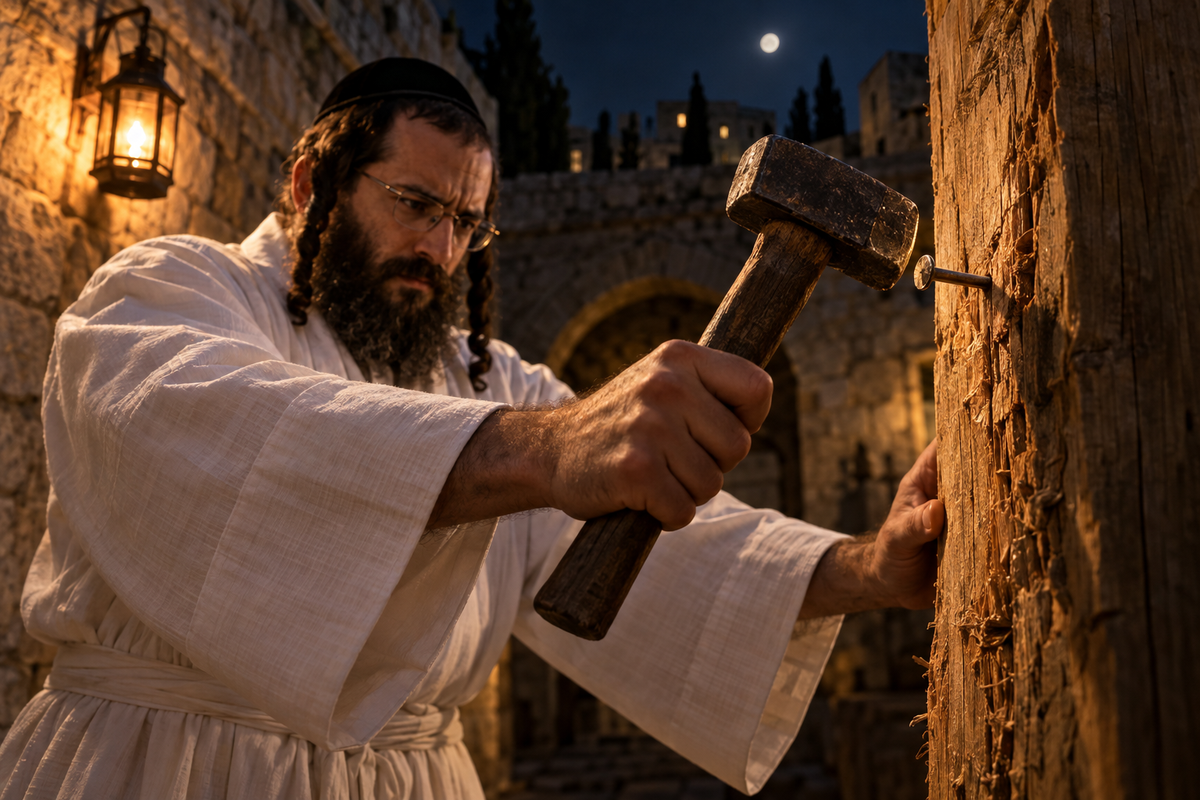
The transition between Yom Kippur and the festival of Sukkot illustrates this principle wonderfully. On Yom Kippur, a person is at the peak of dveikut. They divest themselves of physicality, entering, as it were, into the Holy of Holies, and merit to hear the song of the Cherubim. But immediately after Yom Kippur, following the meal that breaks the fast, they are told: "Now go out to the balcony or down to the courtyard, take a hammer, bang in a nail, and place a board."
After this wondrous dveikut, the first mitzvah is to do something physical in the Sukkah. There were tzaddikim who, every day of the festival, would do a small action in the Sukkah – hanging a decoration or adding a picture. Hashem commands us: Were you at the peak of dveikut? Now throw away your intellect and go do something simple in the Sukkah.
"You are within a body, and you must sanctify the body. To sanctify the nails, to sanctify the beams, to hammer a nail in holiness and purity and say, 'For the sake of the unification of the Holy One, Blessed be He, and His Shechinah (Divine Presence).'"
Finding One's True Place
The spiritual work is to perform the simplest actions with holiness and purity. Sometimes a person only wants to be "in the clouds" and in dveikut, but in reality, they have obligations, they have a family to care for, and sometimes they discover bad character traits and anger within themselves. The moment a person knows their true place, they throw away their illusory intellect and understand what they truly must do.
When a person truly plays music and sings, it should not bring them to pride or anger. The dancing and singing must bring a person to lowliness and a humble spirit. They must see that everyone is greater than them, know that they are the lowest of the low, and not utter a bad word about any Jew. If, after an hour of singing melodies, a person comes out irritable and yells at their surroundings, it shows that their dancing was not genuine.
The goal of all spiritual work is to reach the level of King David, who was leaping and dancing with all his might before Hashem, and through this reached absolute humility, saying: "And I will be even more lightly esteemed than this, and I will be lowly in my own eyes." This is the true lowliness that can bring the Geulah (Redemption).
Part 2 of 3 — Lesson No. 2096
Subscribe to Our Newsletter
Receive Torah articles and inspiration directly in your inbox