The Gathering of Rabbi Yaakov Salama shlit"a
Every Thursday, a gathering of married students and young men from the holy Shuvu Banim community is organized under the leadership of Rabbi Yaakov Salama shlit"a, to hear stories of supreme wonder and miracles about the tzaddik, Rabbi Eliezer Berland shlit"a. The gathering takes place at the Nachalei Netzach yeshiva of the great and righteous Rabbi Shmuel Stern shlit"a, one of the leading students of the Rav shlit"a. In this gathering, as mentioned, many Breslov Chassidim from the holy community assemble to strengthen themselves together in Emunas Chachamim (faith in the Sages) and in the power of tzaddikim, by hearing stories of the tzaddik's wonders.
Among the rabbis who spoke at the gathering and shared their personal stories and other stories about the tzaddik, one can count Rabbi Yehoshua Dov Rubinstein shlit"a, Rabbi Eliyahu Merav shlit"a, the gabbai (attendant) of the Rav, Rabbi Barak Natan Barber shlit"a, and others. In this story, we will recount what was shared with the members of the gathering by Rabbi Yehoshua Dov Rubinstein shlit"a, one of the sons-in-law of the Rav.
"It was during a unique period, when we would travel every Motzaei Shabbos (Saturday night) to the Cave of the Patriarchs in Hebron," Rabbi Rubinstein begins his story. "It was at the beginning of the Intifada, when the general situation between Jews and Arabs was extremely tense. One night, the Rav asked that we enter Halhul.
Halhul is a particularly hostile Arab village located in the vicinity of Mount Hebron, and it is known as a dangerous village where only elite army units enter, and only after an extensive intelligence operation. But nothing, of course, deterred the tzaddik and his followers, and they entered—the entire holy group heading toward the mosque, where according to tradition, the tombs of Natan the Prophet and Gad the Seer are located.
In that early period, there were no clear orders regarding the entry of Israelis into enemy territory, partly because the Intifada had just begun, and mainly because the security echelon did not think anyone would dare enter enemy territory without an armored military escort. But there were those who dared, and not just once. For a long period, the students of Shuvu Banim entered Halhul together with the Rav, while the soldiers at the entrance, who were supposed to guard against Arabs coming out, did not know what to do with the group of Chassidim entering without helmets or bulletproof vests and emerging safely, week after week. They, of course, warned us that they would not risk themselves to extract us and that the entry was at our own responsibility, but we knew that if anyone here could help anyone, it was the tzaddik who could help them, and not the other way around.
We felt so secure in the presence of the Rav that it did not even concern us whether they would rescue us or not; the main thing was that we were attached to the tzaddik, and we were assured that we would enter and exit for a good life and for peace.
The Rav somehow secluded himself with the sheikh of the mosque, and every time, he would come down a few minutes after our arrival and open the doors for us. When students from the yeshiva would arrive without the Rav, he would not agree to open the doors and would not speak a word to them; he only respected and esteemed the Rav. Many fascinating stories are intertwined around this wondrous friendship between the sheikh of Halhul and the Rav, but that is for another time...
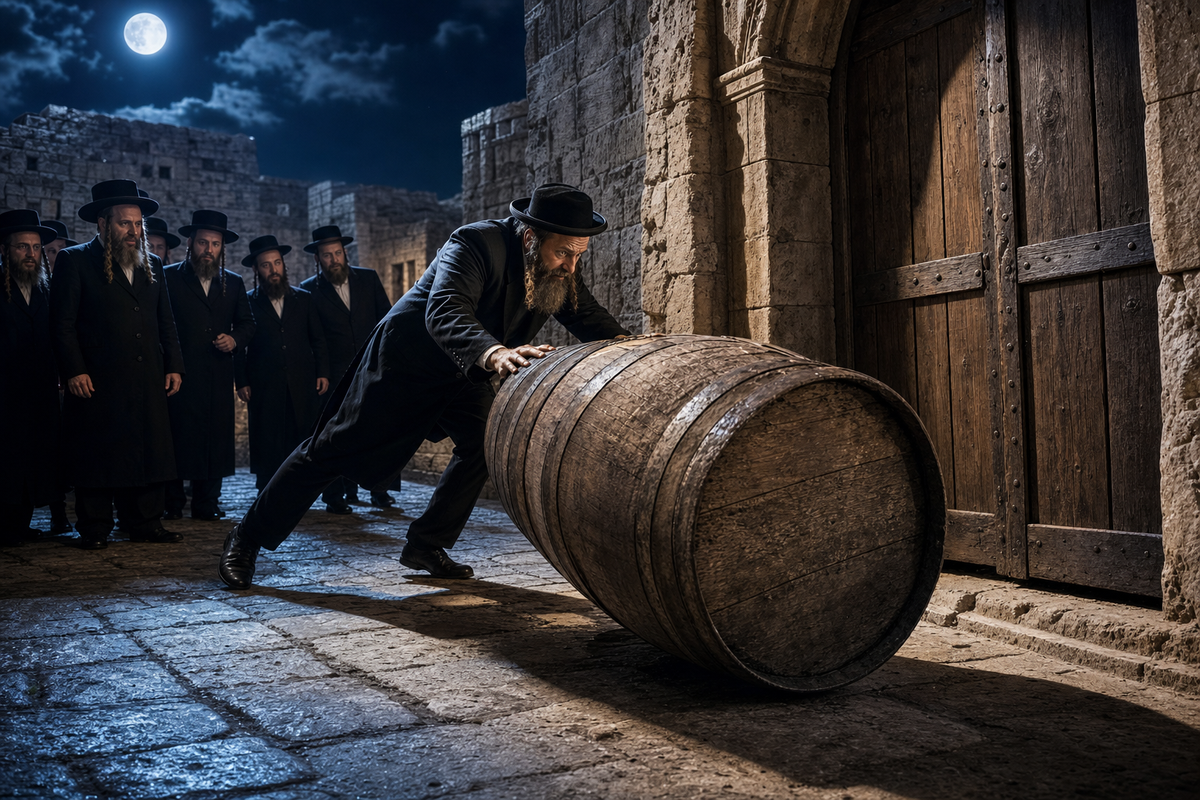
One night, the sheikh did not arrive to open the doors even after fifteen minutes. The Rav was with us, and there were also a few Gerer Chassidim who had drawn close to the Rav at that time. Suddenly, we noticed that the Rav was walking in a certain direction, taking an empty barrel that stood in some corner, and beginning to roll it quickly toward the mosque.
Before we could understand what was happening, the Rav had already placed the barrel under a small window facing the interior of the mosque and began to climb inside. After him, our entire group entered through the small window, and we realized that we were inside the mosque, except that it was dark and gloomy without a single point of light. After a few moments, the Rav flipped some switch on the wall, and a small light turned on, illuminating the dark mosque.
Our astonishment knew no bounds. Hundreds of Arabs were lying there, fast asleep. We later understood that it was a holiday for them, during which many of the villagers sleep in the mosque, apparently to keep up with the quota of lengthy prayers.
[...] the Rav [...] we [...] and everyone is sleep[...] waking up. We went back out through the w[...] the tzaddik, and believing in [...] an additional deep [...] in general and in the princi[...] from Breslov "And the main thing is not to f[...]"
From the book "Peleh Elyon Part 3"
Read more
Subscribe to Our Newsletter
Receive Torah articles and inspiration directly in your inbox