
The Secret of Avraham Avinu's Mesirus Nefesh (Self-Sacrifice): Beyond the Bounds of Nature
Lesson No. 160 | Tuesday, Parashas Vayeira, Eve of 15 Cheshvan 5759 - Lesson for the Breslov Kollel for Young Men
Why was the hospitality of Avraham Avinu engraved for all generations, considering that the nations of the world also welcome guests? Through the inspiring story of the author of the book "Beis Avraham" in the steppes of Siberia, the depth of a Jew's humility and mesirus nefesh (self-sacrifice) is revealed.
Rebbe Nachman elaborates at length, explaining that if a person does not have the intention during his Torah study that right now, through his learning, the entire Jewish people will return in teshuvah (repentance) — he will not merit to illuminate his soul. A person must feel that he is responsible for the entire world. A person who sins tilts the entire world to the scale of guilt, and a person who merits tilts the entire world to the scale of merit. If you do not take responsibility for the world, then Hashem, may He be blessed, will not take responsibility for your children either.
Rebbe Nachman brings down that if a person displays a lack of caring, he is punished with unworthy children, as it is stated:
"Because you have rejected knowledge, I will also reject you from being a kohen to Me; and because you have forgotten the Torah of your God, I will also forget your children" (Hosea 4:6).
The punishment for someone who learns without knowledge, without desire and spiritual awakening, and who does not show a love for the Torah, is that his children will also not love the Torah. "If you do not love the Torah, your children will not love the Torah either." Everything begins with caring — caring about the Jewish people and caring about yourself. After all, Hashem created you and gave you life; you need to care about Hashem, may He be blessed.
Between Lot's Feast and Avraham's Morsel of Bread
In order to truly merit the Torah, one needs humility. Avraham Avinu said:
"And I am but dust and ashes" (Genesis 18:27).
All of Avraham's merit in Parashas Vayeira stems from this humility.
A beautiful question is asked about the weekly Torah portion: Why is it that regarding Lot, when the angels came to him, it is immediately written:
"And he made them a feast, and baked matzos, and they ate" (Genesis 19:3)?
Why does Lot make an entire feast, while Avraham Avinu, the pillar of loving-kindness, offers only a "morsel of bread," a little fine flour, and a calf?
The answer lies in the very essence of hospitality. There is a person who welcomes guests in order to give them what they need — food, drink, and rest, so that they will be satisfied. But with Lot, the motive was different. In Sodom, it was forbidden to host guests, and no one could sit with his friend. Lot was lonely. Suddenly, guests arrive, and for him, this is an opportunity to throw a feast!
The guest thinks that Lot is rejoicing in him, but in truth, Lot is rejoicing in himself, in the fact that he finally has a reason to celebrate and say "L'chaim." With Lot, everything revolved around himself. But Avraham Avinu lived with the feeling of "I am but dust and ashes" — complete self-nullification for the sake of the other.
The Light That Shone in the Frost of Siberia
In the book "Beis Avraham," authored by Rabbi Avraham Eliyahu Maisels, a tremendous question is brought down regarding Avraham's hospitality. Rabbi Maisels was an important Rav and a prominent lawyer in the city of Minsk. When the Communists began closing yeshivas and synagogues, he fought them legally and did not allow them to shut down the religious institutions. Out of sheer terror, people were afraid to enter the synagogues, but he stood in the breach and refused to give up under any circumstances.
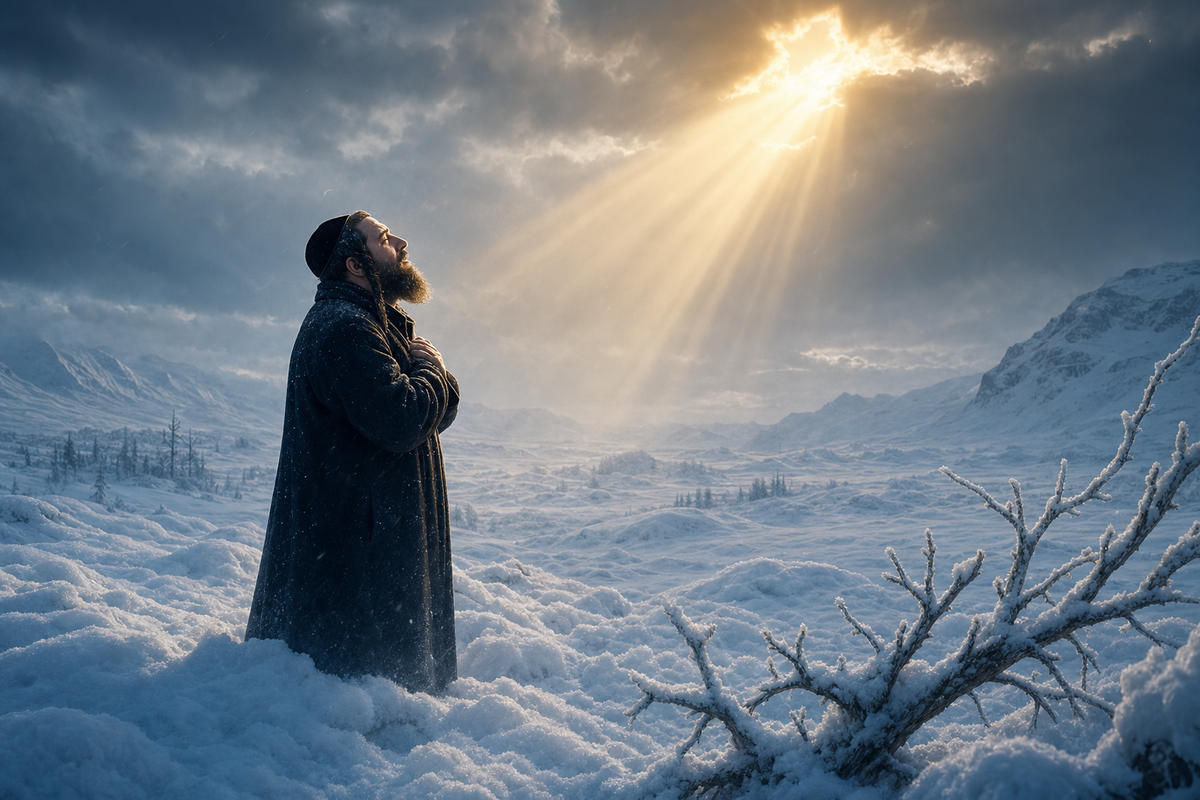
When the authorities saw that they could not get rid of him, they fabricated a plot and exiled him to the city of Kremenchug, and later to Siberia. In Kremenchug, he met Breslov Chassidim who had also been exiled. One day, in the terrible frost of Russia, he went out with them to the field and saw a sight that changed his life: A Jew standing in the snow, speaking with Hashem, may He be blessed, with such longing and supplication, as a man speaks to his friend. He had never seen such an open outpouring of the heart before the Creator of the world. At that moment, he said to himself: "Here is the truth; I am staying here."
Out of a group of ten thousand exiles who walked five thousand kilometers on foot to the heart of Siberia, only about five hundred survived. What kept them going was the power of Breslov Chassidus — that there is no despair in the world at all and one must never lose hope. After the war, Rabbi Maisels merited to make aliyah to the Land of Israel and authored his book.
The Sorrow That is Greater Than the Fire of Gehenna
In his book, Rabbi Meisels asks: What was the immense greatness of Avraham Avinu's hospitality, to the point that it was recorded in the Torah for all generations? After all, even today, if you walk in the Sinai Desert, the Bedouins will run toward you and host you like a king. What is so special here?
The answer is astounding. We are talking about an elderly man of 99, on the third day after his circumcision. This is a day of terrible pain and immense weakness—after all, on the third day after the circumcision of the men of Shechem, Shimon and Levi, two 13-year-old boys, managed to slaughter an entire city because no one could resist them due to the intense pain.
And not only that, but Hashem took the sun out of its sheath. The Midrash says that Hashem brought forth the fire of Gehenna so that Avraham would not be burdened with guests. No person in the world could go outside in such heat. Even Eliezer, the servant of Avraham, went out, felt the burning heat, and fled back inside, telling Avraham: "There is no one outside; it is impossible to go out."
But Avraham Avinu saw that there were no guests, and his sorrow over this was greater than any other pain. Avraham's sorrow over having no guests was harder for him than the pain of the third day of circumcision, and more than the fire of Gehenna bubbling outside. When Hashem saw that Avraham was in such terrible sorrow, He was compelled to send down angels from Heaven for him.
This is the reason Avraham's hospitality was engraved for eternity. It was above the realm of nature and beyond human strength. This is the power of the Jewish people—to act with mesiras nefesh (self-sacrifice) and true lowliness of "I am but dust and ashes," and to do things that are above nature.
Part 1 of 2 — Lesson No. 160
All parts: Part 1 (Current) | Part 2
Subscribe to Our Newsletter
Receive Torah articles and inspiration directly in your inbox