
The Secret of Eliezer's Test: The Depth of Rivkah's Wisdom and the Role of the Mother in Israel
Lesson No. 175 | Thursday, Parashas Vayeshev, the eve of 22 Kislev 5759 - Lesson for Yeshiva students in Bnei Brak
An in-depth discourse on the secret of the hidden light of our mother Rivkah, which is hinted at in the kadkod stones. Through Eliezer's three tests, the central role of the Jewish mother in educating her children emerges, as expressed in the subtle distinction between the words "I will give drink" (ashkeh) and "I will draw water" (ashav).
The Talmud relates regarding the skin of the Leviathan, that Hashem will in the future spread it over the walls of Jerusalem, and its radiance will shine from one end of the world to the other, as it is stated: "And nations shall walk at your light, and kings at the brightness of your shining."
In Tractate Sofrim, an additional secret is brought regarding this matter. It is told there concerning the children of Keturah, whom our forefather Avraham sent away "eastward to the land of the East." Avraham settled them within hidden mountains—perhaps these are the mountains of Tibet or the Himalayas—and built them entire cities covered in earth and rocks, so that no one could discover them. He built iron roofs for them, so that the rays of the sun never entered there.
In order for them to have light, Avraham gave them a tray of precious stones and pearls that shine brighter than the sun. These are stones destined for the World to Come, for the time about which it is stated: "Then the moon shall be confounded, and the sun ashamed." These are the kadkod stones about which it is stated: "And I will make your windows of rubies (kadkod), and your gates of carbuncles," for in the future, Jerusalem will be inlaid with them and will shine with a precious light.
The Secret of the Light of Sarah and Rivkah
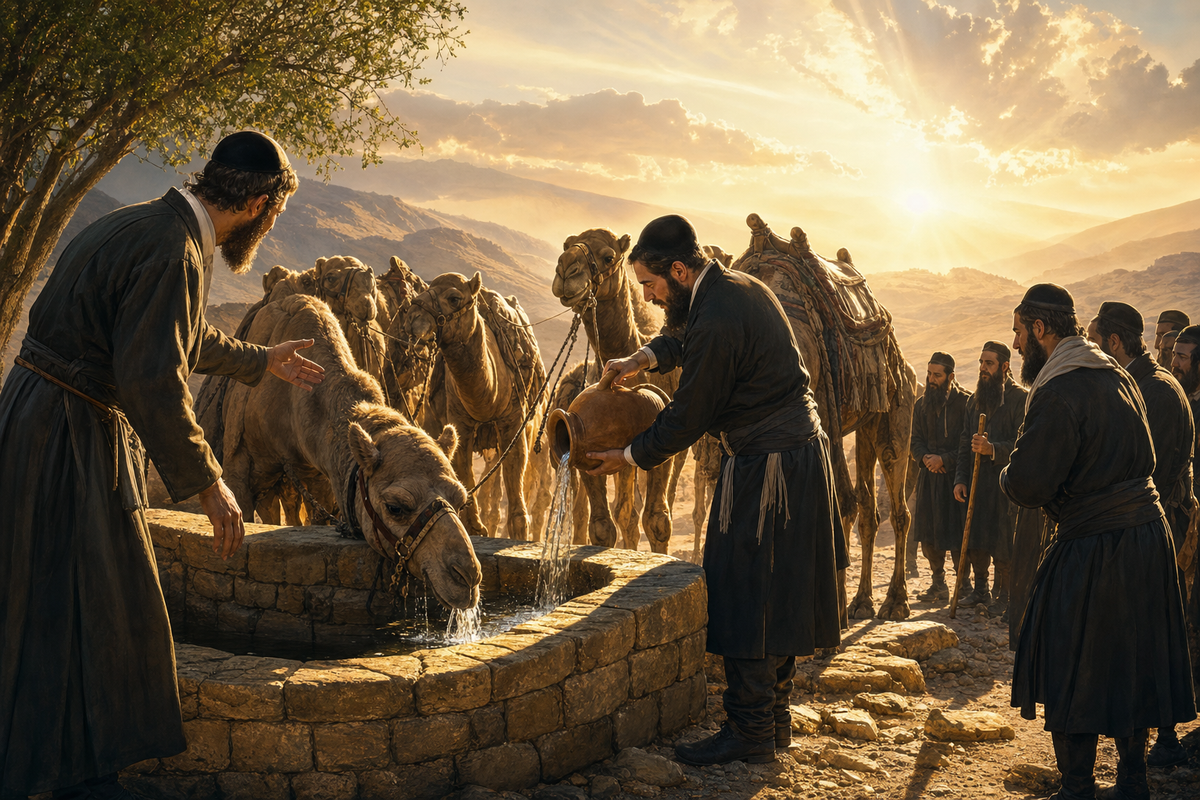
When Eliezer meets Rivkah, the verse repeats the word "her pitcher" (kadah) again and again: "And she let down her pitcher," "And she emptied her pitcher." Why does the Torah emphasize this so much? It is because the word "her pitcher" (*kadah*) hints at the *kadkod* stones. At that very moment, Rivkah was filled with a tremendous light and began to shine with a precious radiance, to the point that the holy Name of Hashem was seen hovering above her.
This light is reminiscent of the light of our mother Sarah. The Midrash relates that when Avraham went down to Egypt and the Egyptians opened the chest in which he had hidden Sarah, the entire land of Egypt shone from her radiance. Sarah literally shone like the sun, and therefore the Baal HaTurim explains that the words "one hundred years" (me'ah shanah, referring to the life of Sarah) correspond to the letters of "sun" (shemesh). This is the exact same wondrous light that Eliezer now saw in Rivkah.
Eliezer's Three Tests
Rebbe Nachman of Breslov explains in Likutey Moharan (Torah 2) that when a person is looking for a wife, he must test her in three things, and primarily to see if she is an "intelligent woman" (ishah maskeles). Eliezer stood by the spring of water and conducted a meticulous test on Rivkah to clarify if she was indeed worthy of Yitzchak.
The first test was the test of modesty. Eliezer said: "Please tip your pitcher so that I may drink." A modest woman who serves water to a strange man does not serve him directly to his face; rather, she tips the pitcher from the side and immediately steps back. The Midrash 'Meor HaAfeilah' brings that just as a man is forbidden to gaze at a woman, so too a woman is forbidden to gaze at a man, as we learn from the daughter of Yiftach, about whom it is stated, "And she knew no man"—meaning she never even looked at the form of a man. Rivkah passed this test perfectly.
The second test was the test of loving-kindness (*chesed*). Eliezer wanted to see if she would say, "And I will also give drink to your camels." Watering ten camels that have returned from a long journey in the desert is a task that requires tremendous loving-kindness and immense effort, since a camel is capable of drinking a quantity of water sufficient for three whole days.
The Teaching of Your Mother: The Role of the Intelligent Woman
The third and deepest test of all was the test of wisdom. Why is it so important that the wife be an "intelligent woman"? Because the primary education of the children rests upon the mother.
The author of the Toldos Yaakov Yosef explains in his book Ben Poras Yosef the verse: "Hear, my son, the discipline of your father, and do not forsake the teaching of your mother."
He explains that the Torah is received from the mother. All the 613 mitzvot, the Grace After Meals, washing hands—everything comes from the mother. The father is away most of the day engaged in Torah study or work, and his role is only "the discipline of your father"—to back up the mother, to ask the children if they listened to her, and to instill discipline when necessary. But the mother is the one who educates, tells stories of tzaddikim (righteous ones), and endears the mitzvot to the children. For this, a woman with intellect and profound understanding is required.
The Secret of the Distinction Between "I Will Give Drink" and "I Will Draw Water"
How did Eliezer test Rivkah's wisdom? He planned to say to her, "Please give me a drink," and expected her to answer: "Drink, and I will draw water for your camels as well."
There is a great difference between "giving drink" (lehashkot) and "drawing water" (lishov). To give drink means to let the camel drink until it is full for three days. But Rivkah, in her wisdom, saw that these camels had set out on their journey only a short time ago (through a miraculous shortening of the way, kefitzas haderech), and therefore they were not so thirsty. A wise woman needs to know how to discern when a child is truly thirsty and when they are not, and this is the role of the mother.
Therefore, when Rivkah answered wisely and said, "I will draw water for your camels as well"—meaning, I will draw only a little water for them to taste, according to their true need—Eliezer knew with absolute certainty that this was the intelligent woman, the one worthy of building the home of our forefather Yitzchak and raising the future generations of the Jewish people.
Part 1 of 2 — Lesson No. 175
All parts: Part 1 (current) | Part 2
Subscribe to Our Newsletter
Receive Torah articles and inspiration directly in your inbox