
The Secret of Humility, the Birth of Souls, and the Power of Renewal
Lesson No. 96 | Monday Morning, Parashat Matot-Masei, 23 Tammuz 5757 - At the Yeshiva in the Old City
An in-depth article explaining how the trait of humility and self-nullification enables a person to attain the level of the Yechidah of Atzilut, and to become a complete "Ayin" (nothingness). The article explains how attachment to the Tzaddik draws down to the world new souls and intellects that never existed before. Additionally, it emphasizes the need to guard the body like a box for a diamond, and to always remain young and renewed in the service of Hashem, as taught by Rabbi Nachman of Breslov.
A person must have in mind during his prayer: "God of Abraham, God of Isaac, and God of Jacob." To remember the God of Abraham – that he should be in the aspect of dust and ashes. The God of Isaac – whose ashes are piled upon the altar. And the God of Jacob – about whom the wicked Balaam said: > "Who has counted the dust of Jacob."
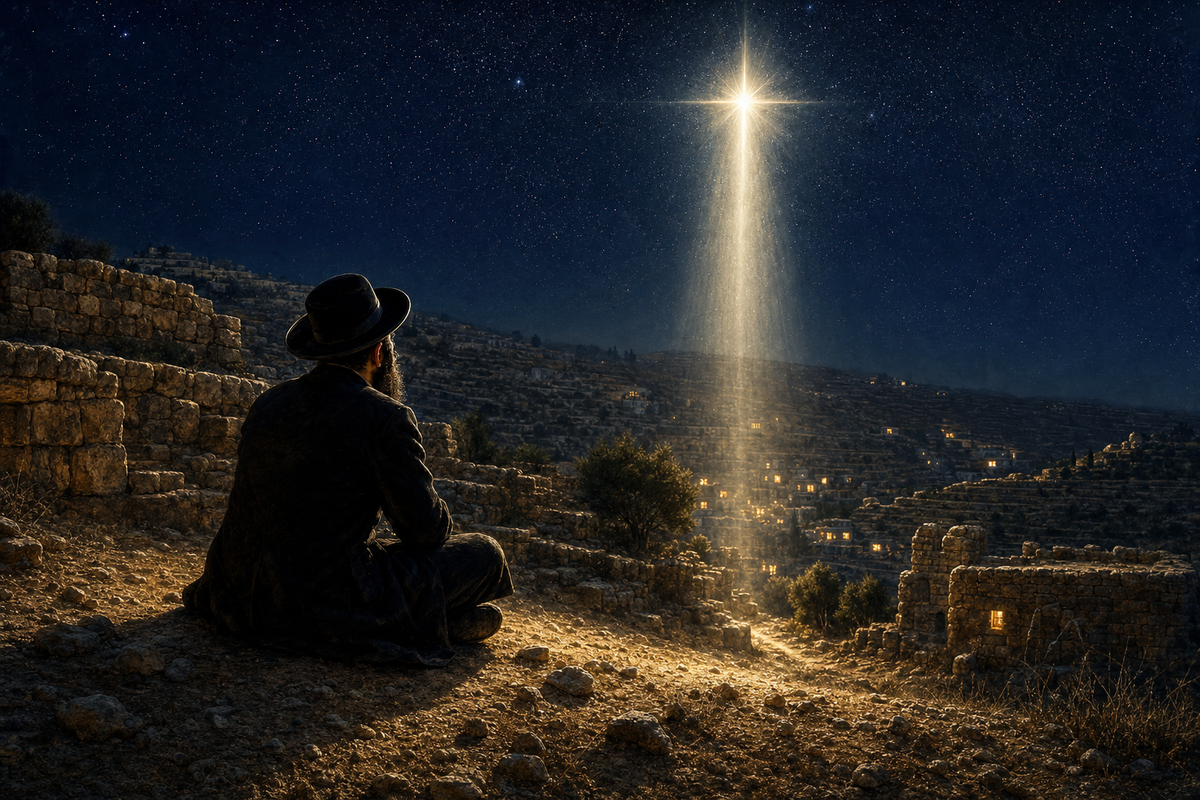
Balaam attained the level of "Yechidah of Atzilut," and he merited to ascend there through the secret of > "A star has stepped forth from Jacob." The truth is that every single Jew has this point of "Yechidah of Atzilut," the aspect of the star that shines within him. But how does one merit to illuminate that star? The path to this passes through "Who has counted the dust of Jacob." Only when a person makes himself like dust and ashes does the path of "a star from Jacob" become revealed within him, and the point of Yechidah of Atzilut within him begins to shine.
Reaching Complete "Ayin" (Nothingness)
Reaching the level of Yechidah depends entirely on humility and lowliness. Rebbe Nachman of Breslov said about himself that he attained the ultimate purpose and the highest level above which there is nothing higher – "Yechidah of Yechidah." When a person merits to reach the level of Yechidah of Yechidah, he remembers the "Ayin" (nothingness); he becomes complete "Ayin."
The Rebbe said that he attained the level of Yechidah at the ultimate highest level (beyond Nefesh, Ruach, Neshamah, and Chayah), and despite all this, his conclusion was: "And it turns out that I know little." Even when one reaches the highest place, one understands that it is still little, and the desire is to attain more and more, for who knows what else lies beyond that. For this purpose man was created – to attain such immense comprehensions out of absolute humility and lowliness.
The tzaddik is entirely humility and lowliness. This is the essence of the tzaddik – of those who are insulted but do not insult, hear their reproach and do not reply, act out of love and rejoice in suffering. Because of this, he is called "the tzaddik, foundation of the world." Just as dust is the foundation and the primary material of which the earth is composed, so too the tzaddik is the foundation upon which the entire world stands. Everything stands upon the tzaddik, everything comes to the tzaddik, and all souls are born from the tzaddik.
The Birth of a New Intellect in the World
The tzaddik is the intellect that gives birth to all intellects. What does it mean that a person gives birth to a child? He is essentially giving birth to a new intellect in the world, an intellect the likes of which has never existed. All forms of life – inanimate, vegetative, animal, and human (speaking) – are all drawn and born from the tzaddik. The soul of the tzaddik includes all souls until the end of all generations, and everything that happens in the world is drawn from the mind and intellect of the tzaddik, in the aspect of the green line that encompasses the entire world (just as Queen Esther, who was "greenish," her soul encompassed the entire world and she found favor in the eyes of all who saw her).
In every moment and every day, the tzaddik continues to give birth to new intellects. Every birth is a completely new intellect that has never yet existed. From this we learn that every Jewish soul that descends into the world is a completely new revelation. Every soul comes to reveal something new in the world, something that has never been revealed since the six days of creation. Through this soul, they will recognize Hashem, may He be blessed, with a new recognition that has never existed before.
The rule is that Hashem does not make two things exactly the same. A soul never descends twice in the exact same manner. Even when we speak of the secret of reincarnations (gilgulim), it refers to the composition of a completely new soul, the handiwork of Hashem, to which a soul from a previous reincarnation is attached so that it may rectify it. A reincarnation is not the exact same soul, nor the same composition of Nefesh, Ruach, and Neshamah. These are always completely new combinations that have never existed.
And all these things, the entire drawing down of souls and new intellects, are done according to the measure of one's connection to the tzaddik. According to how a person connects to the tzaddik, so he merits to draw down a completely new soul, because the tzaddik is the one who draws down all intellects from the Supernal Intellect to the lower intellect.
The Body as a Box for a Diamond
Every person who is born is an aspect of a new intellect, and the body is merely the box. Inside this box is a precious diamond, and we must protect the box so that it does not break and so that there is no hole in it.
The Gemara in Tractate Chullin (24b) asks: Until when is a person called a "child"? And it answers: "As long as he can stand on one foot and take off his shoe and put on his shoe." It is told there about Rabbi Chanina, who was eighty years old, and he would stand on one foot, take off his shoe, and put on his shoe. Rabbi Chanina said: > "The warm water and oil with which my mother anointed me in my youth have stood by me in my old age."
If a person at the age of eighty can still stand on one foot when he comes out of the mikvah and tie his shoe, he is still called a "child"; he has not grown old. Rebbe Nachman of Breslov says in Sichot HaRan that it is forbidden to be old. It is forbidden to be old! One must serve Hashem at all ages, every moment and always, with intention directed toward Him, may He be blessed. The main thing is the desire and the yearnings – to always yearn for Him, may He be blessed, and to know that everything a person knows is still nothing.
The Secret of Renewal and Strength
The service must be with earnestness and simplicity. Not to be a "foolish simpleton," but a wise simpleton. Neither too clever nor a fool. In these places, a Jew must always sit and learn, not moving from the walls of the yeshiva. Even when a person feels that he is already going crazy and has nowhere to go, he must be an earnest Jew, sitting and learning, reciting Tehillim, Likutey Tefilot, and Gemara according to his ability.
It is not good to be old. Neither an old chassid nor an old tzaddik. Rabbeinu forbids us from being old, but rather demands that we always be young, renewing ourselves every day and at every moment anew. On the contrary, a person must improve as he matures, adding strength as he ages. As the Gemara says in Tractate Shabbat: > "The Sages taught: Three things, as long as they age, they add strength – a fish, a snake, and a pig ('another thing')."
The fish alludes to the tzaddik, who adds strength as time passes, in the aspect of: > "They shall still bring forth fruit in old age; they shall be full of sap and green." A person must add strength and add power, because every birth and every passing day brings with it a completely new intellect.
As stated, the body is merely a box for this new intellect. The moment a person does not protect the box, he is considered, God forbid, a shedder of blood, in the aspect of > "Whoever sheds the blood of man, by man shall his blood be shed." If a person can live to the age of one hundred and twenty and he only lives to one hundred, he has shortened his life by twenty years.
Therefore, a person must maneuver for the long term, doing everything with calmness and pleasantness, so that there is no trace of old age, exhaustion, or weakness upon him. Why? Because he came into the world to reveal His Godliness, may He be blessed, and this revelation takes many years. A person cannot reveal His Godliness, may He be blessed, in one day or in one moment. Everyone comes to reveal something completely new that has never existed, and he must pray that he merits to live and lengthen his days in order to complete the unique path he was destined to reveal.
Part 1 of 2 — Lesson No. 96
All Parts: Part 1 (Current) | Part 2
Subscribe to Our Newsletter
Receive Torah articles and inspiration directly in your inbox