The Secret of Joy and Song: Transforming Despair into a Light Above Nature

Lesson No. 2070 | No. 104 - Motzaei Shabbos Kodesh, the eve of 21 Tishrei 5752, Shabbos Chol HaMoed, and the eve of 21 Cheshvan 5752
The historical struggle against the guardian angel of Esav revolves around plunging the Jewish people into sadness and despair, especially in the final generations. Through accepting humiliation with love, dancing, and singing even from within the darkness, we merit to transcend nature and transform every trouble into a blessing, until all of creation joins in our song.
The historical war between Yaakov and Esav, and particularly the struggle against the guardian angel of Esav ("And a man wrestled with him"), revolves entirely around the exile. The guardian angel of Esav attempts to overpower us and prolong the exiles, and his primary weapon is dragging a person into sadness. He plunges a person into terrible sadness, especially when we see that the end of the Geulah (Redemption) is blocked and hidden. Specifically because the Geulah is so very close, the forces of impurity intensify in order to bring a person to a complete loss of hope.
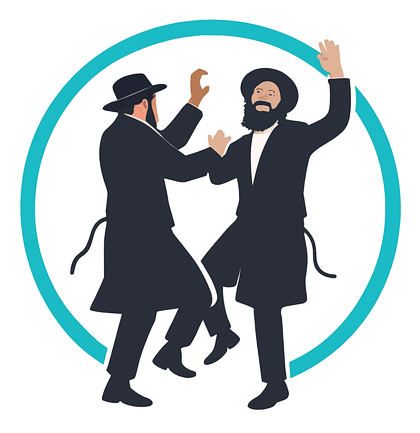
The primary prolongation of the exile stems from this very sadness, because the moment a person falls into sadness, all worldly desires overpower him. The more desires there are, the more sadness there is, and it becomes impossible to ascend and engage in prayer, because "prayer requires an immense amount of joy." Since the guardian angel of Esav is stronger than us, Hashem sends us true tzaddikim in every single generation. As brought down in the laws of honoring one's father and mother, even in the generation of the Flood, when the most severe desires prevailed, the tzaddikim of that generation—Mesushalach, Noach, Yered—were able to pull even the greatest sinners out of their desires. The primary advice of the tzaddikim to extract a person from worldly desires is through joy. The moment the days of joy arrive—Sukkos, Hoshana Rabbah, Simchas Torah, and Simchas Beis HaShoeivah—we must dance and rejoice without cessation.
The Secret of the Name Ekyeh and Accepting Humiliation
The author of the Sfas Emes explains the verse:
"And you shall be only joyous."
The Gemara states that this verse comes to include the night of the final Yom Tov of the festival. The Sfas Emes asks: Why specifically on the final Yom Tov of the festival must we rejoice the most, more than all the other days? The answer is that if a person was joyous throughout all seven days of the festival, then on Simchas Torah, the joy bursts forth on its own. "When a person is joyous, at that moment he is above nature. When a person dances and sings, he is above nature." The Sfas Emes explains that when a person begins to rejoice and dance, all the success in the world will come to him.
The word "Ach" (only) has the numerical value of 21, which is the same numerical value as the Divine Name Ekyeh. Hashem said to Moshe Rabbeinu:
"I will be what I will be."
In the book Arvei Nachal, it is explained that a person must always walk with the Name Ekyeh, which is the Name that hints at humiliation. A person must be prepared to see how to accept upon himself all the humiliation in the world. If a person walks with the Name Ekyeh, and they humiliate him yet he remains joyous—he can draw down upon himself all the joy in the world. Everyone wants joy for the sake of honor, but if one is willing to accept humiliation, his joy is no longer dependent on honor. On the contrary, the more they humiliate him, the happier he becomes, even handing out candies. Rabbi Avraham ben Rabbi Nachman said that if a person truly knew the immense spiritual level of humiliation, he would first go immerse in a mikvah to prepare the spiritual vessels to receive these lights.
Simchas Torah: A Joy That Cannot Be Confined to Mitzvos
The Sfas Emes continues and asks: On every festival, there is a special mitzvah. On Pesach, there is matzah, the four cups, and the Seder of the Haggadah. On Sukkos, there is the sukkah and the Four Species. But what is the mitzvah on Simchas Torah? The Torah did not command any specific mitzvah on Shemini Atzeres; rather, our Sages revealed to us that this is the time of Simchas Torah, where we simply dance and sing.
The answer is that there are spiritual illuminations so lofty that it is impossible to "print" and confine them within a physical mitzvah. Simchas Torah corresponds to the Oral Torah. It is a joy so immense throughout all the spiritual worlds, the singing and dancing of angels, that it cannot be contained within any physical object of a mitzvah. Therefore, the entire essence of Simchas Torah is solely the songs, the dances, and the melodies.
Transforming Despair into Gladness and Joy
The struggle with the guardian angel of Esav reaches its climax when the angel begs Yaakov:
"And he said, 'Let me go, for the dawn has broken.'"
Yaakov answers him: "I will not let you go unless you bless me." Rabbi Nosson explains that the angel touched the sciatic nerve (gid hanasheh), which hints at forgetfulness, sadness, and despair. The angel saw that he was succeeding in bringing despair to the final generations before the Geulah (Redemption), plunging them into disappointments. The angel wanted to go and sing a song of praise over having defeated the final generations, knowing they would face such trials and despair that would seem entirely unsolvable.
But Yaakov Avinu stopped him and said: "I will not let you go until you yourself bless me! Until you yourself transform the sorrow and sighing into joy!" Yaakov demanded that this very guardian angel of Esav, who plunges us into bitterness, must commit to transforming every trouble into a window of light, and every obstacle into pleasantness and songs. If a person stands firm against all the obstacles, they themselves are transformed into blessings, songs, and praises.
The Song of All Creation
The Sfas Emes explains in Parashas Beshalach that when Moshe and the Children of Israel sang the song at the sea, the entire universe sang along with them. The moment a person sings and rejoices, the song is revealed throughout the entire universe—inanimate objects, plants, animals, and humans. This is the secret of Perek Shirah (the Song of Creation). Even the mules sing. And what do they sing?
"All the kings of the earth shall thank You, Hashem, for they have heard the words of Your mouth."
The Chasam Sofer asks: Why specifically does the mule sing this song? The Gemara in Tractate Kiddushin states that this praise was uttered by the angels at the time of the Giving of the Torah. When the nations of the world heard the first Commandments, they thought that Hashem was, so to speak, "seeking honor." They wondered: A mortal king educates his subjects to rebel against their parents for the sake of the kingdom (as we saw in communist regimes where children handed their parents over to death for a sack of flour during years of famine), and here Hashem is demanding honor for Himself?
However, when they heard the Commandment, "Honor your father and your mother," the kings were shaken. They understood that Hashem is not demanding honor for Himself, but rather commanding the honoring of parents above all else. Immediately, all the kings descended from their chariots, bowed, and thanked Hashem. And since it was the custom of kings to ride on mules, the mules were witnesses to that moment when the kings dismounted them to bow to Hashem. Therefore, from then until today, the mules sing: "All the kings of the earth shall thank You, Hashem."
Singing Through the Test: The Song After the Slap
This power of song is passed down from generation to generation. Yehoshua bin Nun merited to stop the sun in the merit of the song he sang in its place. He inherited this power from Yosef the tzaddik, who danced and jumped in prison for twelve years without stopping, and through this, the secret of Perek Shirah was revealed to him.
The Kotzker Rebbe brings a tremendous foundational principle about singing amidst difficulty. The Midrash relates that when Nebuchadnezzar returned to being a human after having been a beast, he began to praise Hashem ("How great are His signs"). He rode on a lion whose bridle was a giant snake, and sang to Hashem. Suddenly, an angel came and slapped him on the mouth to silence him. The Kotzker Rebbe asks: Why did they shut his mouth? Where is free will? After all, Hashem did not even shut the mouth of Bilaam's donkey!
The Kotzker Rebbe explains: Hashem did not take away his free will; rather, He wanted to test him. "Hashem gives him a slap, because He wanted to see how he sings after a slap. You can sing when you are riding on the lion... let's see you sing after a slap!" Nebuchadnezzar was insulted, got angry, and stopped singing.
But a true Jew sings even after he is struck. Yosef sang in prison. The people of Israel sang songs in Egypt in the midst of the harsh enslavement. A Jew can recite songs and praises at the peak of disappointments and bitterness. Even when he receives "slaps," he continues to dance twenty-four hours a day in honor of Hashem, and for every slap, he adds more song and more thanksgiving.
This is the power that Moshe Rabbeinu instilled in the people of Israel at the Splitting of the Red Sea. Moshe heard the song rising from all creations, gathered it, and instilled in the six hundred thousand the awareness to start singing together. The moment a person begins to sing to Hashem, all of creation begins to sing along with him, and Hashem in all His glory joins the song, and in this merit, may we merit the complete Geulah (Redemption) speedily in our days.
Lesson #2070
Subscribe to Our Newsletter
Receive Torah articles and inspiration directly in your inbox