
The Secret of Lowliness and Intellect: The Key to Attaining Spiritual Pleasure
Shiur No. 257 | Cassette Archive No. 257 Thursday Morning, Parashas Eikev, 16 Menachem Av 5760 - At the Yeshiva Friday Morning, Parashas Eikev, 17 Menachem Av 5760 - At the Yeshiva, Shiur A
Humility and lowliness are not merely moral traits, but rather the essential prerequisite for attaining true intellect, dveikus (cleaving to Hashem), and spiritual pleasure. The more a person nullifies his own existence and becomes ayin (nothingness), the more he connects to the Infinite, merits to taste a semblance of the World to Come, and his soul encompasses the entire world.
Rebbe Nachman says in Torah 72 (Part II): "Know that to see oneself with the true tzaddik is also a very great thing." Even when one does not hear any Torah, the very act of seeing and gazing upon the face of the tzaddik is a tremendous thing, because through this, one acquires humility. It is possible to receive the humility of Moshe Rabbeinu, peace be upon him, simply by looking at the tzaddik.
Indeed, if one merits to hear Torah, this is an even greater virtue, and Torah studied lishmah (for its own sake) is a greater virtue still. However, every movement of the tzaddik is nothing but humility and lowliness. Therefore, even when one does not hear Torah, the sight alone has its effect. By seeing oneself with the true tzaddik, whose every movement is humility, a person will receive greatness—and everything is according to his measure of lowliness.
True Greatness Lies in Lowliness
All true greatness is measured only according to lowliness. Moshe Rabbeinu, who was the most humble of all men, merited to draw down greatness to each and every individual. The more a person works on lowliness, the more he will merit greatness. The skin of Moshe's face radiated light because of the immense lowliness and shame (awe of Heaven) that he possessed.
We find this as well with Hashem, who diminishes and lowers Himself down to us. The Sages say:
"Wherever you find the greatness of Hashem, there you find His humility" (Megillah 31a).
Hashem lowers Himself infinitely. He sees sinful and lowly creatures, and nevertheless, He "dwells with them in the midst of their impurity." He brings Himself down to each and every individual, planting and instilling a Divine spark in the heart of every person. The more a person is able to lower himself, that is his true greatness and his true might.
Gathering Points of Lowliness
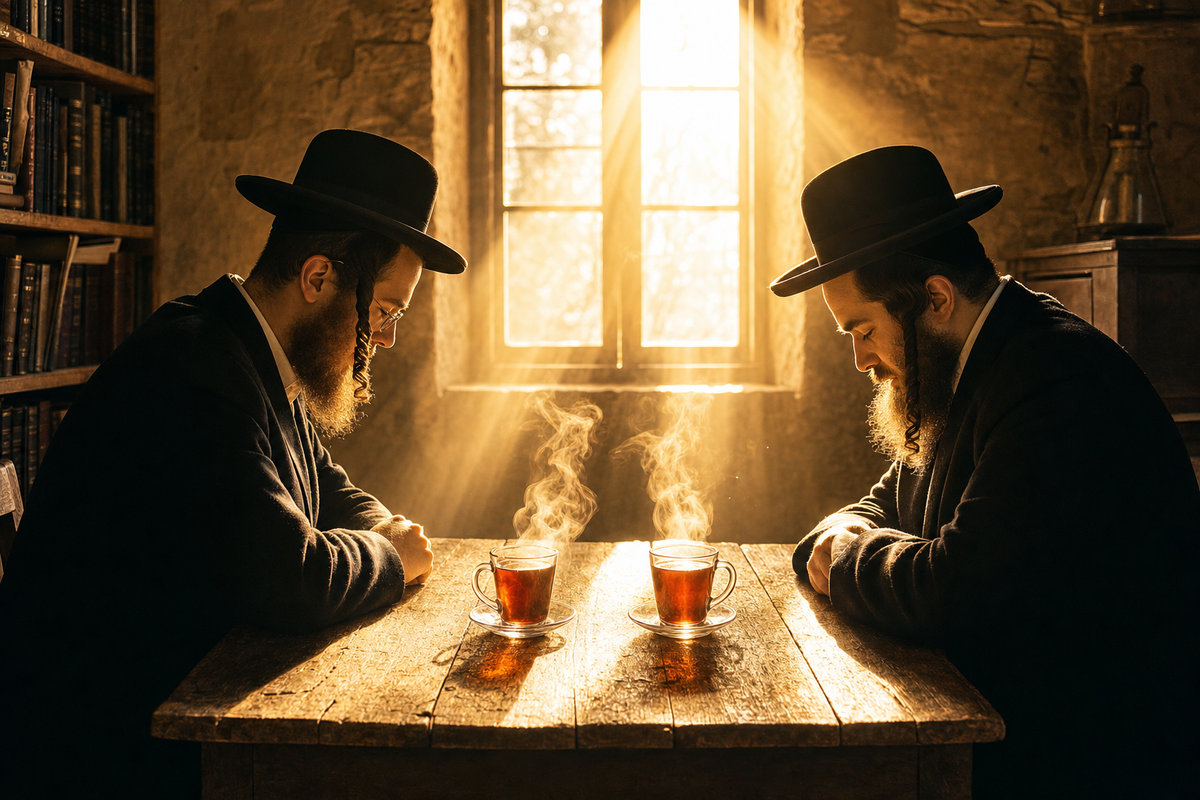
The essence of the Resurrection in the Future to Come depends on the points of lowliness that a person gathered throughout the days of his life. Every day and every second, a person must gather another point of lowliness. The "Yid HaKadosh" (Holy Jew) of Peshischa said that when two Jews sit down to drink a cup of tea, and each one truly believes that he is lesser than his friend—at that very moment, all their sins are forgiven.
The Rebbe said that he could bring Mashiach over a cup of tea, because he felt such immense lowliness. Similarly, Rabbi Avraham of Kalisk said that he has no need to work on humility, because in his eyes, every Jew has the presumption of being kosher and righteous, while he knows very well where he himself stands. That which will arise at the Resurrection of the Dead and merit eternal life are only the points of lowliness that a person gathered in his lifetime.
Humility Depends on Intellect (Mochin)
In order to reach true humility, a person needs mochin (intellect and spiritual awareness). Moshe Rabbeinu merited the forty-nine gates of understanding, and therefore he was the most humble of all men. The more *mochin* and wisdom a person possesses, the more lowly he can be, genuinely believing that he is nothing.
In contrast, when a person lacks intellect, he is incapable of thinking that he is nothing, and therefore he seeks honor. Whoever desires honor is a fool, because honor belongs only to the King of Glory. The less intellect a person has, the more he wants to make himself stand out, in the aspect of "like the crackling of thorns under a pot, so is the laughter of the fool" (Koheles 7:6). Fruit-bearing trees do not make a sound, but barren trees demand that their voices be heard.
King Shlomo sought to bring the Ark of the Covenant into the Holy of Holies, but the gates stuck to one another. He called out:
"Lift up your heads, O gates, and be lifted up, O everlasting doors, that the King of Glory may come in" (Tehillim 24:7).
The gates asked: "Who is this King of Glory?" and Shlomo replied: "Hashem, strong and mighty." Nevertheless, the gates did not open. They absolutely refused to open until Shlomo prayed and said: "Hashem God, do not turn away the face of Your anointed; remember the pious deeds of David Your servant" (Divrei Hayamim II 6:42). The Midrash says that at that very moment, David arose from the grave and opened the gates. Only for King David, who was the ultimate pinnacle of lowliness and smallness, did the gates of the Temple open.
Nullifying the Body and Connecting to the Infinite
It is impossible to attain any spiritual pleasure unless a person is in a state of lowliness and nullifies the body. As long as a person possesses an ego (a sense of self-importance) and a focus on the physical body, he cannot feel the taste of anything spiritual—not in prayer, not in Chatzos (the midnight lament over the destruction of the Temple), and not on Shabbos.
On the holy Shabbos, in order to feel the taste of the Shabbos candles, the taste of Shir HaShirim (Song of Songs), and the Oneg Shabbos (Shabbos delight) itself, a person must strip away the physical body and be at the peak of lowliness, in the aspect of "Ayin" (nothingness). The moment a person becomes '*Ayin*', he connects to the '*Ein Sof*' (the Infinite). The pleasure of the World to Come and the delight of Shabbos are in the aspect of the limitless, and in order to attain them, one must be limitless—and this is only made possible through lowliness.
When a person humbles himself until he becomes "Ayin" (nothingness), his soul turns into a green line that spreads out and encompasses the entire world. This was the case with Queen Esther; because they humiliated her so much, she became "greenish" (yerakrokes)—the secret of the green line of Binah (Understanding) that encompasses the whole world. The soul of the true tzaddik, due to his immense lowliness, becomes the encompassing light of the entire world. Therefore, it is possible to connect to the tzaddik from anywhere.
The more a person is "body" (physical), the more he is limited by space. But the tzaddik, who is literally "Ayin" (nothingness), has no limit whatsoever—he embraces the arms of the world and is found everywhere. The holy Shabbos is a taste of the World to Come, and it is said about it, "Those who taste it merit life." When a person lights the Shabbos candles out of self-nullification (bittul) and lowliness, all the supernal lights are ignited, and his soul ascends to the World of Atzilus (Emanation), to the limitless.
Part 1 of 2 — Lesson No. 257
All Parts: Part 1 (Current) | Part 2
Subscribe to Our Newsletter
Receive Torah articles and inspiration directly in your inbox