The Secret of Opening the Gates: The Power of Song and Dance to Sweeten Judgments
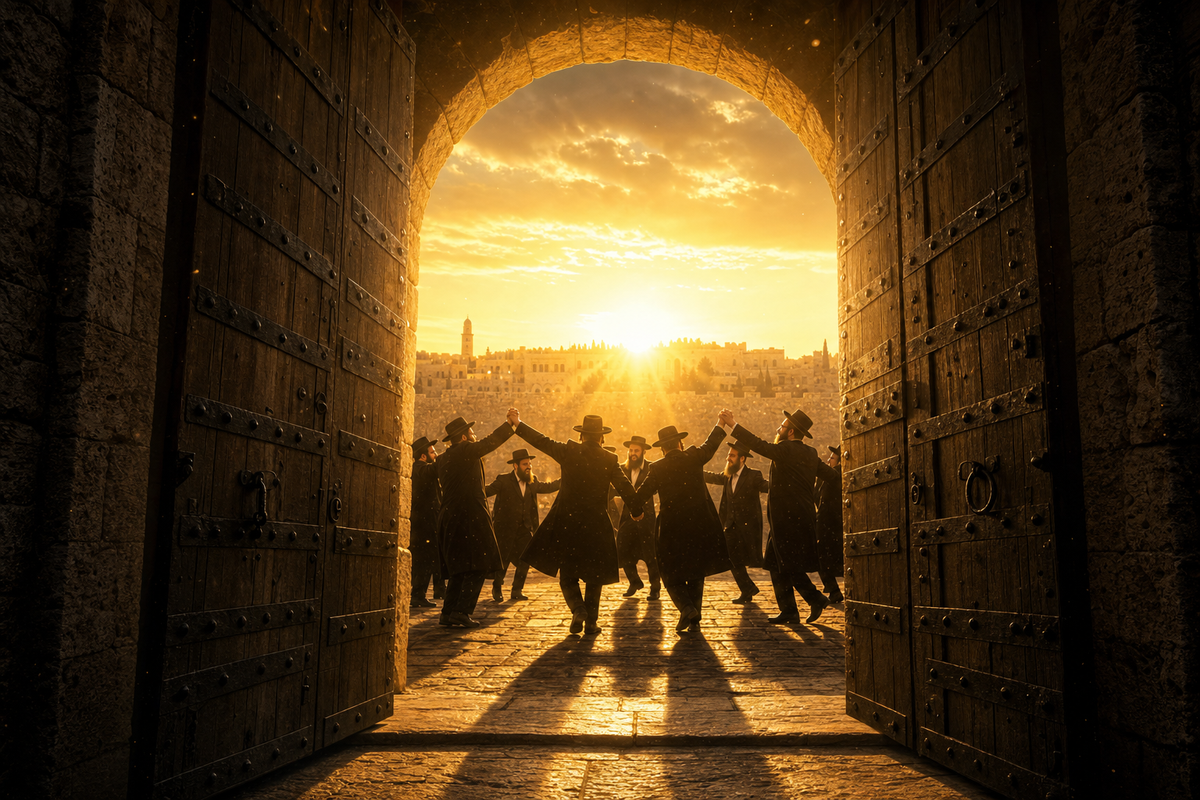
Lesson No. 107 | Tuesday morning, Parashas Eikev, 16 Menachem Av 5757 - at the Yeshiva
A profound discourse explaining how singing and dancing are the exclusive keys to spiritual elevation and opening the gates of Heaven. Through the teachings of the Emek HaMelech and the Ben Ish Chai, it is revealed how dancing sweetens the strict judgments, makes the prosecuting angels laugh, and elevates the soul from one heavenly chamber to the next.
In these days, we need to dance as much as possible, because everything draws from the spiritual inspiration of Tu B'Shvat (the 15th of Shvat) and Tu B'Av (the 15th of Av). The truth is that on Tu B'Shvat there also should have been such great joy, since it is a time of forty days before the creation of the world. The Tosafos in Tractate Rosh Hashanah (27a) asks why we rule according to Rabbi Eliezer that the world was created in Tishrei, when usually the halachah follows Rabbi Yehoshua, who says the world was created in Nissan. The answer is that in Tishrei the thought to create the world arose, and then the souls were created. The physical world, the celestial spheres, and the constellations were created in Nissan, but the souls began to be created in Tishrei.
The Sages say:
"Forty days before the formation of an embryo, a heavenly voice goes forth and proclaims: The daughter of so-and-so to so-and-so."
This proclamation begins on the 25th of Elul, and therefore it turns out that now, around Tu B'Av, is the time when all the souls were created.
Dancing on the Tables All Year Round
Rabbi Eliyahu Lopian zt"l told of his days in the Kelm Yeshiva, under the "Alter" (Elder) of Kelm, Rabbi Simcha Zissel zt"l. Kelm was the pinnacle of brilliance and order in the Lithuanian yeshiva world. Everything was polished, the clothes were clean, and the students did not move from their Gemaras. Even when there was a pogrom outside, no one took their eyes off the book. In Kelm, the students themselves would clean the yeshiva. While washing the floors, the Mashgiach (spiritual supervisor) would announce: "A five-minute study session!" The goal was to train a person to stop in the middle of work, in the middle of business or household chores, and immediately connect to Torah study.
The order and cleanliness in Kelm were legendary. If someone forgot an object on the windowsill, no one would touch it for an entire year. And when Simchas Torah arrived, the entire yeshiva danced and jumped on the tables. When one of the local townspeople saw this, he was astonished: "In Kelm, they dance on the tables?" The Alter of Kelm answered him: "We want to dance like this all year round! Every day one should dance on the tables, but on Simchas Torah it simply bursts forth on its own."
Tu B'Av is a time filled with songs, dances, and joyous circles. In fact, these are the dances of Yom Kippur, since Tu B'Av and Yom Kippur share the same spiritual aspect of tikkun (rectification) and sweetening of judgments. The Pri Tzaddik says that the dedication of the Third Temple will conclude on Tu B'Av, and it will be a Yom Kippur of dancing and rejoicing. "Whoever does not dance, does not feel vitality in dancing, and does not feel the desire to dance – is lacking in their Jewish spark." A person must dance and rejoice. A wedding is the Holy of Holies, the groom is likened to a Kohen Gadol (High Priest), and the day of his wedding is the day of the Giving of the Torah. That is why the daughters of Israel would go out and dance in the vineyards – these are days when one must dance and rejoice.
Having Self-Sacrifice for the Education of Children
Sometimes parents encounter difficulties in educating their children and think there are more important things than investing in the child. The Gemara tells of King Chizkiyahu who planted a sword at the door of the Beis Midrash (study hall). His father, Achaz, was a wicked king who closed all the synagogues and study halls. Chizkiyahu grew up without a rabbi. The Midrash Rabbah says that four individuals did not have a rabbi: Avraham Avinu, King Chizkiyahu, Iyov (Job), and the King Mashiach.
Chizkiyahu learned alone in hidden rooms. He searched for a page of a holy book, and grasped on his own that there is Hashem and there is a Torah, even though the whole world was against him and his father wanted to throw him into the fire. When his father died, he dragged his bed on ropes through the streets in order to achieve atonement for him. Out of this great darkness, a king blossomed who planted a sword at the door of the Beis Midrash and declared: "Anyone who does not engage in Torah study will be pierced by the sword." From here we learn the magnitude of the test a person faces to sit and learn with his son. Even if the child struggles, the parent must double his efforts and invest long hours in him with true mesirus nefesh (self-sacrifice).
The Seal of the Angels: The Secret of Dancing in the 'Emek HaMelech'
In the book Emek HaMelech (Chapter 5, Kiryas Arba), a tremendous secret is brought down: It is absolutely impossible to ascend from one spiritual level to the next in any way, except through songs and dances. Even the angels do not ascend from level to level except through song.
Every single hour, the combination of the letters of the Holy Name of Hashem changes, and every hour the Heavenly Court changes. There are twenty-four Heavenly Courts in a twenty-four-hour period. A person can pass one hour in peace, and suddenly in the next hour everything explodes – there is no shalom bayis (marital harmony), there are troubles. Why? Because he has arrived at a new Heavenly Court and he needs a "seal" from the angels in order to pass through to the next gate.
How does one receive this seal? Only through dancing! "If a person does not sing and dance, then everything is blocked. The mind is blocked, the heart is blocked, the child is blocked. The moment he begins to dance – the heavenly chambers will open." The angels appointed over the gates open them only in the merit of singing and dancing. Therefore, every hour one needs to do some sort of dance, and if it is impossible to do so in the main hall, one should go to a corner and dance.
Making the Prosecuting Angels Laugh
The Ben Ish Chai (in his book Benayahu Ben Yehoyada on Tractate Berachos) adds another layer to the secret of dancing. When a person dances, sometimes those around him start to laugh. This laughter down below causes joy up above, to the point that even the prosecuting angels in Heaven begin to laugh. "The moment the prosecuting angels laugh, all the strict judgments of that day are sweetened and they allow the person to pass." Therefore, if you danced and they haven't laughed at you yet – do another round, until they laugh and the judgments are sweetened.
The power of song operates throughout all of Creation. The sun cannot travel in its orbit except by singing and chanting. When Yehoshua bin Nun wanted to stop the sun, he said to it: "Be still!" The sun asked: "If I am still, who will sing?" Yehoshua answered it: "I will sing in your place." Song gives power to every spiritual thing. The lower waters cry and sing constantly until they merit to be included in the upper waters. At the Splitting of the Red Sea, Miriam went out with tambourines and dances. The women were on a higher spiritual level than the men, because they prepared tambourines in advance out of pure emunah (faith) that there would be miracles.
After the Three Weeks of Bein HaMetzarim (the period of mourning for the Temple), during which we ascended to the root of silence, we now merit days of singing and dancing. Through singing and dancing, all the souls ascend from one heavenly hall to another, and through this, we will merit the rebuilding of the Beis HaMikdash (Holy Temple) and the complete Geulah (Redemption) speedily in our days.
Part 1 of 3 — Lesson No. 107
Subscribe to Our Newsletter
Receive Torah articles and inspiration directly in your inbox