
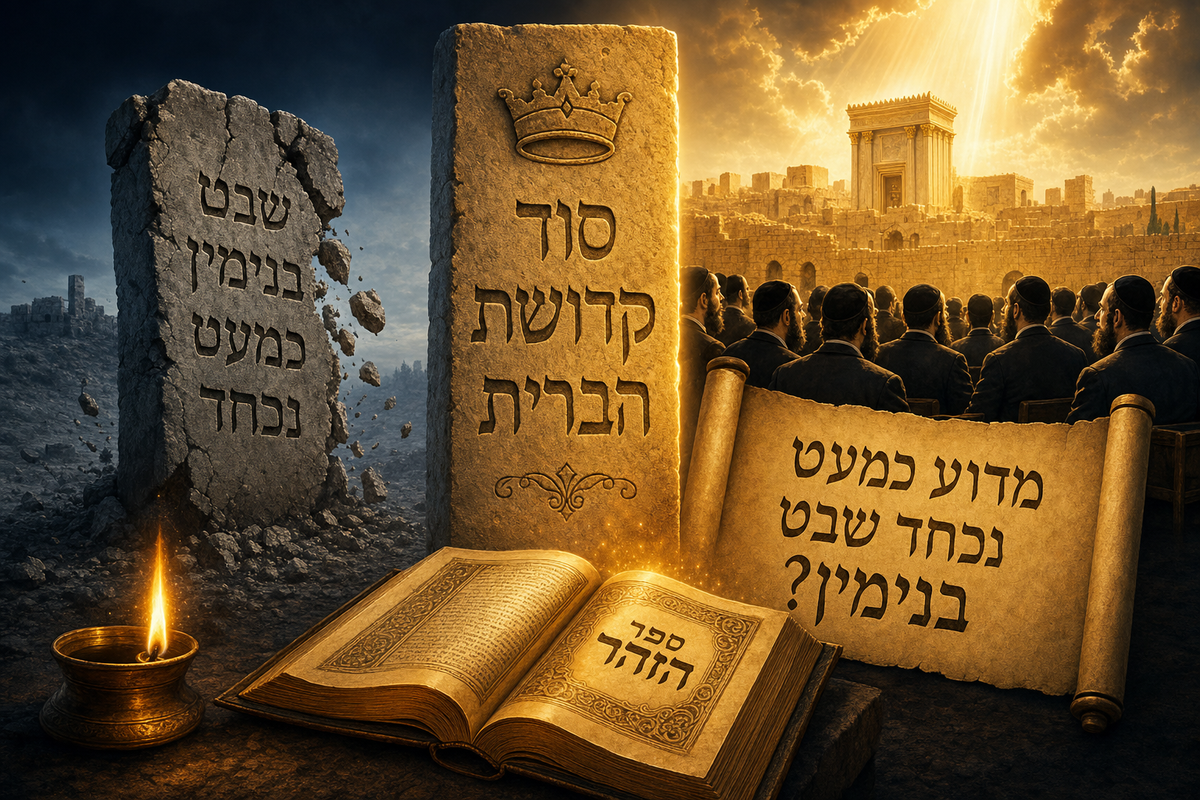
The Secret of the Holiness of the Covenant: Why Was the Tribe of Benjamin Almost Annihilated?
Lesson No. 107 | Tuesday morning, Parashas Eikev, 16 Menachem Av 5757 - at the Yeshiva
The Tribe of Benjamin maintained tremendous holiness for hundreds of years, but the moment the younger generation was left without guidance, a deterioration began. The episode of the Concubine in Gibeah teaches us about the immense severity of pegam habris (blemishing the covenant) within the Jewish people, and how conceding to and having mercy on sinners can lead to the destruction of an entire tribe.
Benjamin named all his children after Yosef the tzaddik. When parents are careful to give the names of tzaddikim, the children absorb the holiness, and thus the ten sons of Benjamin were all awesome tzaddikim. The Tribe of Benjamin maintained its holiness throughout the generations: for 210 years in Egypt they were all tzaddikim, for 40 years in the desert they were all tzaddikim, and even during the first 400 years in the Land of Israel, they all remained tzaddikim.
The Illusion of Hereditary Righteousness
However, after the passing of Joshua and the passing of the Elders, there was no longer anyone to provide spiritual inspiration to the tribe. The fathers were holy and pure, their prayers were accepted, and everything was wonderful, but the children are something else entirely. A person thinks to himself: "Look, I grew up nicely, I found the good path on my own, so my children will also find the path and be like me." But this is a mistake. Your sons are a different generation, with a different evil inclination and different conditions.
The Satan is located inside the person, and there is no need to go looking for him outside. A single drop of the evil inclination is enough for a person to deteriorate. The parents thought that the children would naturally grow to follow after them, but without supervision and guidance, the children slowly lose interest in the path of the father.
A Generation of Open Miracles
The Tribe of Benjamin was clean without sin for hundreds of years. They lived in eras of tremendous revelation of the Shechinah (Divine Presence): they saw Aharon the Kohen, Moshe Rabbeinu, and later Joshua bin Nun who stopped the sun and the moon.
"And the sun stood still, and the moon stayed... and it did not hasten to go down for a whole day" (Joshua 10:13).
The Talmud brings an opinion that the sun stood in the middle of the sky for 60 hours. When one sees such open miracles, who could possibly commit sins? In that era, they were so pure and holy that a sin seemed like an impossible thing.
The Destruction of the Tribe: Zero Tolerance for Blemishing the Covenant
But as mentioned, the moment they left the younger generation to themselves, thinking that they would grow to be tzaddikim on their own, the situation began to deteriorate. The first warning sign was the proliferation of "left-handed people" in the tribe. According to Kabbalistic secrets, this defect hints at problems from previous incarnations, such as a tendency toward controversy or falsehood, which now manifested as a physical punishment. Specifically in the Tribe of Benjamin, the verse emphasizes that there were 700 left-handed men, whereas in the Tribe of Judah, which numbered 400,000 men, this phenomenon was not mentioned at all.
The spiritual deterioration reached its peak with the incident of the Concubine in Gibeah, which led to a terrible civil war. The result was horrifying: an entire tribe was almost annihilated. 25,000 men from the Tribe of Benjamin were killed, and the cities were burned with their inhabitants—women, elders, and children. Only 600 men managed to escape to the Rock of Rimmon.
"But six hundred men turned and fled toward the wilderness to the Rock of Rimmon, and they stayed at the Rock of Rimmon for four months. And the men of Israel turned back against the children of Benjamin, and struck them with the edge of the sword, from the entire city to the animals, to all that was found; they also set on fire all the cities that they came upon" (Judges 20:47-48).
The question arises: What happened here? Why such a severe and cruel punishment? The answer is that when it comes to the holiness of the covenant and blemishes of the covenant—there are no compromises and there is no mercy.
The Mercy That is Cruelty
In cases of pegam habris, mercy is actually cruelty. If a person is blemished in the covenant, he is liable to corrupt the entire city and the entire tribe. The children of Benjamin refused to hand over the criminals to the rest of the tribes, thereby giving backing to the sin. Because of this lack of cooperation, an entire tribe that was destined to host the Holy Temple in its portion was condemned to destruction.
In the wider world, such deeds happen by the thousands and are sometimes considered "normal things." But not among the Jewish people. Among the Jewish people, the slightest blemish in the holiness of the covenant provokes a severe reaction, because whoever has mercy on the wicked will ultimately become cruel to the righteous. A person who has blemishes of the covenant must know that all his spiritual work is damaged; his prayers and divine service do not ascend on high until he rectifies his deeds.
Part 2 of 3 — Lesson No. 107
Subscribe to Our Newsletter
Receive Torah articles and inspiration directly in your inbox