
The Secret of Ruling Over Angels and the Power of Loving Fellow Jews
Class No. 85 | *29 Adar II 5757 at Sha'arei Torah*
The ultimate purpose of every Jew is to create angels from every utterance and mitzvah, and to rule over them. To merit this level, we must love every Jew with a soulful love—even our enemies, guard the holiness of our eyes and heart, and connect ourselves to the true tzaddikim of the generation.
The rule is that every person must have dominion over the angels. Rebbe Nachman of Breslov teaches that if a person fulfills the advice of the tzaddik, he merits to rule over the angels, and they become his messengers, as it is stated:
"For He will command His angels on your behalf, to guard you in all your ways."
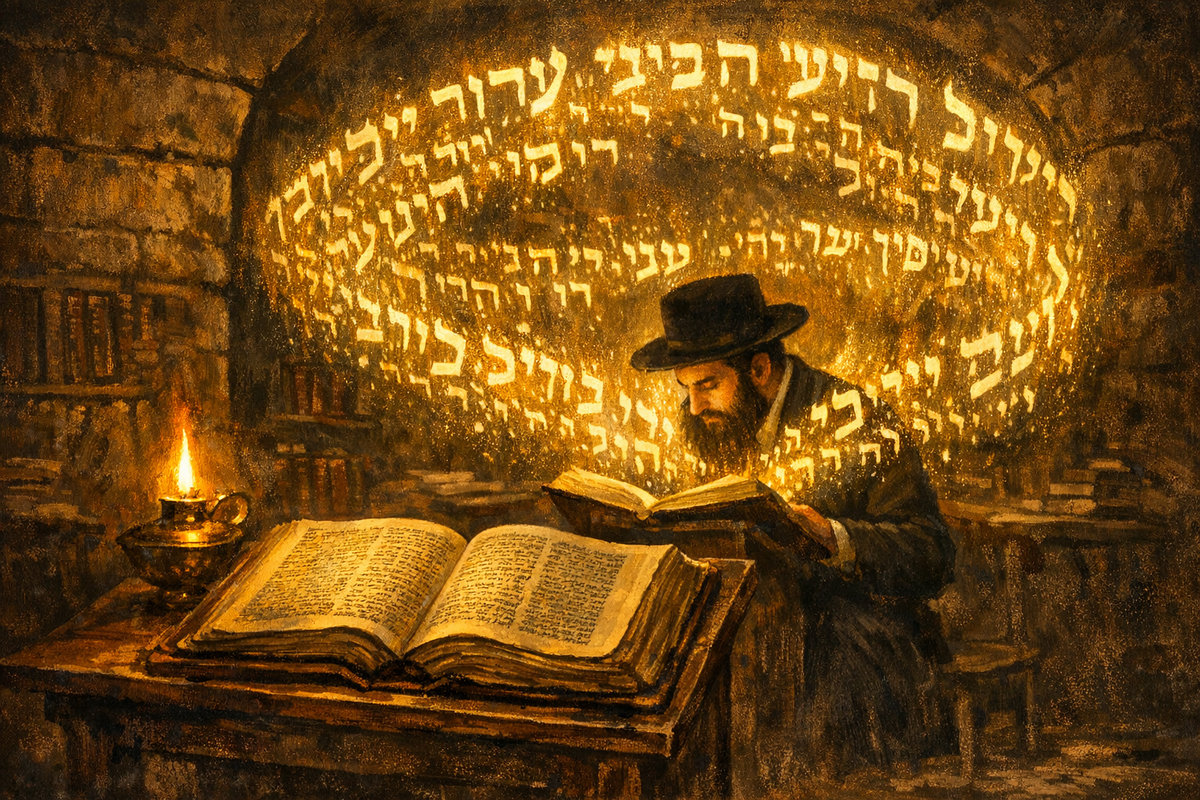
The angels will guard him and surround him. How does this happen? Every second, with every letter and every word of Torah or mitzvah that a person utters from his mouth, he creates an angel. This angel guards him and serves him.
The ultimate purpose of every Jew is to create myriads of angels from every utterance, every step, and every movement. Yaakov Avinu returned with camps of angels surrounding him. A person cannot exempt himself and say: "I am strong, I am a hero, I have intellect and I can manage on my own. Why do I need to create angels? This is a level that belongs only to great tzaddikim." Heaven forbid! This is the ultimate purpose of every Jew.
Every word and letter in the Gemara that you study with awe, with reverence, in holiness, and in purity—creates an angel. If a person gives up on this ultimate purpose and wants to remain "simple" without intentions, he may have to return in a reincarnation to fulfill his destiny. Therefore, every word must be calculated, without evil speech or idle chatter. Hashem wants and obligates you to have angels that will guard you.
Grasping the Throne of Glory: Loving One's Enemies
In Torah 1 (Part II of Likutey Moharan), the Rebbe explains the conditions for how a person can merit to create angels and rule over them. The first and most basic condition is connecting to the roots of the souls. The meaning of this is to love each and every Jew in the world with a soulful love.
This love is called "grasping the Throne of Glory." When Moshe Rabbeinu ascended to the heavens to receive the Torah, Hashem said to him:
"Grasp My Throne of Glory."
Hashem said to Moshe: "If you want to receive the Torah, to create angels and rule over them, you must start anew to love every Jew with a soulful love." Moshe Rabbeinu had many enemies, such as Datan and Aviram who informed on him to Pharaoh and harassed him at every step, as well as Korach who disputed him. Despite this, Hashem commanded him to love specifically them.
The more enemies a person has, the more he needs to love them. Ultimately, they are all good Jews who stood at Mount Sinai. Every Jew has a letter in the Torah. When Datan and Aviram were swallowed into the earth, it was as if letters fell from the Torah and a blemish was created in it. Our role now is to elevate them back and complete the letters of the Torah. Therefore, even if a person hates you, you must know that he is a letter in the Torah, and his hatred stems from a spirit of folly that has entered him.
The Heroism and Modesty of King Shaul
A clear example of this we see with King Shaul who pursued David. King David understood that this was only a spirit of folly, and refused to harm him. When Avishai ben Tzeruyah wanted to kill Shaul in his sleep, David was shocked and said: "Heaven forbid me before Hashem from stretching out my hand against Hashem's anointed." David said that perhaps Shaul would die in battle or from illness, but he himself would not touch him.
Upon these words, a Heavenly voice emerged and rebuked David: "How can you say such words about Shaul? For Shaul is a greater tzaddik than you!" The Midrash says about this: "They were swifter than eagles, they were stronger than lions." David indeed killed Goliath from afar using a sling and a stone, but Shaul revealed self-sacrifice that was many times greater.
When the Ark of the Covenant was captured by the Philistines, Shaul ran sixty mil from Shiloh to the battlefield. He struggled face-to-face with Goliath, snatched the Tablets of the Covenant—which weighed tons—from his hands, and ran back with them another sixty mil to return them to Shiloh. The Heavenly voice said to David: "You do not have self-sacrifice and heroism like that of Shaul, how do you dare speak like this about Hashem's anointed?"
Shaul's greatness was also expressed in his extraordinary modesty. He was completely covered in sheets and tallitot, to the point that David, his son-in-law, did not recognize him in the cave. Shaul ensured that no spot on his body would be exposed, since any exposure allows the forces of impurity to take hold of a person, and from there all blemishes of the covenant are created.
The Burning Fire of Forbidden Sights
This modesty and holiness characterized the Torah giants of Israel in all generations. It is told of the Baba Sali, zt"l, that he would enter the mikvah completely wrapped, change his clothes inside the water, and emerge covered in many blankets. In our generation, we barely understand these concepts of holiness. If a person understood what impurities he is immersed in, he would turn into a pile of bones out of sheer terror.
The holy Alshich explains the magnitude of caution required against forbidden sights through the story of Shem and Yefet, who covered Noach, their father. The Torah emphasizes three things: "And they walked backward," "and their faces were turned backward," "and they did not see their father's nakedness." Why the repetition?
First, they held their bodies firmly to walk backward without shifting. Afterward, they were careful that their faces would not move even a millimeter. And finally, "they did not see"—they guarded even their eyeballs from moving to the sides. Hashem created the eyes so they could see to the sides to defend against danger, but Heaven forbid, not to look at forbidden sights.
From every forbidden sight emerges a spiritual fire that burns a person's face and mind. Even if a person closes his eyes, if his face is turned toward a sinful matter, the "skin of his face" is burned, and he loses the "light of his face" and his holiness.
The same applies to the heart. Halachah forbids praying when "his heart sees nakedness," and therefore one must wear a belt (gartel) that separates the heart from the lower half of the body. If a person does not partition his heart, his heart is spiritually burned. He loses the ability to feel Hashem, to be moved by holiness, or to understand words of faith, because his heart becomes sealed.
Connecting to Tzaddikim and Accepting Rebuke with Love
To be saved from all this and to merit holiness, the central spiritual work is to connect to the tzaddikim of the generation. There are tzaddikim in our generation who have never blemished the covenant and never blemished their eyes. We must love them with a soulful love, whether they belong to our circles or not. They are the ones who guard the walls of religion, the education, the modesty, and the holiness of the Jewish people.
The Rambam writes that if a kosher person dies and the public does not weep for him, "he deserves to be buried alive." The tzaddikim of the generation are the messengers of Hashem; through them, the light and the Torah descend to the world, and in their merit, we have synagogues and mikvaot everywhere.
This connection to the roots of the souls of Israel also includes those who hate us. If someone hates you and rebukes you for not waking up for prayer or for not studying properly—he is right! Instead of hating him back, you must thank him. He serves as your free rebuker.
Moshe Rabbeinu was required to love Datan and Aviram while they were still alive. Hashem said to him: "Grasp My Throne of Glory—love them with a soulful love, and only then will you be able to bring down the Torah to the Jewish people and rule over the angels." Every Jew is a conduit among the six hundred thousand conduits of the Name Havayah. When a person loves every Jew, accepts with love the rebuke of those who demand that he elevate himself, and connects to the true tzaddikim—he completes the Name Havayah, merits true holiness, and reaches the ultimate purpose of creating angels from every utterance and deed.
Part 1 of 3 — Class No. 85
Subscribe to Our Newsletter
Receive Torah articles and inspiration directly in your inbox