
The Secret of the Garments of Light: Reaching the Comprehensive Intellect of Rabbi Meir
Lesson No. 106 | It is known that the unification of a bride and groom, in its supernal root, is very, very high. It is higher than Yom Kippur. As the Degel (Degel Machaneh Ephraim) says, a bride and groom are higher than Yom Kippur, very, very high. Therefore, we do not say Tachanun (supplication prayers), because the sins are already forgiven without falling on our faces (in prayer). How are the sins forgiven? By receiving the mochin (spiritual intellect/awareness), because a person does not sin unless a spirit of folly enters him. So now, this is a time of seven days of Yom Kippur. There were 14 days of Yom Kippur here, which is very, very high, high above high, where no thought can grasp it at all. No thought and no mind can absorb and understand to which worlds the bride and groom ascend. They ascend to hidden and concealed worlds, like Adam and Eve before the sin. As the Imrei Emes says on Parashas Vayikra, they ascend to the light of the Seven Days, the Hidden Light, and are concealed in supernal and hidden worlds. From there, they draw down abundance to everyone in their presence. All seven days, they draw down such an abundance of mochin, that through these mochin, all sins are forgiven. A person's mochin are completed through the dancing and the songs sung with the bride and groom. Through this, we become vessels for all the wondrous mochin that descend to the entire public, and especially to them—mochin for their entire lives. Because according to how much the bride and groom rejoice during these days—not sleeping, not eating, only rejoicing in Hashem, only feeling the Supernal Unification, the clinging to Hashem—that is how mochin are drawn down to them now for all 70 years. Every day corresponds to 10 years, so every hour is almost two and a half hours, every hour influences two and a half hours. And all this is the aspect of the aforementioned Torah teaching said about the wedding: "For the light of the blazing heart of a Jewish person is infinite." Every hour comes out to like half a day, two and a half hours is like a day, because the light of his blazing heart is from the root of his soul. For now they ascend to the root of the soul. Rebbe Nachman says in Torah 49 that "the light of the blazing heart of a Jewish person is infinite," that the soul ascends to infinity. The soul of the bride and groom ascends to infinity, ascending up to Binah (Understanding). The groom himself transforms into Binah, and they must elevate everyone in their presence, elevating them to the Sefirah of Binah, to the Infinite Light. Now they literally ascend to the Infinite Light, because Jerusalem is Malchus d'Atzilus (Kingship of the World of Emanation). The Holy One, blessed be He, swore that He would not enter the Jerusalem below until He enters the Jerusalem above. The Jerusalem below is called Malchus d'Atzilus, and the Jerusalem above is called Malchus d'Ein Sof (Kingship of the Infinite), the Kingship of Adam Kadmon (Primordial Man). Now there is a unification between Malchus d'Atzilus and the Malchus of the Infinite, which is the bride and groom, as if building one of the ruins of Jerusalem. For the man is the aspect of Atzilus, the man is the aspect of the Infinite, and the woman is the aspect of Atzilus. So the man is the aspect of Malchus d'Ein Sof, the Jerusalem above, and the woman is the Jerusalem below, she is the Malchus of Malchus, Malchus d'Atzilus, and he is Malchus d'Ein Sof. So now a unification takes place, which is the rebuilding of a ruin from the ruins of Jerusalem. Meaning, Jerusalem is built both above and below. Because if the bride and groom truly merit holiness and purity, then they merit to elevate the entire public together with them up to infinity, without limit, to draw down mochin for everyone. Because now, for 12 months, the Zohar says on Parashas Ki Seitzei, "Hashem builds Jerusalem"—there is a Jerusalem above and a Jerusalem below. The Holy One, blessed be He, swore not to enter the Jerusalem above until He enters the Jerusalem below. Malchus d'Atzilus is called the Jerusalem below, and Malchus d'Ein Sof is called the Jerusalem above, and this is the unification of the bride and groom. So here is the explanation of the prayer, a wondrous explanation: "Hashem builds Jerusalem." We must connect Malchus d'Atzilus with Malchus d'Ein Sof. The groom is Malchus d'Ein Sof and he must receive the light from the Infinite, to receive the mochin. His role is to receive the mochin and to bestow it upon the bride, who is called Malchus d'Atzilus. This is explained by the Zohar on Ki Seitzei: "When a man takes a new wife, he shall not go out to the army... he shall be free for his home for one year, and he shall gladden his wife whom he has taken." Let us look for a moment at the verse in Ki Seitzei: "When a man takes a new wife, he shall not go out to the army... for any matter; he shall be free for his home for one year, and he shall gladden his wife whom he has taken." So they explain "he shall be free (clean)"—it is written in all the Chassidic books, clean from all desires. The first year, they are clean from all desires. The first year, they only live from the Infinite Light, only living from clinging to Hashem. For a year, such a light descends, such a light, that on the contrary, they are cleansed of all desires. Therefore, it is called Kiddushin (sanctification), not just marriage or a wedding, it is called Kiddushin, because the bride and groom are sanctified in the first year with such holiness. And this is what the Zohar says in Ki Seitzei (277b), that this is the matter of the 12 months. 12 months, it says, corresponds to the 12 oxen. The basin of Solomon stood on 12 oxen, and some say this corresponds to the 12 oxen brought by the princes, which never died. And now the bride and groom receive such mochin of the resurrection of the dead; they can simply revive the dead. The bride and groom merit to cling to Hashem now, and in this year, this is the whole year. In the seven days, the light of the Seven Days literally shines, they literally ascend to the Sefirah of Binah—Imma Ila'ah (the Supernal Mother). This is the Sefirah of Yom Kippur, and even higher than Yom Kippur, says the Degel. Much higher than Yom Kippur. They draw down such mochin to all those accompanying them, to all those participating with them, to all those rejoicing with them. Such mochin that are greater than what is drawn down on Yom Kippur. And this is during all these seven days, and also throughout the entire year, such mochin are drawn down. They will not receive these mochin afterward for the rest of their lives, only according to what they received in the first 7 days. As we said, every 2.4 hours is called almost two and a half hours, this is a day—corresponding to a year—this corresponds to 10 years. So two and a half hours corresponds to a year. And afterward, they have another 12 months where such mochin are drawn down to them, mochin they will not receive again in their entire lives, only according to what they merited to draw down in these 7 days, and in these 12 months. And this is the 12 oxen upon which the Sea of Solomon stands. The Sea of Solomon represents Malchus d'Atzilus, which stands on 12 oxen, which is the 12 months. And the rectification of the bride is in these 12 months; he draws down mochin to the bride. The groom is obligated to draw down mochin to the bride. He must draw it down to her, he is the Malchus d'Ein Sof, he is obligated. He is considered the basin of Solomon, to draw down to the bride who stands on 12 oxen, which is now 12 months, which is stated as "one year." What is this year? Is it a year of vacation? What is a year of vacation? It is a year where he must draw down mochin! It is not a vacation! For a year he must draw down such mochin now, such mochin, he must draw down in this year. Every month he receives a completely new mind, and he draws down mochin to the bride in these 12 months. He must draw down such mochin to her, such mochin that will fill her for her entire life, for all 120 years. These 12 months correspond to 120 years. And this is the awesome secret of these 12 months, that the Torah says "and he shall gladden his wife" for a full year. What is a full year? Why not half a year? Why not 9 months? Pregnancy is 9 months! Why not two years? Nursing is two years! Why specifically a year? Rather, 12 months, says the Zohar, contains awesome secrets, that the morning stands on 12 months, on 12 oxen is the Sea of Solomon. The groom is the Sea of Solomon, he is the aspect of King Solomon, he must bestow upon the 12 oxen, he bestows such mochin upon the 12 months. And this is a secret, "this is the secret of the year." There is an awesome secret here why it is a year. Why not 9 months? Why not two years? Why specifically a year? Because primarily, the groom must bring joy, he must bring joy! The groom might say, "Why should I gladden her? Let her gladden me a little too! What, do I have to just dance and sing all day? Am I a singer? Am I this? I want to sit quietly! Let her sing a little! Let her bring some joy!" So the Zohar says, no! That is a mistake! It does not say "and she shall gladden her husband," it does not say "and they shall both rejoice," it does not say "and they shall gladden each other." It says "and he shall gladden his wife." This is his mitzvah! He might say after 7 days, he will tell his wife, "Listen, my dear wife, I'm already tired of this, now you start gladdening me a little." Then he transgresses a positive commandment! He transgresses a positive commandment! He wants a division of labor, he wants equal rights. There are no equal rights in the Torah. In the Torah, there are no equal rights; there are things he is obligated to do, and things she is obligated to do, and each one must do their role with self-sacrifice (mesirus nefesh). His role is to draw down mochin to his wife. This is his role, says the Zohar, "and he shall gladden his wife." It does not say they shall gladden each other, it does not say they shall rejoice together, it says "and he shall gladden his wife." The man must draw down mochin to the woman. He needs to have a mind, he needs to learn a lot of Gemara so he will have a mind! Because if he doesn't learn Gemara, he won't have a mind! He needs to start learning at 9 in the morning, his 8 hours, whether it's until 1:00, and then from 3:00 to 7:00, the 8 hours. If not, he has no mochin! He has no mochin! Many women run away home after a month, they run home. "What, did we marry a wall? Did we marry a chair? A table? What did we marry?" As they run home after a month, the father comes, the mother comes, they appease, and so on. But the man must be a father, and a mother, and a brother, and a sister, and a friend, and also bring joy, and he needs to be everything! He needs to be everything! Therefore he is a man, therefore he is a man! She is the Sefirah of Malchus, and he has the 9 Sefiros. He must bring joy, and then she will be "a woman of valor, the crown of her husband." If he gladdens her, she will ascend to Keser (Crown). The woman jumps straight from Malchus to Keser, and then she becomes the crown of her husband! "And he shall gladden his wife"—it does not say "and they shall rejoice" together, but rather "and he shall gladden." "He shall bring joy to the bride," he is obligated to gladden her in this manner. And then, if he gladdens her, says the Zohar, there is joy in all the worlds. He might say, "What do I have to do with this bride? What do I have to do with this woman? We got married! Fine, she fell into the trap, she fell into the trap, what can I do? Can I bring joy all day? Dance? Sing? What can I do? I want to rest a little, sleep a little, I come home and I want to sleep! To rest! To sleep until morning! In the morning I will get up and go about my business! We'll barely meet on Shabbos!" So the Torah says, no! If you gladden your wife, then you gladden 12 worlds. There are 12 supernal chambers that only receive joy from the fact that the man comes home with joy, with mochin, with Daas (knowledge). And therefore, "he shall be free for his home for one year." They also give him freedom. What is "free"? Free from the king's service, but not free from Hashem's service! He is free from all the king's duties, free from taxes, free from property taxes, free from poll taxes, also free from an optional war. A commanded war, which is a matter of saving lives, he is not free from! But from an optional war he is free, clean. "And he shall not go out to the army to wage war," because he must gladden the 12 chambers in heaven. There are 12 chambers, and every month the bride and groom enter a different chamber. "Joy is found above and below." Every month they must enter... there are 12 chambers, and every month they enter a different chamber, and there must be joy above and below. "And joy comes above." And through him gladdening his wife, he awakens joy in heaven. He literally gladdens the holy Shechinah (Divine Presence), since she is Malchus d'Atzilus and he is Malchus d'Ein Sof. She is called the Shechinah and he is the aspect of the Holy One, blessed be He. And every single moment that there is joy in the home, there is light in the home, then there is another unification between the Holy One, blessed be He, and His Shechinah. Therefore, these are the dances and circles that are danced all 7 blessings, and from this, it must be drawn down for the whole year, drawn down all the time, drawn down for their whole lives. "Fortunate is the holy nation," says the Zohar. Where is there such a Torah? Where are there such mitzvot? Where are there such revelations of secrets? No nation or tongue has merited this! Has not merited such revelations! Such secrets! No nation or tongue! "Fortunate is the holy nation," that this is only revealed to the Jewish people. As the Zohar says in Parashas Balak, when the Holy One, blessed be He... it says, "Hashem came from Sinai and shone forth from Seir to them; He appeared from Mount Paran and came with myriads of holy ones." First, Hashem had to... what does it mean "Hashem came from Sinai and shone forth from Seir to them"? Hashem first went to Seir, right? And what is "shone forth from Seir to them"? So the Zohar says in Balak, when the Holy One, blessed be He, went to the children of Seir for them to accept the Torah, He had a terrible fear: maybe they will accept it? Maybe they will accept it? Heaven forbid, if they accepted it, we would be lost! Hashem went in terrible fear. The Zohar in Balak says He didn't just go to Seir, He offered them the Torah! And if they had accepted it? Why not? What's bad about the Torah? There is Shabbos! Sleeping, dancing, eating three meals. So Hashem was afraid. Hashem will bring the Jews back in teshuvah (repentance), but the non-Jews, Hashem was literally afraid, maybe they will accept Shabbos? Maybe, heaven forbid... such joy of a bride, a groom, seven blessings, a year to rejoice, such secrets. Hashem had a terrible fear. So the Zohar says, "Hashem, when You went forth from Seir, when You marched out of the field of Edom, the earth trembled." When the Holy One, blessed be He, returned from Seir, He shone. He returned with such joy that they did not accept the Torah, with such joy He returned. Heaven forbid, if they had accepted the Torah, what would we have done? "What is meant by 'trembled'?" First the earth trembled, it was terrified to death. And the same thing from Paran, "He appeared from Mount Paran." He appeared with joy from Mount Paran, because He immediately showed the nations something they wouldn't want. But He was afraid, maybe they would say, "Show us something else, let's see, let's bargain, maybe You have other offers?" If a person is immediately shown something not to his liking, he already says, "I don't want it! I don't want it! Leave me alone!" Hashem was afraid maybe they would have a little more sense and say, "Is this all You have to offer? Maybe other things? Come, let's bargain, let's take some of the mitzvot. If not 'Do not murder', then there are 613 mitzvot, we'll take the 613 mitzvot. We'll say one mitzvah is hard for us, but give us the 613 mitzvot." So the Holy One, blessed be He, immediately... it was such a joy for the Holy One, blessed be He, that they immediately told Him they don't want it. "There is such a mitzvah? We don't want any of it!" Sometimes a person is shown something, they start by showing him the thing they know he won't want, misleading him from Heaven. So the Zohar says: "Joy was found above and below." So the Holy One, blessed be He, came with such joy. And it wasn't for nothing. Esau could have said to Him, "Why did You offer me such a deal? This was a bit of a trick." He could have complained later. So Hashem said to him, "Maybe nevertheless? Maybe nevertheless you'll accept it?" He says, "No! If there is such a thing, I don't want it. I'm done, this whole thing is disqualified for me, I've lost all desire for this whole matter." So Hashem said to him, "Maybe nevertheless? Maybe nevertheless?" And how many times did Hashem try to persuade him, so he wouldn't say, "They just offered me a fake deal, they just lured me, they just tricked me, why didn't they show me other things?" So Hashem went back again and again. So the Holy One, blessed be He, "shone forth from Seir to them, He appeared to the Jewish people from Mount Paran... the Holy One." Then the Holy One, blessed be He, came, He skipped straight to "Do not murder" and went to the Samael (the prosecuting angel), the ministering angel of Esau, and said to him, "Maybe nevertheless you will accept the Torah?" "What? My whole vitality is only wars! What does Esau do? Wars! Conquering countries! If I don't conquer countries, what will I do? I'll go crazy from boredom! What does he have to do? Does he learn Torah? A person learns 8 hours, what does he have to do for the other 16 hours now? He already worked 10 years, he's going crazy, he goes and makes wars, conquers countries, makes weapons of destruction, dreams of conquering countries. At least he dreams about it. He can't yet, it's impossible to see, because Hashem arranged that the other country also has the same weapon of destruction, so it's impossible to activate the weapon of destruction. But everyone dreams, maybe nevertheless the other will be a bit weak, maybe nevertheless I will have a bit of courage. So everyone, all their lives, just dreams of when they will finally go conquer countries. From this he... this is the whole vitality of Esau. Even though in practice we see a world war happens only once in a while. So it was, and it ended in '17, they already started in '39 after 22 years. After 18, after 21 years they already started a world war. Now, thank God, it's been 55 years without a world war, it's impossible to know what will be in another moment. In any case, the dream of a world war, just in this dream, it's such a pleasure, it's such vitality. For Esau, 'I already have this and that, Russia already has 30 thousand atomic missiles, and America on the other hand surely also has 30 thousand atomic missiles, and everyone counts their missiles, and whenever I want I can conquer the world, and I just simply have pity, I go beyond the letter of the law, I am a bit considerate of the world, I am a bit... but whoever annoys me, I will show them who I am.' And just all this nonsense is the whole vitality of Esau! This is his whole vitality! He has no other vitality! Does he get vitality from a cup of tea? So Esau says, 'This is my whole vitality, I dream of wars, if I don't make wars I dream of wars! From this I live! You want to take this vitality from me? This vitality? So what will I do?' So He said to him, 'Maybe nevertheless you will accept? Maybe nevertheless?' So he said, 'So who should I give it to?' So Hashem arranged it like this, so Esau said, 'Give it to the children of Jacob, the children of Jacob, give it to them!' And he thought in his heart, 'For them it will be good, the children of Jacob will accept "Do not murder" and they won't make wars, and if they make wars then He will remove them from the world.' The Holy One, blessed be He, said to him, 'But aren't you the firstborn? You are the firstborn? You deserve it!' He said, 'What? I already sold my birthright a long time ago! And I already conceded the blessings, as it is written "and he blessed him there," and I already conceded the blessings, and the birthright already belongs to Jacob.' So Hashem orchestrated that he would concede the blessings and the birthright once again. 'And I already sold the birthright, and I agree that he will be the firstborn, just don't give... just let them give the Torah to Jacob.' After that He went... so the Holy One, blessed be He, said, 'Listen, give Me advice. Look, you don't want it, "Do not murder" doesn't find favor in your eyes. I will go to them, something won't find favor in their eyes either. There are 613 mitzvot here, am I already sure they will accept? You already disappointed Me, now give Me advice. I am afraid of these Jews. These Jews, I will come to them, I will tell them Shabbos, so they will say they want to travel to the sea. Oneg Shabbos (Shabbos delight) is traveling to the sea! I know what they can say, like the secular people say today!' So they didn't claim this because they had the mochin, they saw the mochin of Shabbos, they saw the Shabbos. But the moment a person doesn't see the mochin of Shabbos, then for him Oneg Shabbos is to travel there, 6 hours to the Kinneret, and roast there in the sun, and the food falls into the sand, and to fight there, and all the children are crying and screaming 'Why did we travel?' And this he calls Oneg Shabbos. And the steak burns there on the fire, completely burns, nothing is left, barely anyone knows, everyone just told me exactly how it goes. And after that they have to return 6 hours, and tomorrow, tomorrow they come to work, they don't even know how they are working. Legs get caught in the cars, hands get cut, fingers get cut, they don't even know what's happening anymore. It's not enough that for 6 days he is already exhausted, the seventh day is equal to all the 6 days. It's literally like the Gemara says, the 6 days, the seventh day is equal to all the six. He was so exhausted, and toiled so much, and suffered so much, all six days. Sunday arrives and he doesn't even know what's happening anymore. So nevertheless they call it Oneg Shabbos. I don't know, there are all kinds of concepts that we don't know. So the Holy One, blessed be He, says, 'I will come to the Jew to accept Shabbos, they will say they want to travel to the sea. I know what they can say to Me! So give Me advice to bribe them. I know, I need to come to them with mochin, I need to come show them some lights. I can't just tell them Shabbos! Shabbos! What, on Shabbos we don't travel to the sea? We don't go on trips? What is this here? We can't even pick up a phone? What's going on here? So I want to bribe them!' So the Samael said: 'Master of the Universe, all the lights that I have,' he said, 'all the lights that I have, I give them to You now. Show them to the Jewish people, give them to the Jewish people. The main thing is that they accept the Shabbos, the main thing is that they accept the Torah. I will strip off all the lights, I will be blacker than black, I am willing to be complete darkness. The main thing is leave me alone, give the Torah to the Jews.' The Samael stripped himself of all his lights, says the Zohar here, in section 192, Balak, he stripped himself of all his lights, and Hashem came with a bounty of lights. He came with lightning, thunder, a bounty of lights. They saw all the lights in the world, and all the lights that the Samael had, Hashem brought to the Jewish people. Because it says, and this is the root, the Samael donated from his own so that the Jewish people would see such lights, Shabbos with such lights, with such experiences, to feel such things that there is absolutely no thought not to accept Shabbos, not to accept the Shabbos. After that Hashem went to Ishmael, He said to Ishmael, 'Do you want to be bribed? Take the light and give from all the hosts of heaven and give upon them so they will accept.' After that He went to Ishmael... He went to the Arab, He said, 'Arab, well, what do you think of the Torah?' He immediately showed him what the Ishmaelites, Hashem have mercy, He showed them, He showed them what He showed them. They said if there is such a thing they are not willing, not willing! He said, 'Why? For what reason? What is it?' He started to beg, He started to beg, the Holy One, blessed be He, started to beg. He said, 'What, I want only you to accept.' He said, 'No, give it to Isaac, give Ishmael... his brother is Isaac, give it to my brother's children.' He said, 'Why? But aren't you the firstborn? You are the firstborn?' 'I give up the birthright, I give up everything, just give it to the children of Isaac, not to me! Not to me! Not to me!' So He appeared from Mount Paran. What is 'He appeared from Mount Paran'? So Hashem said, 'And what will I do if they don't agree, just like you don't agree, maybe they won't agree either?' He said, 'Take, take, take all my lights, all the bounty of lights that I have, all the lights, and give them to the Jewish people.' So the Holy One, blessed be He, appeared with more lights. He had all the lights of the Samael, all the lights of the Arab, all the lights. All the lights were stripped away, they remained in complete darkness, utter darkness. And all these lights Hashem appeared with at Mount Sinai. This is 'shone forth from Seir to them.' He shone like the sun, He came from Mount Seir like the sun, because the lights of the Samael are more than the sun, an angel shines more than the sun. So 'shone forth'—they saw such lights, more than the sun, because 'and He shone forth,' He took all the lights that the Samael had and with that He appeared. After that He took all the lights that the Arab had, there were slightly fewer lights there, so He only 'appeared', only 'appeared'. And the light is also called Yifa'as (appearance). The light is called... so He appeared. And not only that, 'and came with myriads of holy ones.' What is 'myriads of holy ones'? And so He went to the ministers of all the nations of the world before Hashem arrived at the mountain, to Israel. He went to the ministers of all the nations of the world, to everyone He offered what He offered, to everyone He offered the Torah. And everyone found some flaw, that this 'Do not steal', and this is like this, this 'Do not lie', and this... and in each and every one, this 'Do not wrong one another'. Everyone just found some thing that didn't suit them. So the Holy One, blessed be He, also said to him, 'So how will I give it to them? Who says they will agree?' So every angel said, 'I give You all my lights, all my lights, give it to the Jews, just, just leave me alone!' And so Hashem came with a bounty of lights, 'came with myriads of holy ones.' He took all the lights of all those appointed over the rest of the people of the world, and so He came with a bounty of lights to Israel. They completely forgot that there is a sea, that there is this, they only saw the lights, they only saw the mochin. And in every mitzvah they saw the lights, they saw the mochin that is in every mitzvah, and the lights that are in every mitzvah. So the Zohar says, 'Fortunate is the holy nation that the Holy One, blessed be He, reveals to them such secrets.' What is 'and he shall gladden'? What is the seven days of the feast? What is 12 months to gladden a bride and groom? That the man puts in the mochin! It is an obligation upon him! After seven days the man might say, 'I'm already tired, now let my wife gladden me a little!' It says no! This is your obligation for the 12 months! And through this you gladden all the supernal chambers. And fortunate is the nation to whom such secrets are revealed, and the Holy One, blessed be He, rejoices in them, and they are meritorious in this world, and they are meritorious in the World to Come.
A profound article explaining the difference between "garments of skin" (kosnos or with an ayin) and "garments of light" (kosnos or with an aleph), and the secret of removing one's shoes on Yom Kippur. Through the figure of Rabbi Meir and the self-nullification of King David, it is revealed how one can reach the "Comprehensive Intellect" and transform all sins into merits.
It is known that shoes symbolize advice. Therefore, on Yom Kippur, we remove our shoes, and by doing so, we ascend spiritually all the way to the Holy of Holies. By removing our shoes, we merit entirely new advice, the aspect of the "Comprehensive Intellect." It is impossible to enter the Holy of Holies with shoes, because they represent constrictions (tzimtzumim).
From Light to the Letter Ayin: The Secret of the Blemish of the Eyes
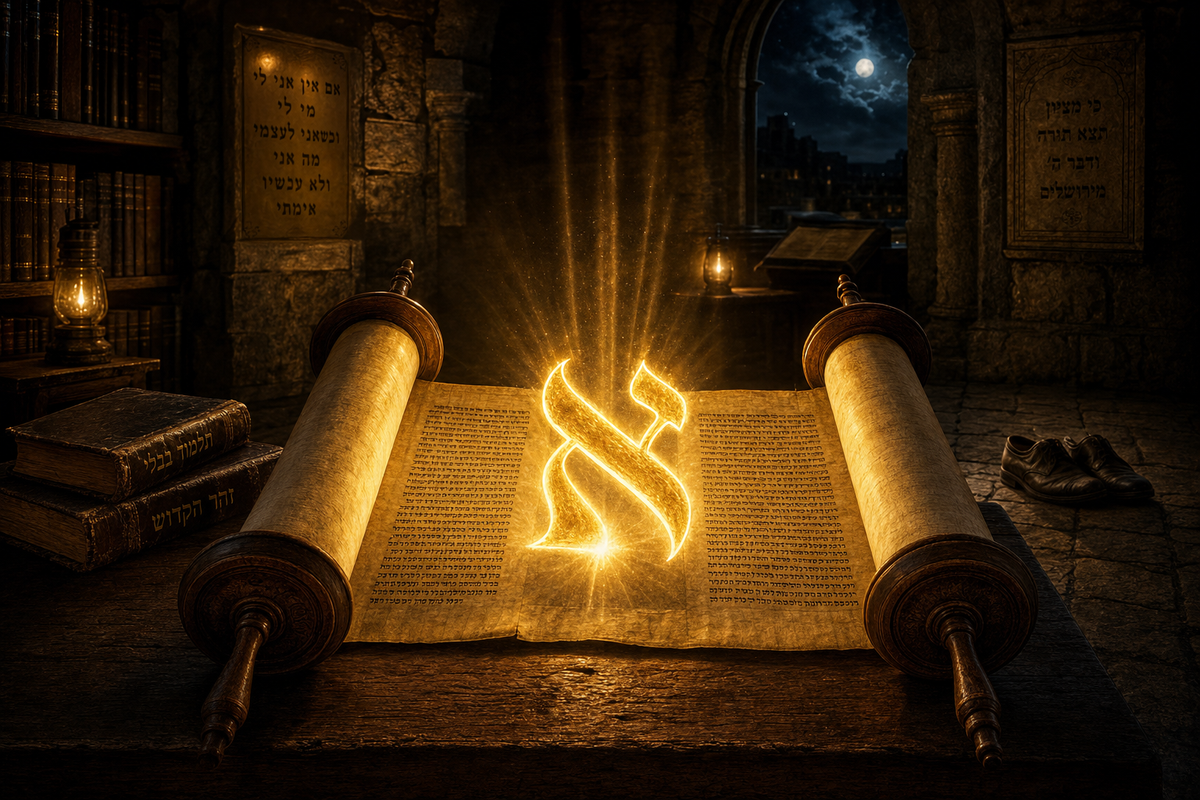
In the Holy of Holies, the light (or) shines with the letter aleph. The Sages teach that in the Torah scroll of Rabbi Meir, it was written "garments of light" (or with an aleph), and not "garments of skin" (or with an ayin). The main thing in serving Hashem is to merit seeing the light with an *aleph*—to see the light of Hashem, to feel the joy in Hashem, and to rejoice with Him.
After the sin of Adam, it is said that Hashem made for Adam and Eve "garments of skin" (or with an ayin), which are the aspect of shoes and constrictions. As long as a person lacks the right advice, he remains in the aspect of "garments of skin," which hints at a blemish of the eyes (ayin), the aspect of "it was a delight to the eyes." When a person blemishes his eyes, he turns the "light" (with an aleph) into "skin" (with an ayin).
But Rabbi Meir, who "enlightened the eyes of the Sages in Halachah," merited the light of Hashem in its entirety, and therefore in his Torah, they were "garments of light." He possessed the correct advice, and he knew how to draw down the supernal light without the constrictions of the skin.
The Danger of the Human Intellect: The Rebellion of Joab
Rabbi Meir merited the light of the Torah in its supernal root, to such an extent that his students and colleagues could not fully comprehend the depths of his mind. Since his entire service was to illuminate the pure light of the Torah, they struggled to understand his rulings and his ways, asking themselves why he acted in such a manner and not according to the simple understanding of the Halachah.
We find something similar with Joab the son of Zeruiah, who thought he understood the Halachah better than King David. Joab claimed that David was transgressing an explicit Halachah:
"He may not give the right of the firstborn to the son of the beloved wife in preference to the son of the hated wife, who is the firstborn."
He claimed that David hated Haggith (the mother of Adonijah) and loved Bathsheba, and therefore he was crowning Solomon unlawfully. Joab was certain that he had "caught" David in a transgression.
But the Sages reveal the truth to us. Joab leaned toward Adonijah, and in the past, he had also wanted to lean toward Absalom. Joab's halachic argument was merely an excuse from the evil inclination. The truth is that he wanted to rebel against King David, except that in the past he was afraid of him because David was at the peak of his power, and now that David was old, he dared to rebel. When a person thinks he understands Halachah better than the tzaddik, it is only an excuse to kick against the tzaddik and justify the inclination of his own heart.
The Humility of King David
In contrast, King David stood with tremendous humility. Facing all his pursuers—Doeg, Ahithophel, and men of deceit—David says: "But as for me, in the abundance of Your lovingkindness I will enter Your house." In his humility, David thought: 'I am exactly like them, I am full of schemes and plots, I am worse than everyone.' Yet despite this feeling of lowliness, he cried out: "Even if I am the worst criminal and sinner of all—I will never abandon drawing close to Hashem for anything in the world!"
David knew that the connection with Hashem is the key to everything. He continued to come to the House of Hashem, to serve with enthusiasm, with joy, and with tremendous awe, as the "sweet singer of Israel." Rebbe Nachman says that it is completely impossible to grasp the intensity of the awe that King David possessed, because it was so awesome and exalted.
Transforming Sins into Merits
Let us return to Rabbi Meir. The reason his students could not fully comprehend the depths of his mind is that he merited the aspect of the "Comprehensive Intellect." As the foremost student of Rabbi Akiva, he merited the light of his teacher, and through him, he reached the Comprehensive Intellect, which is the aspect of the Foundation Stone (Even HaShetiyah). There, in that elevated place, is found the aspect of the teshuvah (repentance) of Yom Kippur.
Our human intellect is full of personal biases. Our understanding is the opposite of the truth, and we are twisted by all sorts of ulterior motives. Only the Comprehensive Intellect, the intellect of the tzaddik, can illuminate the true truth within us. To get there, we must pass through the days of Bein HaMetzarim (the Three Weeks). During these days, we cry over the destruction and over the fact that we have inverted reality—we purified the impure and defiled the pure. The moment a person recognizes his lowliness and cries over what he has ruined, he immediately merits that all his deliberate sins are transformed into merits, and this is the secret of the light of Yom Kippur.
This was the tremendous power of Rabbi Meir. The Gemara says that Rabbi Meir could purify a creeping creature (sheretz) with one hundred and fifty reasons. Moharnat (Reb Noson of Breslov) explains that the novelty is not merely intellectual gymnastics; rather, Rabbi Meir truly succeeded in extracting the spirit of impurity from the creeping creature! In the future to come, the Holy One, blessed be He, will remove the spirit of impurity from the earth, and the prohibitions will remain forbidden only due to an "abundance of light," not due to impurity. Rabbi Meir, through the power of the Comprehensive Intellect, knew how to elevate impurity to purity and transform all sins into merits.
Our spiritual work is to merit this light just one day a year—on Yom Kippur. On that day, we remove our shoes, nullifying the aspect of "garments of skin" (kosnos ohr with an ayin), and we merit the all-encompassing intellect. However, Rabbi Meir, on his immense spiritual level, knew how to draw down the intellect of Yom Kippur and illuminate the "garments of light" (kosnos ohr with an aleph) throughout every day of the year.
Part 3 of 4 — Lesson No. 106